The Angel Raphael's Journey in the Book of Tobit

A family in crisis, and a journey that has to be made
The Book of Tobit opens not with an angel but with hardship. Tobit, an Israelite living in exile in Nineveh, has gone blind, and his household is struggling — among his outstanding affairs is a substantial sum of money left years earlier with a relative in the distant city of Rages in Media. Believing he may not live much longer, Tobit sends his son Tobiah to retrieve it, a journey of real distance and real danger for a young man who had never traveled it before.
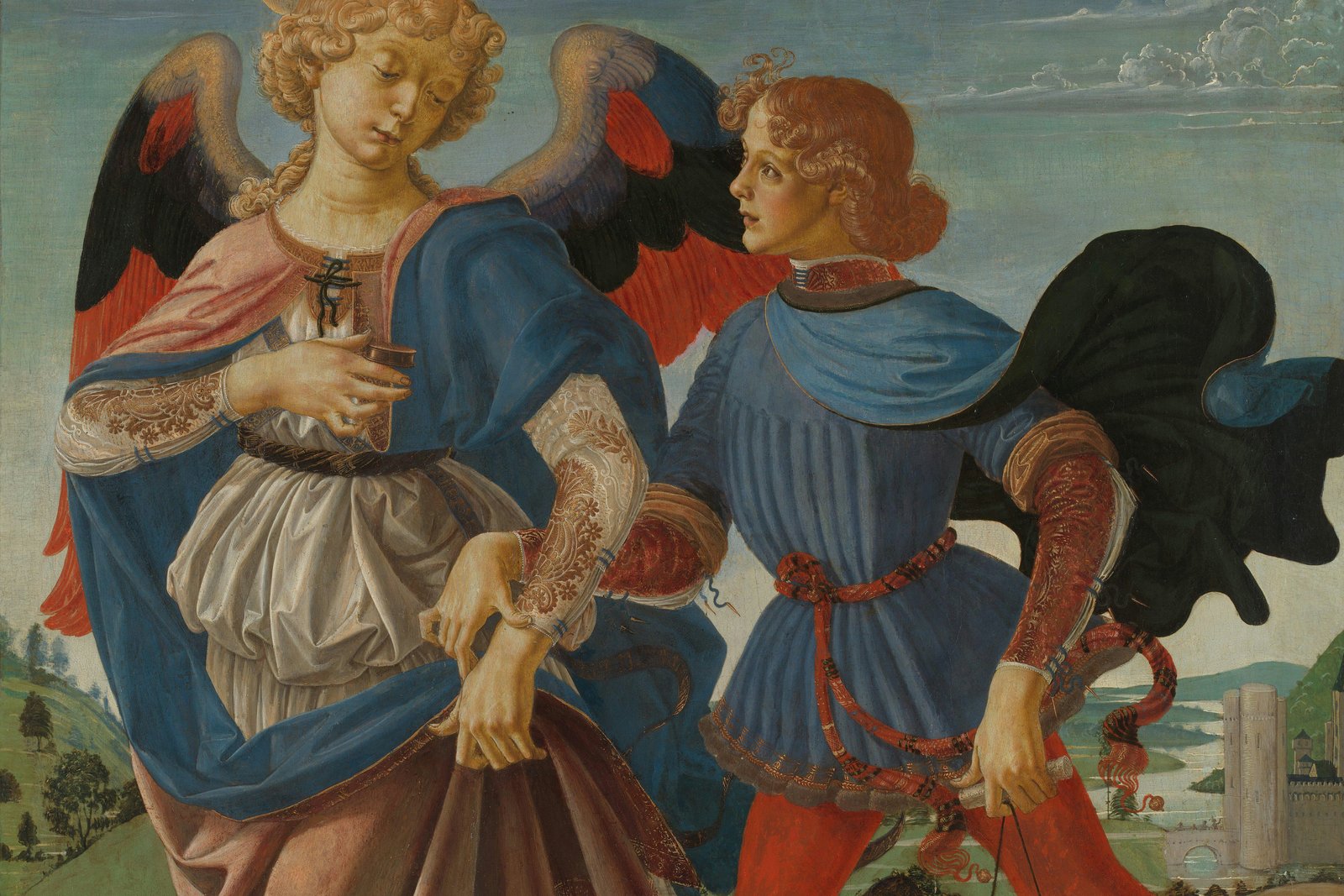
Workshop of Andrea del Verrocchio, Tobias and the Angel, c. 1470-1475, National Gallery, London — public domain.
What Tobit doesn't know — what none of the human characters in the story know until the very end — is that the "fellow Israelite" his son hires as a guide for the journey is no ordinary traveler at all.
Hired without knowing who he was
Tobiah, sent out to find a suitable companion, "went out and found the angel Raphael standing before him (though he did not know that this was an angel of God). Tobiah said to him, 'Where do you come from, young man?' He replied, 'I am an Israelite, one of your kindred. I have come here to work'" (Tobit 5:4-5, NABRE). Asked whether he knows the road to Media, the disguised angel answers with practiced ease: "'Yes,' he replied, 'I have been there many times. I know the place well and am acquainted with all the routes'" (Tobit 5:6, NABRE).
There's something quietly remarkable about how the Book of Tobit tells this part of the story. Unlike many other angelic encounters in Scripture, which announce themselves immediately with dramatic, unmistakable signs, Raphael's disguise here is sustained and convincing — he answers questions, gives a plausible personal background, and travels for what the narrative implies is a journey of considerable length, all while presenting entirely as an ordinary hired guide named Azariah. The reader is let in on the secret from the start; the human characters in the story are not.
Guiding, healing, and defending along the way
Raphael's disguised presence does far more than simply keep Tobiah safe on the road. When the travelers stop beside a river, Raphael instructs Tobiah to catch a large fish and keep specific organs from it — the heart, liver, and gall — explaining that they carry healing and protective properties. This detail, easy to pass over quickly in the narrative, turns out to be central to everything that follows: the fish's gall is later used to cure Tobit's blindness, and its heart and liver, burned as instructed, drive away a demon that had killed each of the seven previous husbands of a woman named Sarah, whom Raphael also guides Tobiah toward marrying along the way.
Throughout this stretch of the story, Raphael functions less as a dramatic wonder-worker and more as a patient, practical companion — offering guidance at each step, but always framed within the ordinary texture of a long journey, sharing the road rather than appearing suddenly to solve each problem from outside it.
The reveal: "I am Raphael"
Only once the journey is fully complete — Tobit's sight restored, Tobiah safely married, the family's debt recovered — does the disguised companion finally identify himself. Offered payment for his services, he instead reveals the truth: "I am Raphael, one of the seven angels who stand and serve before the Glory of the Lord" (Tobit 12:15, NABRE), adding, "I was sent to put you to the test. At the same time, however, God sent me to heal you and your daughter-in-law Sarah" (Tobit 12:14, NABRE).
The family's reaction — awe, and a kind of retrospective realization of everything that had actually been happening around them the whole time — gives the story its emotional payoff, and it's part of why Tobit remains one of the most beloved and dramatically satisfying angel narratives anywhere in Scripture. Raphael's identification of himself as one of "seven angels" who serve before God's glory is also historically significant: it's one of the clearest scriptural sources behind the later Jewish and Christian tradition of seven archangels, a tradition explored more fully in the Church's teaching on the seven archangels.
Why Tobit's angel story is unlike most others
Most angelic appearances in the Bible are brief — a sudden visitation, a message delivered, and the angel departs. Tobit is unusual precisely because it sustains an angelic presence across an entire extended narrative, embedded so thoroughly in the ordinary details of travel, work, and family life that the angel's true nature becomes almost easy to forget, both for the characters in the story and, in a different way, for readers absorbed in its unfolding plot.
That structure carries its own quiet theological suggestion: that divine guidance and protection aren't always announced with fanfare, but can travel alongside ordinary people through ordinary hardship, becoming visible for what it truly was only once the journey has reached its end. Raphael's name — meaning "God heals" — captures the story's central movement precisely: healing that arrives not instantly, but through patient companionship on a long and uncertain road.
Trivia
What is the Book of Tobit about?
How does the angel Raphael first appear in the story?
When does Raphael reveal his true identity?
What does Raphael's name mean, and why is it fitting for this story?
What does the Book of Tobit reveal about how Raphael understood his own mission?
Related Reading