Esther Saves Her People From Annihilation

A queen who hid where she came from
Esther's rise to power in the Persian court began with a secret. A young Jewish woman named Hadassah — known by her Persian name, Esther — was raised by her older cousin Mordecai after losing her parents, and when King Ahasuerus deposed his previous queen and held an empire-wide search for a replacement, Esther was chosen. Mordecai instructed her not to reveal her Jewish identity or her family background, and she followed that instruction all the way to the throne.
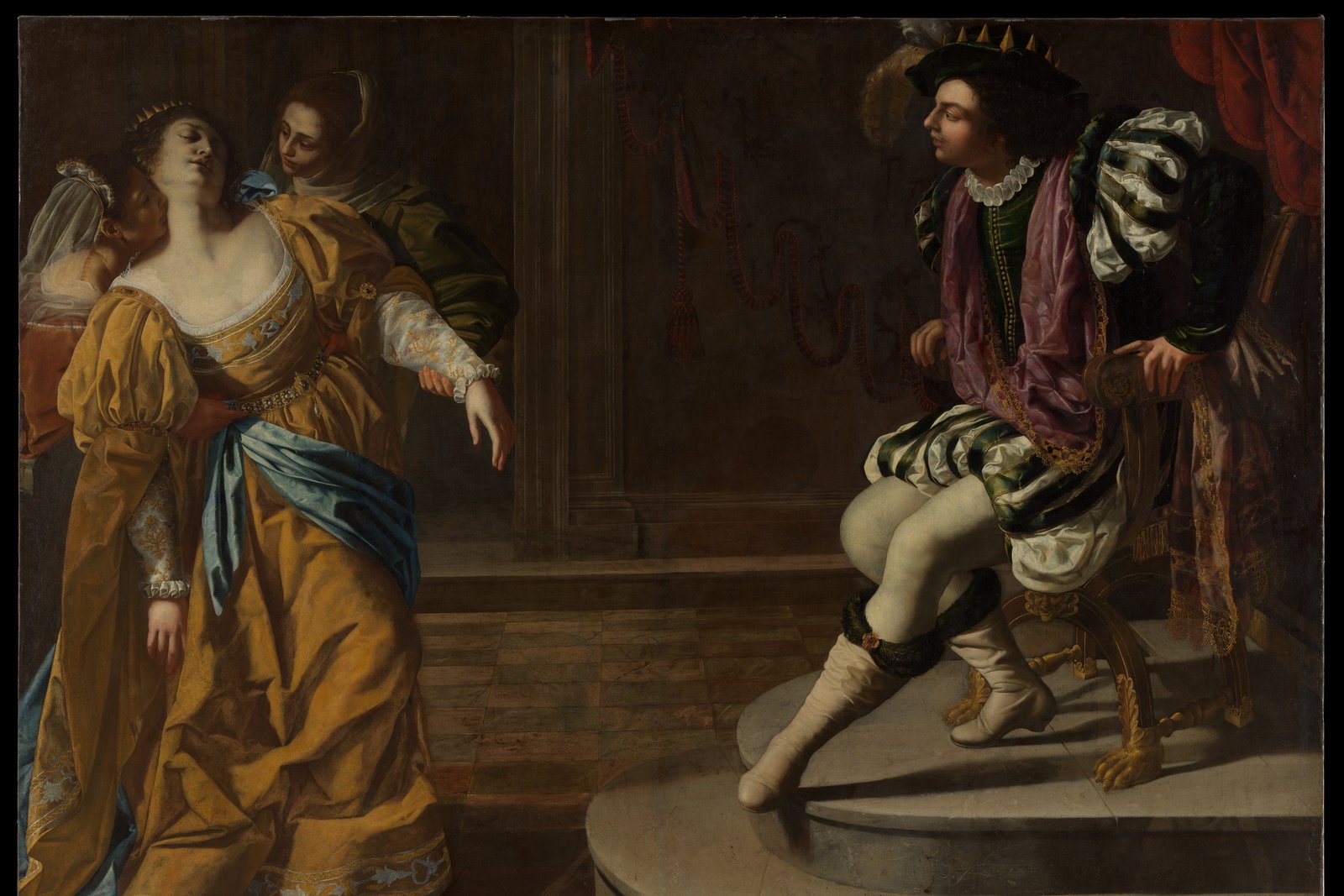
Artemisia Gentileschi, Esther before Ahasuerus, c. 1628-35. Public domain, The Metropolitan Museum of Art.
That silence became critical when Haman, a powerful royal official, was offended that Mordecai refused to bow to him. Rather than settle the grudge with Mordecai alone, Haman convinced the king to authorize the destruction of the Jewish people throughout the entire Persian Empire — a decree sealed with the king's own ring and sent out to every province (Esther 3).
Mordecai's message through the palace gate
When Mordecai learned of the decree, Esther 4:1 says he "tore his garments, put on sackcloth and ashes, and went through the city crying out loudly and bitterly." Word of his public grief reached Esther inside the palace, and she sent clothes for him to change into — a request he refused, forcing the two to communicate through an intermediary, the eunuch Hathach, since Mordecai in mourning clothes couldn't enter the palace gate itself.
Mordecai used Hathach to relay everything: the decree, the exact sum Haman had promised the royal treasury for the massacre, and a direct instruction — Esther needed to go to the king and plead for her people (Esther 4:6-8). Esther's reply laid out the real danger plainly: "any man or woman who goes to the king in the inner court without being summoned is subject to the same law—death. Only if the king extends the golden scepter will such a person live. Now as for me, I have not been summoned to the king for thirty days" (Esther 4:11). Thirty days without an audience wasn't a small detail — for a queen in a court built on royal favor, it was a sign that favor might already be slipping.
"Who knows—perhaps it was for a time like this"
Mordecai's answer to Esther's hesitation is the pivot point of the entire book. He didn't minimize the danger she was describing. Instead he told her that deliverance for the Jewish people would come one way or another — "from another source," if not through her — but that her own silence wouldn't protect her from the decree either, since she was Jewish too, whether the court knew it or not. Then came the line the book is remembered for: "Who knows—perhaps it was for a time like this that you became queen?" (Esther 4:14).
Esther's response wasn't a bold speech — it was a request for solidarity before action. She asked Mordecai to gather every Jew in Susa to fast on her behalf for three days, while she and her maids did the same. Only then would she act: "I will go to the king, contrary to the law. If I perish, I perish!" (Esther 4:16). It's a line that reads less like defiance and more like someone making peace with the worst possible outcome before walking toward it anyway.
What happened next
The chapters that follow Esther 4 tell how the king did extend his scepter, sparing Esther's life, and how she carefully, patiently exposed Haman's plot over the course of two banquets rather than blurting it out immediately — a demonstration of political shrewdness as much as courage. Haman was ultimately executed on the very gallows he'd built for Mordecai, and the king's decree, which couldn't be formally revoked under Persian law, was countered by a second decree allowing the Jewish people to defend themselves. Their survival is still commemorated annually in the Jewish festival of Purim.
A story about visibility and risk, not just victory
The book of Esther holds an unusual place in scripture: in its original Hebrew form, God is never mentioned by name even once, though later Greek additions to the book (included in Catholic and Orthodox versions of the Bible) make prayers and divine action explicit, including Esther's own prayer before approaching the king. Catholic tradition reads the book's restraint as intentional — providence working quietly through ordinary courage, timing, and one woman's willingness to risk everything for people she could have easily kept hidden from. Esther didn't perform a miracle. She used the one position she had, at the one moment it mattered, and refused to let fear make the decision for her.
Esther in Christian art and memory
Painters returned to this story again and again, and almost always to the same moment: Esther standing before the throne, dressed in royal clothing she describes in the Greek additions as worn "in the extremity of her anguish" rather than pride, waiting to see whether the king's scepter would rise or stay still. Artemisia Gentileschi, whose Baroque painting illustrates this article, was one of relatively few women painters working in seventeenth-century Italy, and she returned to biblical heroines — Esther, Judith, Susanna — more than most of her male contemporaries did, often giving them a physical presence and interior seriousness earlier paintings had softened into decoration.
Medieval and early Christian commentators sometimes read Esther typologically, as a figure whose intercession before an earthly king prefigured Mary's intercession before Christ — an interpretation found in devotional writing rather than in official Church teaching, and worth naming as such. What stayed constant across centuries of retelling wasn't the theology attached to her, though, but the shape of the dilemma itself: a person with real standing to lose, facing a choice between using it and protecting it. That's part of why the story of Esther keeps getting paired with other Old Testament accounts of courage under threat, such as the trial faced by Abraham in the binding of Isaac — different tests entirely, but the same insistence that faith gets proven in the moment it costs something.
Purim itself, the holiday the book explains, is marked by a public reading of the scroll of Esther, with listeners traditionally drowning out Haman's name with noise whenever it's read aloud, alongside gift-giving, charity to the poor, and a festive meal — customs that turn a story about a near-massacre into an annual celebration of reversal, one where the plot meant to destroy a people instead became the reason they still gather to remember it.
Trivia
What is the famous line Mordecai says to convince Esther to act?
Why was it dangerous for Esther to approach the king?
Who was plotting to destroy the Jewish people in the story of Esther?
What does Esther say right before she risks her life to see the king?
What Jewish holiday commemorates the events of the book of Esther?
Related Reading