Philip and the Ethiopian Eunuch

An angel's instruction with no explanation attached
This episode comes right on the heels of Stephen's death and the scattering of believers it triggered (see our article on the stoning of Stephen). Philip, one of the seven men originally chosen alongside Stephen, has been preaching successfully in Samaria when he receives a strange, specific instruction: "Then the angel of the Lord spoke to Philip, “Get up and head south on the road that goes down from Jerusalem to Gaza, the desert route." (Acts 8:26). No reason is given — just a direction and a destination, out toward an empty stretch of desert road.
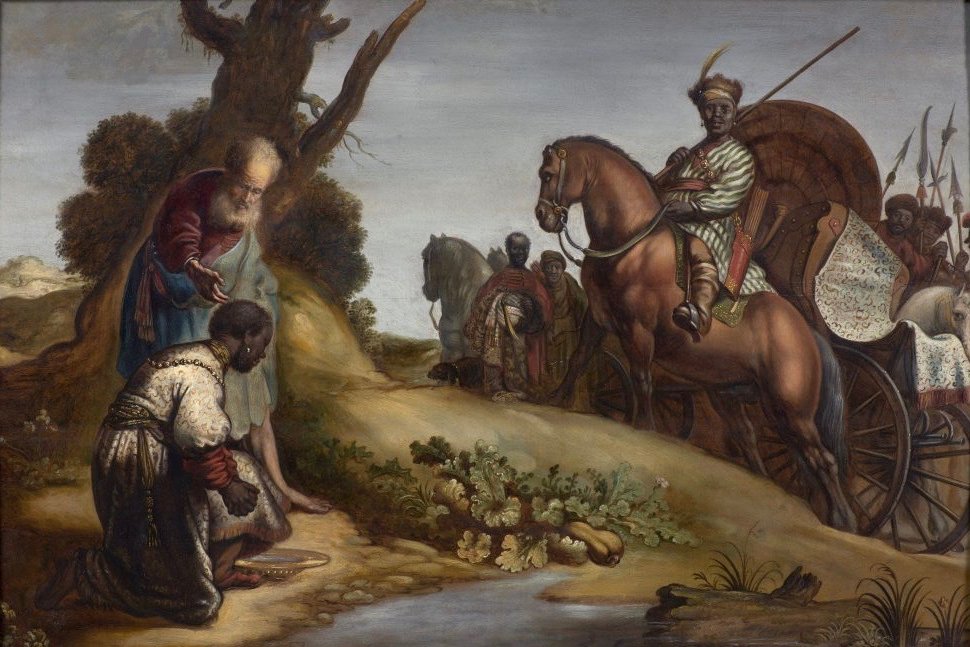
Follower of Rembrandt van Rijn, "The Baptism of the Eunuch," 17th century. Public domain.
A powerful official reading Isaiah out loud
What Philip finds there is specific and unlikely: "there was an Ethiopian eunuch, a court official of the Candace, that is, the queen of the Ethiopians, in charge of her entire treasury, who had come to Jerusalem to worship, and was returning home. Seated in his chariot, he was reading the prophet Isaiah" (Acts 8:27-28). "Candace" was a title used for the queens of the Kingdom of Kush, centered around Meroë in what is now Sudan — this man was a senior treasury official in a real, historically attested African kingdom, and his pilgrimage to Jerusalem places him among the God-fearing Gentiles and proselytes drawn to Jewish worship even without full membership in the covenant community. Under Jewish law, a eunuch's own standing within Temple worship would have been restricted (Deuteronomy 23:1), a detail that adds real poignancy to his search for understanding on the road home.
"Do you understand what you are reading?"
"The Spirit said to Philip, 'Go and join up with that chariot.' Philip ran up and heard him reading Isaiah the prophet and said, 'Do you understand what you are reading?'" (Acts 8:29-30). The eunuch's answer is disarmingly honest: "How can I, unless someone instructs me? So he invited Philip to get in and sit with him" (Acts 8:31) — a foreign official of real rank and wealth inviting a stranger up into his own chariot on the strength of one direct question.
The passage he couldn't make sense of
The specific text the eunuch had been reading turns out to be exactly the passage most directly applicable to Jesus in the entire Hebrew Bible: "Like a sheep he was led to the slaughter, and as a lamb before its shearer is silent, so he opened not his mouth. In [his] humiliation justice was denied him. Who will tell of his posterity? For his life is taken from the earth" (Acts 8:32-33, quoting Isaiah 53:7-8) — part of the section of Isaiah known as the Suffering Servant songs. The eunuch's confusion is understandable and specific: "About whom is the prophet saying this? About himself, or about someone else?" (Acts 8:34).
Philip's answer: this passage is about Jesus
"Then Philip opened his mouth and, beginning with this scripture passage, he proclaimed Jesus to him" (Acts 8:35). Acts doesn't record the content of Philip's explanation in detail, but the implication is clear: he walked the eunuch through how this ancient prophecy of a silent, suffering servant, rejected and put to death unjustly, described what had just happened to Jesus in Jerusalem — a city the eunuch had, notably, just left.
"What is to prevent my being baptized?"
The eunuch's response to Philip's explanation is immediate and practical: "As they traveled along the road they came to some water, and the eunuch said, 'Look, there is water. What is to prevent my being baptized?'" (Acts 8:36). There's no hesitation, no extended catechesis described in the text — only a direct, almost eager question, from a man who just minutes earlier hadn't understood what he was reading. "Then he ordered the chariot to stop, and Philip and the eunuch both went down into the water, and he baptized him" (Acts 8:38).
Philip vanishes, and the eunuch rejoices
What happens immediately after is one of the more startling images in Acts: "When they came out of the water, the Spirit of the Lord snatched Philip away, and the eunuch saw him no more, but continued on his way rejoicing" (Acts 8:39). Philip reappears a few verses later "at Azotus" (Acts 8:40), a considerable distance north along the coast, with no explanation of how he got there — the text simply moves on, leaving the eunuch to continue his own journey home, newly baptized and, notably, still rejoicing rather than confused by the sudden disappearance of the man who had just instructed him.
An early sign of the Gospel reaching beyond Israel's borders
This story holds significant weight in how Acts tells the story of the early Church's expansion. The eunuch is both a Gentile-adjacent God-fearer and, by Jewish law, someone excluded from full Temple participation — and yet he becomes one of the first individuals outside Judea baptized into the Christian community, carrying that faith back with him to a kingdom far south of anywhere the apostles themselves had traveled. Christian tradition in Ethiopia has long pointed to this episode as part of the foundation story of Christianity in the region, predating any organized missionary effort there by outside evangelists. Read within Acts as a whole, it sits alongside stories like the later conversion of the Roman centurion Cornelius as one of the text's deliberate signals that the Gospel was never intended to remain confined to Jerusalem or to Israel alone.
A quiet devotional scene favored by painters
The image illustrating this article, a 17th-century work from Rembrandt's circle, captures the baptism itself — a moment of quiet intimacy between two men beside a chariot on an otherwise empty road, one kneeling in the water, the other pouring or laying on hands. Dutch painters of Rembrandt's era were drawn repeatedly to this exact scene, in part because of how neatly it distilled a whole theology of grace into a single, uncluttered image: no crowd, no debate, just an open question answered plainly and acted on immediately.
Trivia
Who was the Ethiopian eunuch and what was his role?
Why did Philip approach the eunuch's chariot?
What passage of Scripture was the eunuch reading?
What did Philip explain to the eunuch?
What happened after the eunuch was baptized?
You May Also Like
Related Reading