The Ascension of Jesus: Why the Disciples Kept Staring at the Sky

Forty days of proof
The book of Acts opens by picking up exactly where Luke's Gospel leaves off — the author, traditionally identified as Luke, addresses both books to the same person, Theophilus, and treats them as one continuous account. Acts 1:3 summarizes the period between the Resurrection and the Ascension in a single dense sentence: Jesus "presented himself alive to them by many proofs after he had suffered, appearing to them during forty days and speaking about the kingdom of God."
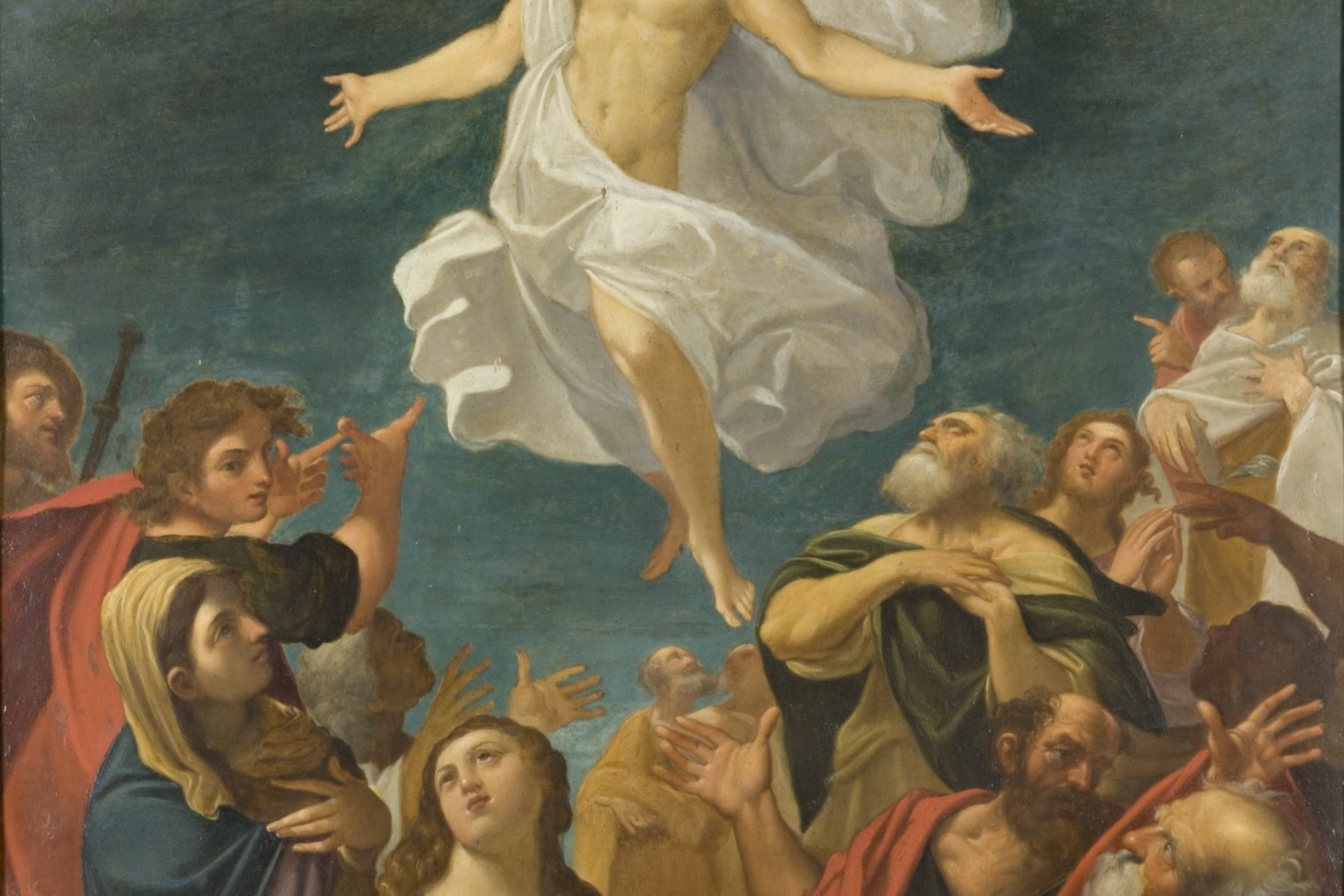
Giacomo Cavedone, Ascension of Christ, c. 1640. Public domain, LACMA, Wikimedia Commons.
Forty days is a number that carries weight throughout scripture — the flood, Moses on Sinai, Israel's wandering in the desert, Jesus's own fast in the wilderness. Here it marks a sustained period in which the risen Jesus appears repeatedly to his followers, not as a single startling event but as an extended, deliberate confirmation that he was truly alive, truly bodily present, and not a ghost or a vision.
A command to wait, not to leave
Before ascending, Jesus gives the disciples one final, very specific instruction: stay in Jerusalem. Don't scatter to spread the news immediately. Wait. "John baptized with water, but in a few days you will be baptized with the holy Spirit" (Acts 1:5). The disciples, still thinking in fairly earthbound political terms, ask him directly, "Lord, are you at this time going to restore the kingdom to Israel?" — a question about national liberation from Roman occupation.
Jesus doesn't answer that question directly. Instead he redirects it entirely: "It is not for you to know the times or seasons that the Father has established by his own authority. But you will receive power when the holy Spirit comes upon you, and you will be my witnesses in Jerusalem, throughout Judea and Samaria, and to the ends of the earth" (Acts 1:7-8). It's a reframing of the whole mission — not a restored earthly kingdom on a set timetable, but a worldwide witness carried forward by the Spirit, starting from exactly where they stood.
Taken up before their eyes
"When he had said this, as they were looking on, he was lifted up, and a cloud took him from their sight" (Acts 1:9). Luke's Gospel account of the same event adds that Jesus led them out toward Bethany, near the Mount of Olives, raised his hands and blessed them, and "was taken up to heaven" even as he blessed them (Luke 24:50-51). The cloud is a detail worth noting — in the Old Testament, a cloud frequently signals the presence of God (at Sinai, over the tabernacle, in Daniel's vision of "one like a son of man" coming on the clouds of heaven). Its appearance here marks the Ascension as an entry into God's own glory, not simply a departure.
"Why are you standing there looking at the sky?"
What happens next is the detail that gives the story its most human moment. The disciples, understandably, keep staring upward at the empty sky where Jesus had just vanished. "Suddenly two men dressed in white garments stood beside them" — understood in Christian tradition as angels, the same kind of figures who appeared at the empty tomb — and asked them, not unkindly but pointedly: "Men of Galilee, why are you standing there looking at the sky? This Jesus who has been taken up from you into heaven will return in the same way as you have seen him going into heaven" (Acts 1:10-11).
The message does two things at once. It promises Christ's eventual return — the basis for later Christian belief in the Second Coming — and it redirects the disciples away from passive gazing and back toward the mission they'd just been given. They obey: Acts 1:12 says they returned to Jerusalem and, in the following verses, devoted themselves to prayer together while they waited for Pentecost.
An echo of Elijah, and a departure unlike any other
Readers steeped in the Old Testament would have recognized the shape of this scene before Luke finished describing it. The prophet Elijah, in 2 Kings 2, is taken up into heaven in a whirlwind while his disciple Elisha watches, and Elisha's mentor leaves behind a visible sign — his cloak — as a mark of the prophetic authority now passed on. The Ascension echoes that pattern loosely, but the differences matter more than the similarity: Elijah is swept away by natural forces beyond his control, while Jesus ascends by his own divine power, deliberately and calmly, blessing his disciples as he goes. Where Elisha is left grasping for a discarded cloak, the apostles are left instead with a direct promise of the Holy Spirit's coming and a mission stretching to "the ends of the earth." The echo signals continuity with the prophetic tradition; the contrast signals something genuinely new.
How the Church has pictured the moment
Christian art settled early on a fairly consistent way of depicting the Ascension: Christ rising above a cluster of disciples, often with only his feet or the hem of his garment still visible at the bottom edge of a cloud, the apostles below caught mid-gesture, looking up. Some of the earliest surviving depictions appear in illuminated Gospel manuscripts from the fifth and sixth centuries, and the composition proved durable enough that Baroque painters like Giacomo Cavedone, whose Ascension is used as this article's hero image, were still working within essentially the same visual logic a thousand years later. The recurring choice to show only Christ's feet disappearing into the cloud is a subtle way of making a theological point visible: he is leaving the earth definitively, not fading out gradually or lingering in ambiguous half-departure.
What the Church teaches about the Ascension
The Ascension is one of the events commemorated in the Church's earliest creeds — "he ascended into heaven and is seated at the right hand of the Father" appears in both the Apostles' and Nicene Creeds. The Catechism describes it as marking Christ's definitive entry into heavenly glory in his humanity, not an abandonment of his followers but the necessary condition for the sending of the Holy Spirit and for Christ's ongoing intercession for humanity (CCC 659-667). The Church still marks the event liturgically, on the Feast of the Ascension, traditionally kept forty days after Easter — a direct echo of the timeframe Acts itself records.
Trivia
How many days after the Resurrection did the Ascension happen?
What did Jesus tell the disciples to do right before he ascended?
What did the two men in white say to the disciples after Jesus ascended?
From where did the Ascension take place?
Is the Ascension the same event as Jesus's Resurrection?
You May Also Like
Related Reading