Pentecost

A gathering that was, until this moment, still hiding
Acts opens this scene with deliberate simplicity: "When the time for Pentecost was fulfilled, they were all in one place together" (Acts 2:1, NABRE). "They" are the apostles and other disciples, and the timing matters — it's the Jewish feast of Shavuot, the fiftieth day after Passover, which is also what gives Pentecost its name (from the Greek for "fiftieth"). Fifty days earlier, most of these same men had scattered or hidden out of fear following Jesus's arrest. What happens next transforms that same frightened group into something entirely different.
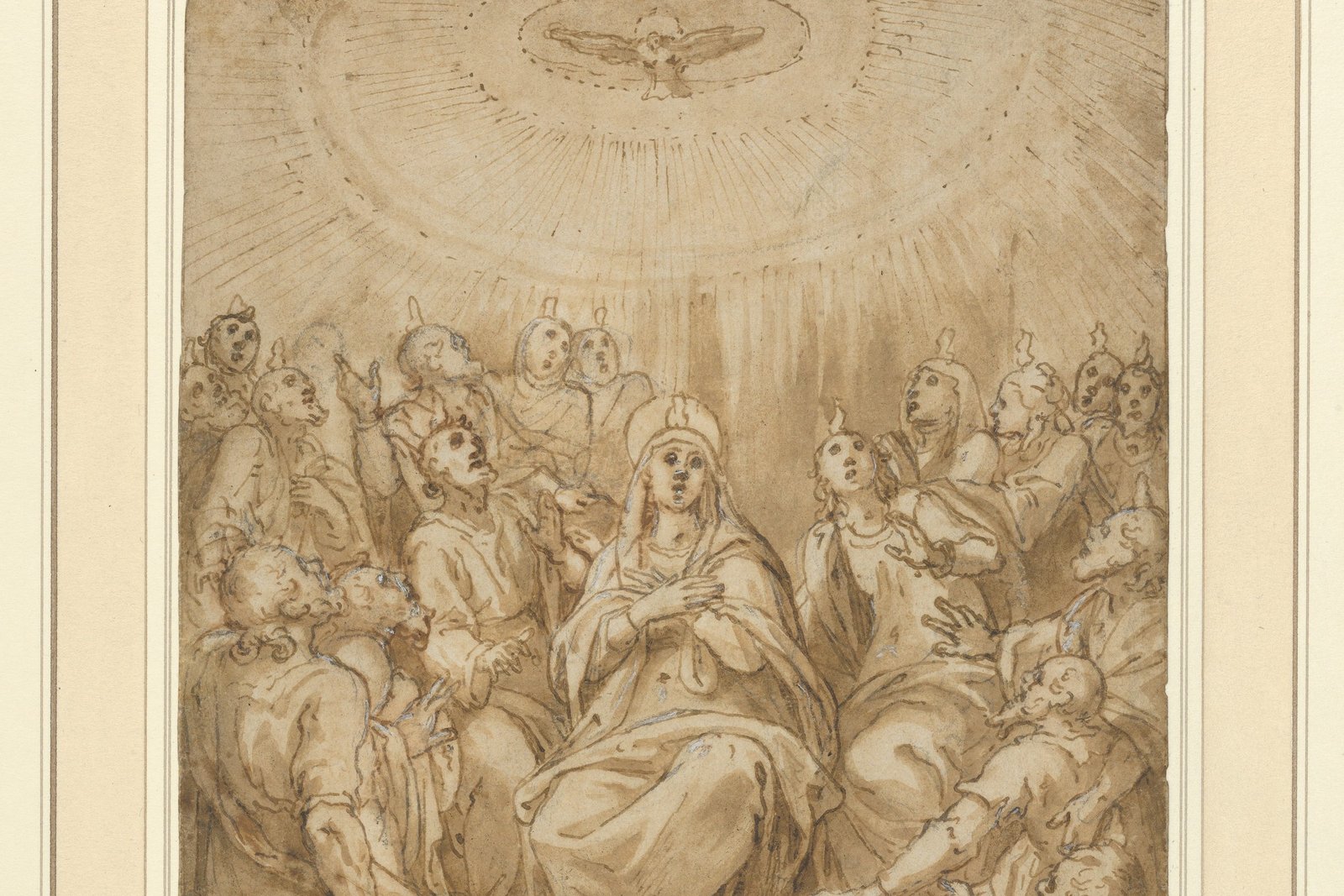
Cesare Nebbia, "The Pentecost (The Descent of the Holy Spirit)," c. 1576, The Metropolitan Museum of Art. Public domain.
Wind and fire, together and at once
The description Luke gives is deliberately sensory and strange: "suddenly there came from the sky a noise like a strong driving wind, and it filled the entire house," followed immediately by "tongues as of fire, which parted and came to rest on each one of them" (Acts 2:2-3, NABRE). Both wind and fire carry deep resonance in Jewish Scripture as signs of God's presence — wind (or "spirit," the same word in both Hebrew and Greek) recalling the breath of God in Genesis, fire recalling the burning bush and the pillar of fire that led Israel through the wilderness. Luke isn't inventing new imagery here; he's drawing on symbols his audience would already recognize.
Understood, not just heard
What happens to the disciples' speech is the detail Luke returns to again and again: "they were all filled with the holy Spirit and began to speak in different tongues, as the Spirit enabled them to proclaim" (Acts 2:4, NABRE). Because it was a pilgrimage festival, Jerusalem was full of Jews and converts from across the ancient world — Luke lists Parthians, Medes, Elamites, and people from Mesopotamia, Cappadocia, Egypt, Libya, Rome, Crete, and Arabia among those present (Acts 2:9-11, NABRE). The miracle isn't described as the disciples simply making noise that sounded impressive — each listener reports hearing the message "in his own native language" (Acts 2:8, NABRE), understanding rather than mere sound.
Two very different reactions from the same crowd
Acts records a split response. Some are "astounded and bewildered," genuinely asking what this could mean (Acts 2:12, NABRE). Others reach for a dismissive explanation instead: "They have had too much new wine" (Acts 2:13, NABRE) — an accusation of drunkenness rather than anything supernatural. It's a detail that keeps the scene grounded rather than triumphant; not everyone who witnessed Pentecost was immediately convinced by it.
Peter's answer, and the day the Church went public
It's this accusation of drunkenness that Peter directly addresses when he stands up to speak — pointing out it was only about nine in the morning, too early in the day for the explanation to hold (Acts 2:14-15, NABRE). What follows is the first recorded sermon of the early Church, in which Peter — the same man who had denied Jesus three times weeks earlier — publicly proclaims the resurrection to the same Jerusalem crowds that had witnessed the crucifixion. Catholic tradition marks Pentecost as the birth of the Church precisely because of this shift: fearful disciples becoming public witnesses, empowered, Scripture says, by the Holy Spirit itself. The feast is kept fifty days after Easter, closing out the Easter season on the Church's liturgical calendar.
A harvest festival reinterpreted
Shavuot, the Jewish feast underlying Pentecost's timing, was originally an agricultural festival marking the wheat harvest, and by the first century it had also become closely associated with the giving of the Law to Moses at Mount Sinai — a connection many Jewish teachers of the period already drew. Christian readers going back to the early Church noticed the parallel and leaned into it deliberately: just as God had once given the Law on the fiftieth day after the Exodus from Egypt, so now the Spirit descends on the fiftieth day after the true Passover, Christ's resurrection. Where the Sinai event was marked by fire and smoke on the mountain (Exodus 19:18), Pentecost is marked by fire resting directly on each believer — a shift many early Christian writers read as a sign that the Law once written on stone was now, in some sense, being written on the disciples themselves.
Undoing Babel
Several early Christian commentators also connected Pentecost's central miracle — many languages suddenly understood as one message — to the story of the Tower of Babel, where humanity's languages were confused and scattered as a consequence of collective pride (Genesis 11:1-9). Readers can find that earlier episode explored in The Tower of Babel. At Pentecost, the confusion of tongues isn't undone by everyone suddenly speaking one shared language again; instead, each listener hears the apostles' one message in their own distinct language, unity achieved through difference rather than by erasing it. It's a detail that has shaped how the Church has long understood its own mission: not to flatten cultures into sameness, but to carry one Gospel message into many different languages and peoples at once.
Mary's place in the room
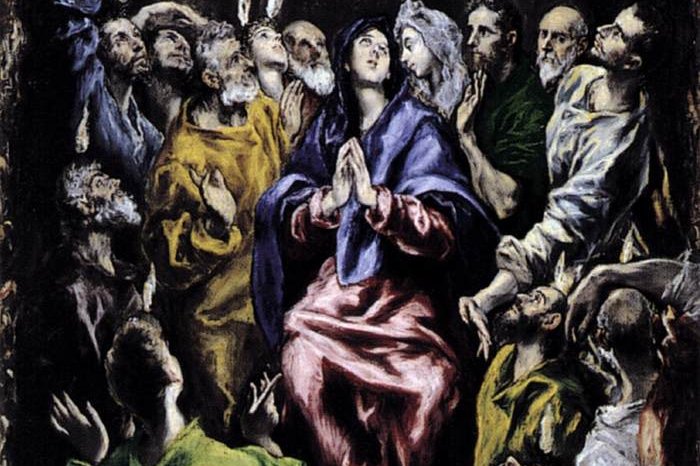
Acts doesn't specify everyone present in the house that morning, but Luke's own Gospel and the opening of Acts both place Mary, the mother of Jesus, among the disciples gathered in prayer in the days leading up to Pentecost (Acts 1:14, NABRE). Christian art has long included her at the center of Pentecost scenes — as in the painting illustrating this article — even though the biblical text focuses its narrative attention on the apostles' speech and the crowd's reaction rather than on any one individual's experience. Her presence in the room where the Church's public mission began is one reason later Catholic devotion has sometimes described her as present at both the beginning of Christ's earthly life, at the Annunciation, and at the beginning of the Church's public life, at Pentecost.
Trivia
What physical signs accompanied the coming of the Holy Spirit at Pentecost?
What happened to the disciples' speech after the Spirit came upon them?
Why was such a diverse crowd in Jerusalem to witness this?
What accusation did some onlookers make against the disciples?
Why does the Church consider Pentecost the birth of the Church itself?
Related Reading