The Birth of John the Baptist

An elderly, childless, righteous couple
Luke opens his Gospel not with Jesus but with an older couple whose story sets the whole narrative in motion. Zechariah, a priest belonging to the priestly division of Abijah, and his wife Elizabeth are introduced as people of unusual integrity: "Both were righteous in the eyes of God, observing all the commandments and ordinances of the Lord blamelessly" (Luke 1:6). And yet: "they had no child, because Elizabeth was barren, and both were advanced in years" (Luke 1:7). It's a deliberate echo of earlier Old Testament stories of aged, childless, faithful couples — most directly Hannah's own long wait for a son — a pattern Luke's first readers, steeped in Scripture, would have recognized immediately as the setup for a divine intervention.
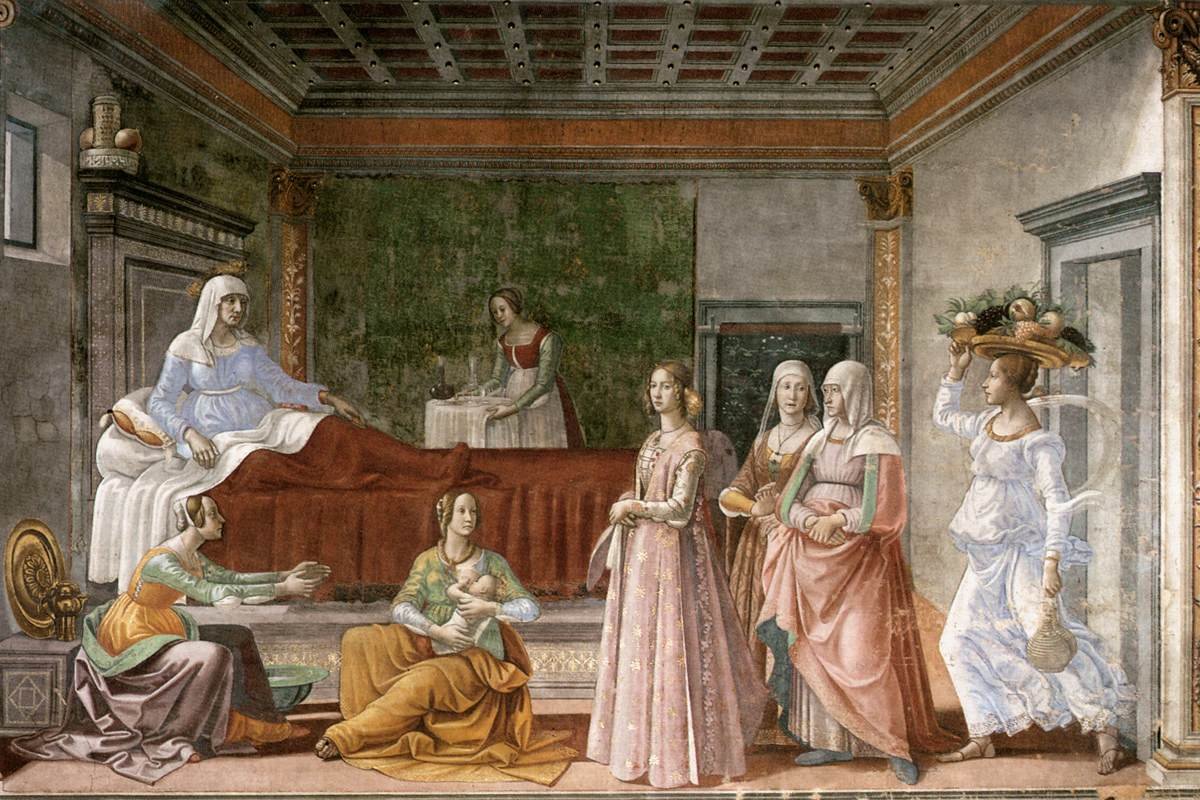
Domenico Ghirlandaio, "Birth of Saint John the Baptist," 1486-90, Tornabuoni Chapel, Santa Maria Novella, Florence. Public domain.
An angel appears during the incense offering
The scene shifts to the Temple in Jerusalem, where Zechariah has been chosen by lot — a customary method among the priestly divisions — to enter the sanctuary and burn incense while the assembled people pray outside (Luke 1:8-10). It's in this moment of solemn, routine priestly duty that everything changes: "Then the angel of the Lord appeared to him, standing at the right of the altar of incense. Zechariah was troubled by what he saw, and fear came upon him" (Luke 1:11-12). The angel's opening words address that fear directly and connect it to years of prayer: "Do not be afraid, Zechariah, because your prayer has been heard. Your wife Elizabeth will bear you a son, and you shall name him John" (Luke 1:13).
A promise, and a role already defined before birth
The angel doesn't stop at the announcement of a birth — he describes who this child will become: "he will be great in the sight of [the] Lord. He will drink neither wine nor strong drink. He will be filled with the holy Spirit even from his mother's womb, and he will turn many of the children of Israel to the Lord their God" (Luke 1:15-16). The abstinence from wine echoes the Nazirite vow, a mark of someone set apart entirely for God's service. The angel goes further still, describing the child's role in language drawn straight from the prophet Malachi: he "will go before him in the spirit and power of Elijah... to prepare a people fit for the Lord" (Luke 1:17) — casting this unborn child as the forerunner whose coming Israel's prophets had anticipated for centuries.
Doubt, and a strange sign in response
Zechariah's reaction isn't awe but skepticism, understandable given his and Elizabeth's ages: "How shall I know this? For I am an old man, and my wife is advanced in years" (Luke 1:18). The angel's response carries real weight — he identifies himself by name, something angels rarely do directly in Scripture: "I am Gabriel, who stand before God. I was sent to speak to you and to announce to you this good news" (Luke 1:19). And then comes the consequence of Zechariah's doubt: "you will be speechless and unable to talk until the day these things take place, because you did not believe my words, which will be fulfilled at their proper time" (Luke 1:20). It's not simply a punishment — it's a sign, guaranteed to be visible to everyone around him, that something extraordinary is underway.
Nine months of silence
Zechariah emerges from the sanctuary unable to speak to the waiting crowd, who realize "that he had seen a vision in the sanctuary" (Luke 1:22) from his gestures alone. He finishes his period of priestly service and goes home, and Luke records simply that "after this time his wife Elizabeth conceived, and she went into seclusion for five months" (Luke 1:24), praising God for having "So has the Lord done for me at a time when he has seen fit to take away my disgrace before others." (Luke 1:25) — childlessness having carried real social stigma in the culture of the time. It's during this same period of Elizabeth's pregnancy that Gabriel appears again, this time to a young relative of hers in Nazareth named Mary, connecting these two miraculous pregnancies directly (see our article on the Annunciation) — Elizabeth and Mary would go on to meet in person during the Visitation, each carrying a child whose births Luke has bound together from the opening chapter of his Gospel.
A name no one expected
When the time comes, "Her neighbors and relatives heard that the Lord had shown his great mercy toward her, and they rejoiced with her." (Luke 1:57-58). At the circumcision on the eighth day, custom assumed the boy would be named after his father: "they were going to call him Zechariah after his father, but his mother said in reply, 'No. He will be called John'" (Luke 1:59-60). The relatives push back — "There is no one among your relatives who has this name" (Luke 1:61) — and turn to Zechariah, still mute, for a final decision. "He asked for a tablet and wrote, 'John is his name,' and all were amazed" (Luke 1:63). The name confirmed, exactly as Elizabeth had already insisted and exactly as the angel had specified nine months earlier, is the trigger for the sign's release: "Immediately his mouth was opened, his tongue freed, and he spoke blessing God" (Luke 1:64).
Zechariah's song
What Zechariah says once his voice returns isn't recorded as ordinary speech but as prophecy, later known in Christian liturgical tradition as the Canticle of Zechariah or the Benedictus, prayed daily in the Church's Liturgy of the Hours. Addressing his infant son directly, he says: "you, child, will be called prophet of the Most High, for you will go before the Lord to prepare his ways, to give his people knowledge of salvation through the forgiveness of their sins" (Luke 1:76-77) — the same forerunner role Gabriel had announced before the child was even conceived, now spoken aloud by the father who had once doubted it.
Ghirlandaio's crowded, domestic fresco
The fresco illustrating this article, painted by Domenico Ghirlandaio in the Tornabuoni Chapel of Santa Maria Novella in Florence between 1486 and 1490, depicts the aftermath of the birth itself — Elizabeth in bed, attendants and visiting women filling the room in the elegant contemporary Florentine dress typical of Ghirlandaio's patrons, who liked to see biblical scenes staged in recognizably their own world. It's a warm, densely populated domestic scene, less about the miraculous mechanics of the story than about the ordinary joy of a household finally, after so long, welcoming a child.
Trivia
Who were the parents of John the Baptist?
What did the angel Gabriel tell Zechariah in the Temple?
Why did Zechariah lose his ability to speak?
How did Zechariah get his voice back?
What did Zechariah say once he could speak again?
Related Reading