Moses and the Burning Bush

Forty years of ordinary work
By the time Scripture returns to Moses at the burning bush, he's no longer the man who once grew up in Pharaoh's household and later fled Egypt after killing an Egyptian overseer. He's spent decades as a shepherd for his father-in-law Jethro, a Midianite priest — work about as far from palace life as it's possible to get. The text notes almost in passing that he had led the flock "beyond the wilderness" to reach Horeb (Exodus 3:1, NABRE), meaning he'd wandered further than usual that day, following pasture rather than any plan. Nothing in the scene suggests Moses expected anything unusual. He was simply doing his job when the job led him somewhere strange.
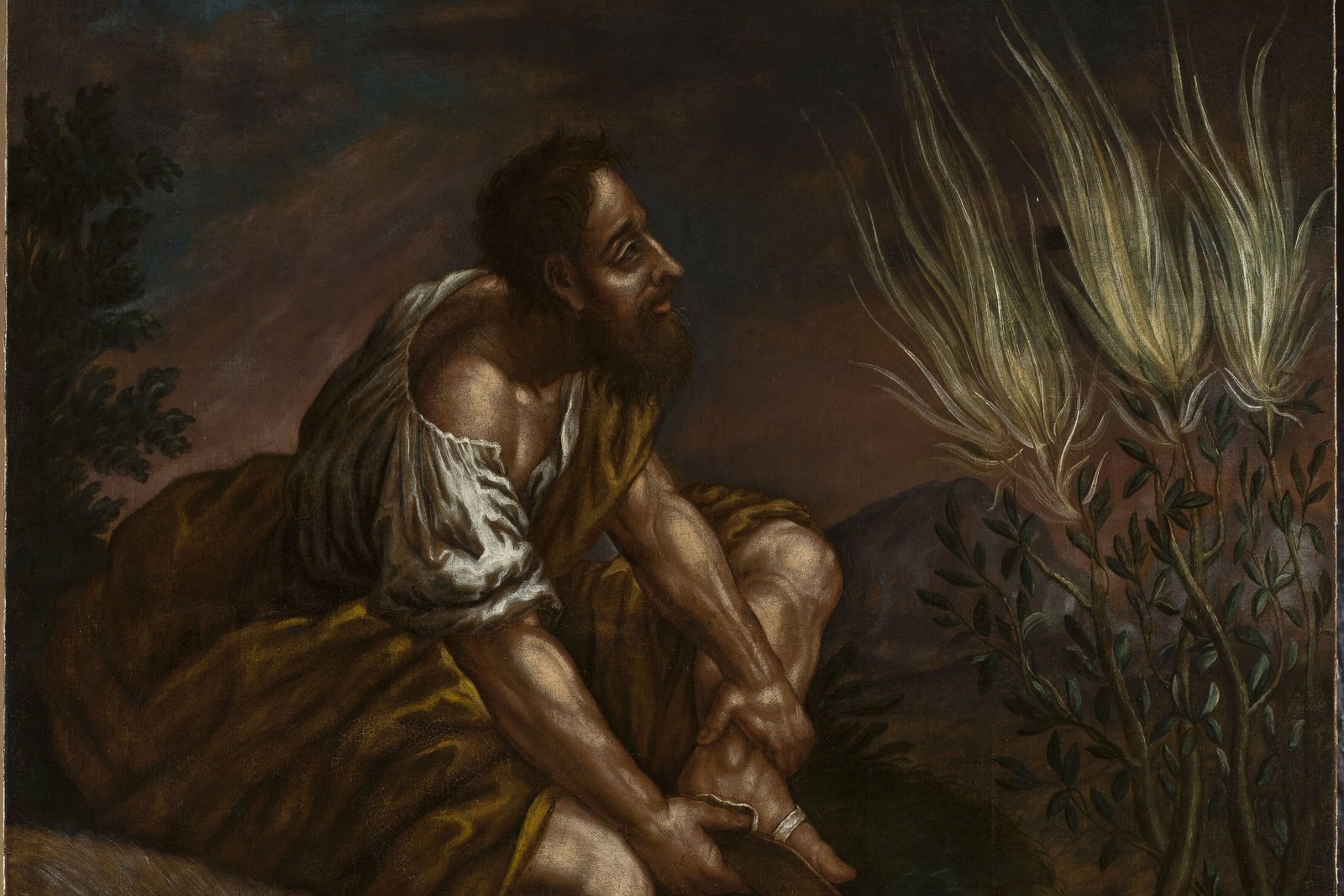
Domenico Fetti, "Moses Before the Burning Bush," c. 1621-1622, National Museum in Warsaw. Public domain.
A fire that wouldn't behave like fire
What stops him is specific and small: a bush on fire that isn't being consumed. Ordinary desert scrub burns fast and burns out — this one kept burning without disappearing. Moses' own reaction is telling: "I must turn aside to look at this remarkable sight. Why does the bush not burn up?" (Exodus 3:3, NABRE). He isn't awestruck yet. He's curious, the way anyone would be at something that breaks a pattern they've watched their whole life. It's only once he turns aside that the story changes register entirely — "When the Lord saw that he had turned aside to look, God called out to him from the bush: Moses! Moses!" (Exodus 3:4). The encounter depended, in a very ordinary way, on Moses choosing to look closer at something he could easily have ignored.
Holy ground and a hidden face
God's first instruction has nothing to do with the mission ahead — it's about how to stand in this particular place. "Do not come near! Remove your sandals from your feet, for the place where you stand is holy ground" (Exodus 3:5, NABRE). Removing sandals was, and still is in parts of the Middle East, a basic gesture of respect before entering someone's home or a sacred space — here it marks the ground itself, ordinary desert a moment earlier, as suddenly set apart. God then identifies himself not as a new deity but as continuous with Israel's own history: "I am the God of your father... the God of Abraham, the God of Isaac, and the God of Jacob" (Exodus 3:6). Moses' response is immediate and physical — he hides his face, "for he was afraid to look at God" (Exodus 3:6). It's a detail worth sitting with: even a man about to be given an extraordinary mission doesn't casually withstand a direct encounter with the divine.
A name that refuses to be pinned down
The most theologically weighty moment in the whole account comes when Moses, already anticipating resistance from the Israelites, asks what name he should give when they ask who sent him. God's answer is famously strange in its grammar: "I am who I am," followed by the instruction, "This is what you will tell the Israelites: I AM has sent me to you" (Exodus 3:14, NABRE). The Hebrew behind this — built from the verb "to be" — has been read across centuries of Jewish and Christian theology as pointing to something essential about God's nature: he is self-existent, dependent on nothing outside himself for his being, the source rather than a product of existence. It isn't a name in the sense of a label attached to one god among many; it's closer to a declaration that God simply is, without qualification. Catholic tradition, following the Church Fathers, has long treated this as one of the most important verses in the Old Testament for understanding who God claims to be. Readers wanting the broader arc this moment belongs to can find it laid out in our guide to Old Testament stories every Catholic should know.
A reluctant messenger
What follows the name-revelation, across the rest of Exodus 3 and into chapter 4, is Moses arguing — repeatedly and specifically — against the job he's just been given. He questions his own standing ("Who am I that I should go to Pharaoh...?"), worries the Israelites won't believe he was sent, and eventually pleads that he isn't eloquent enough for the task. None of these objections are treated as sinful or shameful in the text; they read as genuinely human hesitation in the face of an overwhelming assignment. God doesn't dismiss the concerns so much as answer them one at a time — providing signs Moses can perform, and eventually agreeing to send his brother Aaron along as a spokesman. The burning bush, in other words, isn't the end of the story but the opening argument of a much longer negotiation between a reluctant man and the God who had just called him by name.
Why the story still matters
The burning bush scene does something few other call-narratives in Scripture do: it locates a life-altering encounter with God in the middle of completely unremarkable labor. Moses wasn't praying in a temple or seeking a vision — he was watching sheep, the same work he'd done for years, in a place he'd wandered into by accident while following the grass. Catholic tradition has long read the moment as a template for how God frequently breaks into ordinary life rather than only into moments set aside for religious devotion. The mountain itself — Horeb, closely associated with Sinai — would become the site of an even larger revelation decades later, when Moses returned there with the freed Israelites to receive the Ten Commandments, closing a loop that began with one man noticing a bush that simply wouldn't stop burning.
Trivia
What was strange about the bush Moses saw on Mount Horeb?
Why did God tell Moses to remove his sandals?
What name did God give Moses when Moses asked who was sending him?
Was Moses eager to accept the mission God gave him at the burning bush?
Where did the burning bush encounter take place?
You May Also Like
Related Reading