The Road to Emmaus

Two grieving men, and an uninvited third
Luke sets this account on the same day the tomb was found empty — "that very day," two disciples are walking to Emmaus, a village about seven miles from Jerusalem, "conversing about all the things that had occurred" (Luke 24:13-14, NABRE). One of them is named, Cleopas; the other is left unnamed. As they talk, a stranger falls into step beside them and asks what they're discussing. Luke gives the reason for their blindness plainly, without elaboration: "Jesus himself drew near and walked with them, but their eyes were prevented from recognizing him" (Luke 24:15-16, NABRE). The text doesn't explain the mechanism of that prevention — only that it was real.
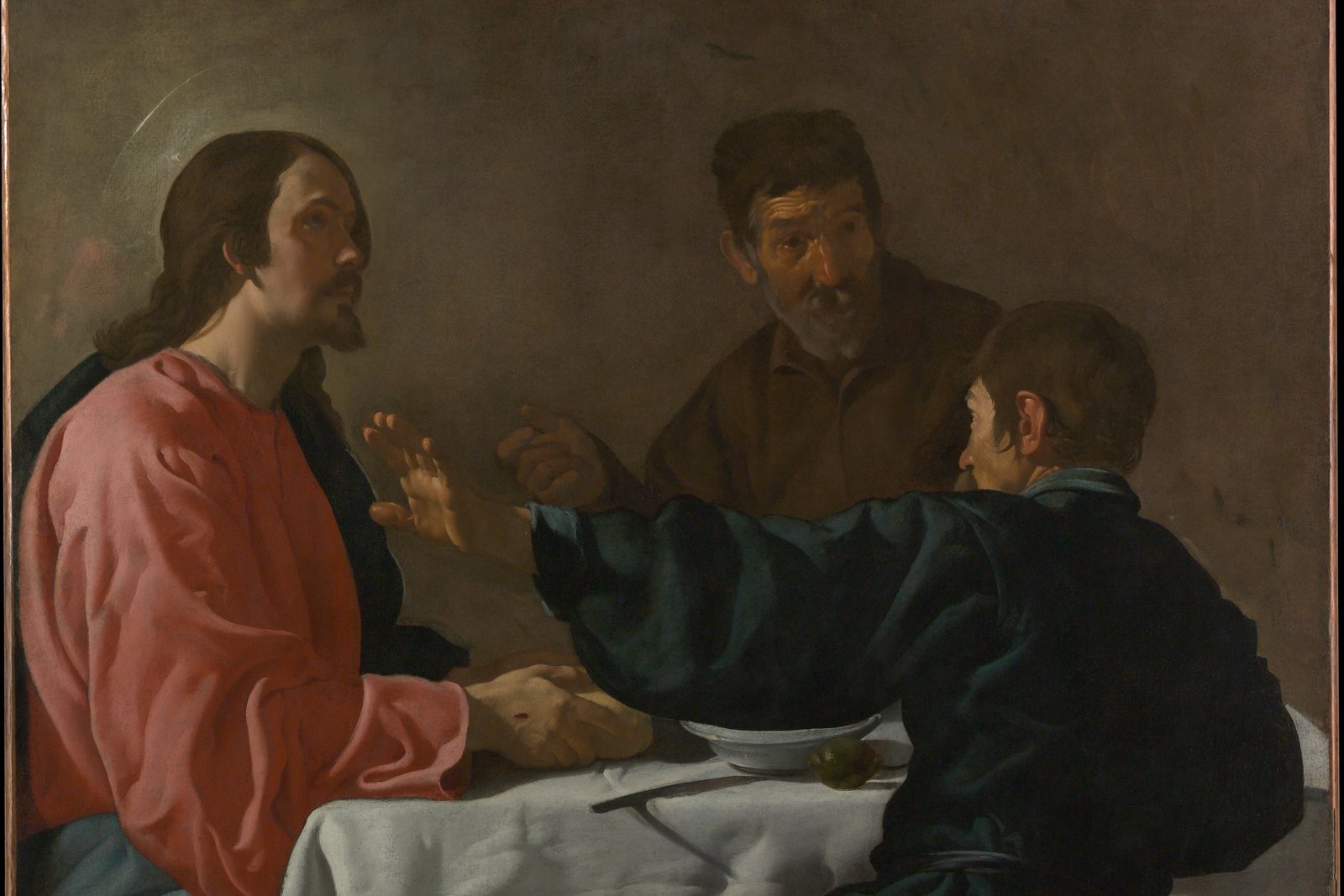
Diego Velazquez, "The Supper at Emmaus," 1622-23, The Metropolitan Museum of Art. Public domain.
Emmaus itself is a minor puzzle for biblical geographers: several ancient sites in the vicinity of Jerusalem have been proposed as the actual village Luke means, and no single identification has won universal scholarly agreement. That uncertainty doesn't affect the story's meaning, but it's a reminder that Luke wrote for readers who already knew exactly where Emmaus was — a piece of local geography so ordinary it needed no further explanation, unlike the extraordinary events unfolding on the road to it.
Grief spoken to the very person it's grieving
What follows is one of the more quietly devastating exchanges in the Gospels. Cleopas, surprised that this apparent visitor to Jerusalem seems unaware of recent events, lays out the whole story to the risen Jesus himself: a prophet "mighty in deed and word," handed over to death by the religious authorities, and — worse than the death itself — a hope now apparently broken. "We were hoping that he would be the one to redeem Israel," Cleopas says, "and besides all this, it is now the third day since this took place" (Luke 24:19-21, NABRE). He even reports the women's confusing account of an empty tomb and a vision of angels, without believing it changes anything (Luke 24:22-24, NABRE).
There's something almost unbearable about the position Luke puts his readers in here: they already know, from earlier in the same chapter, that Jesus has risen, so every word Cleopas says about a hope that seems to have failed lands as dramatic irony. Cleopas isn't wrong about the facts — the crucifixion happened exactly as he describes it — he's only wrong about what those facts mean, standing in front of the very answer to his grief without any way yet of seeing it.
A Bible study led by its own subject
Jesus's response isn't to reveal himself immediately, but to correct their understanding of Scripture. "Oh, how foolish you are! How slow of heart to believe all that the prophets spoke!" he says, before asking whether it wasn't necessary for the Messiah to suffer before entering into glory (Luke 24:25-26, NABRE). Then, Luke tells us, "beginning with Moses and all the prophets, he interpreted to them what referred to him in all the scriptures" (Luke 24:27, NABRE) — walking two despairing men through their own Hebrew Scriptures, showing them a pattern they'd read many times but never connected to what they'd just witnessed.
Luke doesn't record the specific passages Jesus used, which has left centuries of readers to speculate about which parts of "Moses and all the prophets" he might have drawn on — texts like the suffering servant passages in Isaiah, or the psalms describing a righteous sufferer vindicated by God, are frequent guesses. The omission may well be deliberate: rather than handing readers a fixed proof-text list, Luke leaves open an invitation to search the whole of the Hebrew Scriptures the same way Jesus reportedly did on that walk, rather than treating the exercise as already closed.
A supper, and a familiar gesture
As they near Emmaus, the disciples urge the stranger to stay — the day is nearly over. He agrees, and at the table, Luke describes an action with unmistakable weight: "he took bread, said the blessing, broke it, and gave it to them" (Luke 24:30, NABRE) — the same sequence of verbs Luke used earlier to describe the Last Supper. It's this gesture, not a dramatic unveiling, that finally opens their eyes: "their eyes were opened and they recognized him, but he vanished from their sight" (Luke 24:31, NABRE). Catholic tradition has long read this moment as pointing toward the Eucharist — Christ made known specifically in the breaking of bread, a connection the disciples themselves draw in their own recollection afterward (Luke 24:35, NABRE).
Artists have returned to this exact instant — bread broken, eyes suddenly opened — more than almost any other Resurrection scene precisely because of that Eucharistic weight. Caravaggio painted it twice, decades apart, each version catching the moment of recognition as something closer to a physical shock than a quiet realization; Velázquez's version, used as this article's hero image, takes a gentler approach, focusing on the ordinary domestic table setting that makes the disciples' astonishment land even harder by contrast.
Hearts that were burning before they understood why
Once Jesus vanishes, the two disciples don't sit with their astonishment — they immediately retrace the seven miles back to Jerusalem, at night, to find the other disciples. Before they even finish explaining, they're met with news of their own: "The Lord has truly been raised and has appeared to Simon!" (Luke 24:34, NABRE). Looking back on the walk itself, they realize their confusion had been shot through with something they hadn't named at the time: "Were not our hearts burning [within us] while he spoke to us on the way and opened the scriptures to us?" (Luke 24:32, NABRE) — a recognition that had been happening beneath the surface long before their eyes caught up to it.
That order — hearts burning first, understanding arriving only afterward — has shaped how the Catholic Church talks about the two halves of the Mass ever since: a Liturgy of the Word, where Scripture is read and explained much as Jesus explained it on the road, followed by a Liturgy of the Eucharist, where bread is taken, blessed, broken, and given, echoing the supper at Emmaus directly. The road to Emmaus is often cited for exactly this reason as a kind of template for Christian worship in miniature — proclamation first, then recognition in the breaking of bread. Readers interested in what came just before this walk may also want to read about the Risen Christ, covering the discovery of the empty tomb earlier that same morning.
Trivia
Where were the two disciples going, and what were they discussing?
Why couldn't the disciples recognize Jesus when he joined them?
What did Jesus do once the disciples described their confusion and grief to him?
What exact moment caused the disciples to finally recognize Jesus?
What did the disciples do immediately after recognizing Jesus?
Related Reading