The Woman with the Issue of Blood: A Healing Miracle

An illness with no cure and no money left
The Gospel of Mark introduces her with a brief but devastating summary: "There was a woman afflicted with hemorrhages for twelve years. She had suffered greatly at the hands of many doctors and had spent all that she had. Yet she was not helped but only grew worse" (Mark 5:25-26, NABRE). Twelve years is roughly the length of time the Gospels also record for Jairus's daughter, the girl whose story frames this same episode — a detail ancient readers would likely have noticed, one life measured in years just beginning, another measured in years of illness with no end in sight.
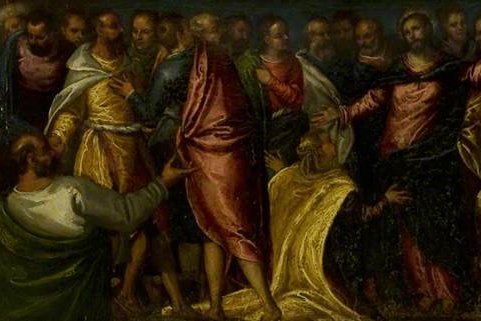
Attributed to Alessandro Maganza, Christ Healing the Woman with an Issue of Blood, early 17th century, Brodick Castle — public domain.
Beyond the physical suffering itself, the woman's condition carried a heavy social and religious weight under the purity regulations described in Leviticus, which treated a woman's abnormal or prolonged blood flow as a source of ritual impurity capable of being transmitted to others and to objects she touched. Twelve years of this condition would have meant twelve years of social isolation on top of physical decline — a woman who had exhausted her savings on doctors and, in an important sense, exhausted her place within the ordinary religious and social life of her community as well.
Reaching out from behind
By the time she encounters Jesus, in Mark and Luke's accounts, he is already on his way to the home of Jairus, a synagogue official whose young daughter is dying, and a large crowd is pressing in around him. It is in that crush of people that the woman approaches: "She had heard about Jesus and came up behind him in the crowd and touched his cloak. She said, 'If I but touch his clothes, I shall be cured'" (Mark 5:27-28, NABRE). Matthew's account specifies that she touched "the tassel on his cloak" (Matthew 9:20) — likely a reference to the ritual fringes, or tzitzit, worn on the corners of a devout Jewish man's garment in observance of Numbers 15:38-39, a detail that adds a layer of religious significance to her choice of exactly where to reach.
Her plan works precisely as she hoped, and more immediately than she likely expected: "Immediately her flow of blood dried up. She felt in her body that she was healed of her affliction" (Mark 5:29). She had sought healing without confrontation, without having to explain her condition to anyone, without drawing the crowd's attention to herself at all — a plan built entirely around remaining unnoticed.
Found out anyway
That plan does not survive contact with Jesus. Mark 5:30 records that Jesus, "aware at once that power had gone out from him, turned around in the crowd and asked, 'Who has touched my clothes?'" (NABRE). His disciples, reasonably enough given the crush of people around them, reply, "You see how the crowd is pressing upon you, and yet you ask, 'Who touched me?'" (Mark 5:31) — how could he possibly identify one touch out of so many? Jesus, undeterred, keeps looking for the person responsible.
What follows is the moment the story turns from a quiet, private healing into a public encounter: "The woman, realizing what had happened to her, approached in fear and trembling. She fell down before Jesus and told him the whole truth" (Mark 5:33, NABRE). Having gotten exactly the physical healing she wanted while avoiding exposure, she now finds herself exposed anyway, kneeling before Jesus in front of the same crowd she had hoped to pass through unnoticed, explaining a twelve-year illness she had likely spent years trying not to have to explain to anyone at all.
"Your faith has saved you"
Jesus' response reframes the entire encounter. Rather than treating her forced confession as an intrusion or a violation of the privacy she had sought, he responds with words that publicly affirm and dignify her: "Daughter, your faith has saved you. Go in peace and be cured of your affliction" (Mark 5:34, NABRE). Matthew's parallel account records a similarly warm response — "Courage, daughter! Your faith has saved you. And from that hour the woman was cured" (Matthew 9:22) — with the word "daughter" standing out in both versions as a term of tenderness rarely used elsewhere in the Gospels, addressed to a woman who, moments before, had been a stranger in a crowd.
The title "daughter" also carries theological weight beyond simple warmth: it identifies the healing not merely as a medical event but as an act that restores the woman fully into relationship and community, precisely the kind of restoration her years of ritual impurity would have made socially difficult. For the continuation of this same episode — what happens when Jesus finally reaches Jairus's house — see the companion article, The Raising of Jairus's Daughter, the healing this woman's own encounter with Jesus briefly interrupted.
Trivia
What illness did the woman have, and how long had she suffered from it?
Why did the woman touch Jesus' cloak instead of asking him directly?
What happened the moment she touched his cloak?
What did Jesus say to her after she came forward?
In which Gospels does this story appear?
Related Reading