Catholic Teaching on Capital Punishment, Explained

Where the older teaching came from
For most of Christian history, the Catholic Church did not teach that capital punishment was inherently wrong. This wasn't an oversight — it reflected a specific, carefully reasoned theological tradition that traced back through medieval theology, most notably Thomas Aquinas, who argued the state held legitimate authority to execute those guilty of sufficiently grave crimes as a matter of protecting the common good, comparable to how a surgeon might remove a diseased limb to save the rest of the body. This reasoning drew partly on Old Testament precedent, where capital punishment for serious offenses appears within the Mosaic legal code, and partly on a broader theological tradition affirming the state's legitimate authority to use force, including lethal force, in defense of justice and public order.
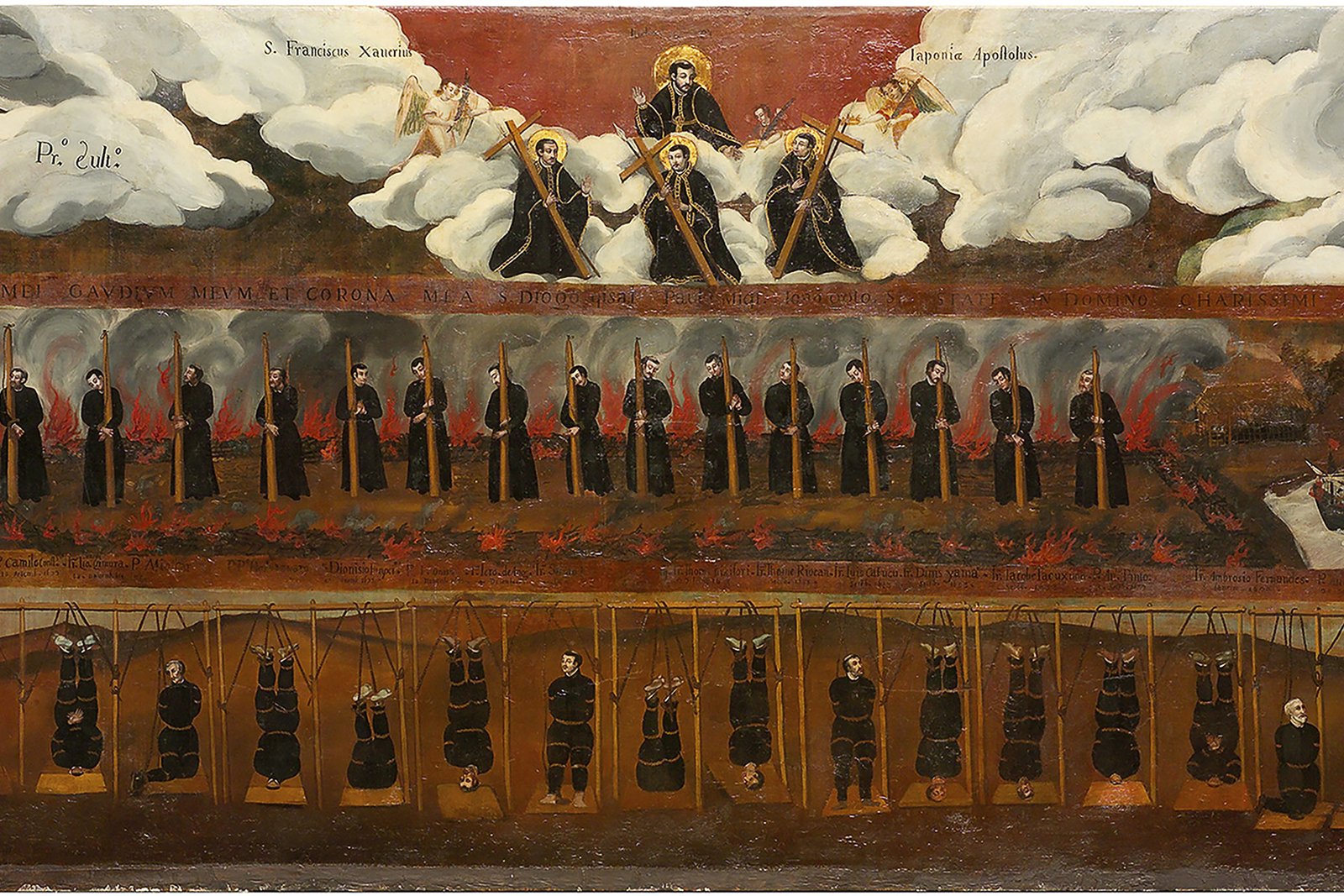
Unknown artist, The Martyrdom of Paul Miki and Companions in Nagasaki, c. 1635 — public domain.
Under this older framework, the Church's older Catechism (in its earlier editions) taught that the death penalty could be legitimate in cases of extreme gravity, while still expressing a preference for non-lethal means whenever they were sufficient to protect society — the door was never fully open to unrestricted use of capital punishment, but it was not closed outright either.
A shift building for decades before 2018
The 2018 change didn't appear out of nowhere. Popes in the second half of the 20th century, particularly John Paul II, had already moved the Church's practical teaching substantially in a more restrictive direction. John Paul II's 1995 encyclical Evangelium Vitae argued that cases where execution was genuinely necessary to protect society were "very rare, if not practically non-existent" in contemporary conditions, given the availability of modern, secure detention systems capable of protecting the public without recourse to execution. The 1997 revision of the Catechism incorporated that reasoning, tightening the traditional teaching considerably while still formally leaving a narrow theoretical exception in place for extreme cases.
What changed in 2018, specifically
Pope Francis's 2018 revision went further than any previous modern statement, removing the conditional language entirely. The revised Catechism paragraph 2267 now states that the death penalty is "inadmissible because it is an attack on the inviolability and dignity of the person," and commits the Church to working "with determination" for its abolition worldwide. This moved the Church's position from "rarely, if ever, justified in practice" to a flat statement of inadmissibility in principle — a meaningfully stronger and less conditional claim than the 1997 language it replaced.
The Vatican's accompanying explanation framed the change as growing from two connected developments: a "more adequate" understanding of human dignity, one that extends even to those guilty of terrible crimes, and the now widespread practical availability of detention systems that can protect society effectively without ending the offender's life — meaning the traditional justification for capital punishment, protecting the common good, no longer requires execution as a tool in the vast majority of contemporary circumstances.
Development of doctrine, or reversal?
This is where careful, honest theological distinction matters, echoing the same principle this site addresses when explaining the difference between tradition and dogma more broadly. The Church itself insists the 2018 change represents a "development of doctrine" — a legitimate, organic deepening of an unchanging underlying principle (the inviolable dignity of the human person) applied more consistently to changed historical circumstances — rather than a contradiction of previously infallible dogma. Supporters of this framing point out that the Church never treated the moral permissibility of capital punishment itself as unchangeable dogma in the same category as, say, the Trinity or the Resurrection; it was always understood as a prudential judgment about the legitimate use of state authority, open in principle to development as circumstances changed.
Some Catholic theologians, including a number of prominent moral theologians, have pushed back more sharply, arguing the 2018 language goes further than legitimate doctrinal development can stretch, given how explicitly earlier authoritative Church teaching, including Scripture itself, affirmed the state's legitimate authority to execute in at least some circumstances. This remains a genuinely live and unresolved debate within Catholic theological circles, not a settled matter with unanimous agreement, even as the Catechism's current, official text is now unambiguous.
Where the teaching stands today
Whatever the underlying theological debate about how to characterize the change, the Catholic Church's current, binding catechetical teaching is clear and universal: capital punishment is inadmissible, and Catholic bishops' conferences around the world, including the USCCB in the United States, actively campaign for its abolition as a matter of Catholic social teaching, standing alongside the Church's broader commitment to the dignity of human life from conception to natural death. Whatever a Catholic's own views on the underlying philosophical arguments, the Church now speaks with a single, explicit voice on where the question currently stands.
It's worth noting that this teaching, like other areas of Catholic social teaching, asks something practical of ordinary believers, not just theologians debating in the abstract. Catholics in countries that retain capital punishment, including the United States, are asked to weigh this teaching seriously when forming their own conscience on criminal justice policy — not as one political opinion among equally valid others, but as a considered application of the Church's broader, consistent teaching on the dignity of the human person, extended even to those who have done the gravest wrong.
Trivia
What does the Catholic Church currently teach about the death penalty?
Did the Catholic Church always oppose capital punishment?
Is the 2018 Catechism change on capital punishment considered a change in dogma?
Why did Church teaching on capital punishment develop over time?
Do individual Catholics have to personally oppose the death penalty to remain in good standing with the Church?
Related Reading