The Prayer of Saint Francis: Origins and Meaning

A prayer with a mysterious paper trail
Historians who have traced the Peace Prayer back through print records keep arriving at the same starting point: a small French Catholic magazine called La Clochette ("The Little Bell"), published by a priest-led charitable association in Normandy. Its December 1912 issue printed a prayer titled simply "Belle prière à faire pendant la messe" — "A beautiful prayer to say during Mass." No author was named. No connection to Francis of Assisi appeared anywhere in the text.
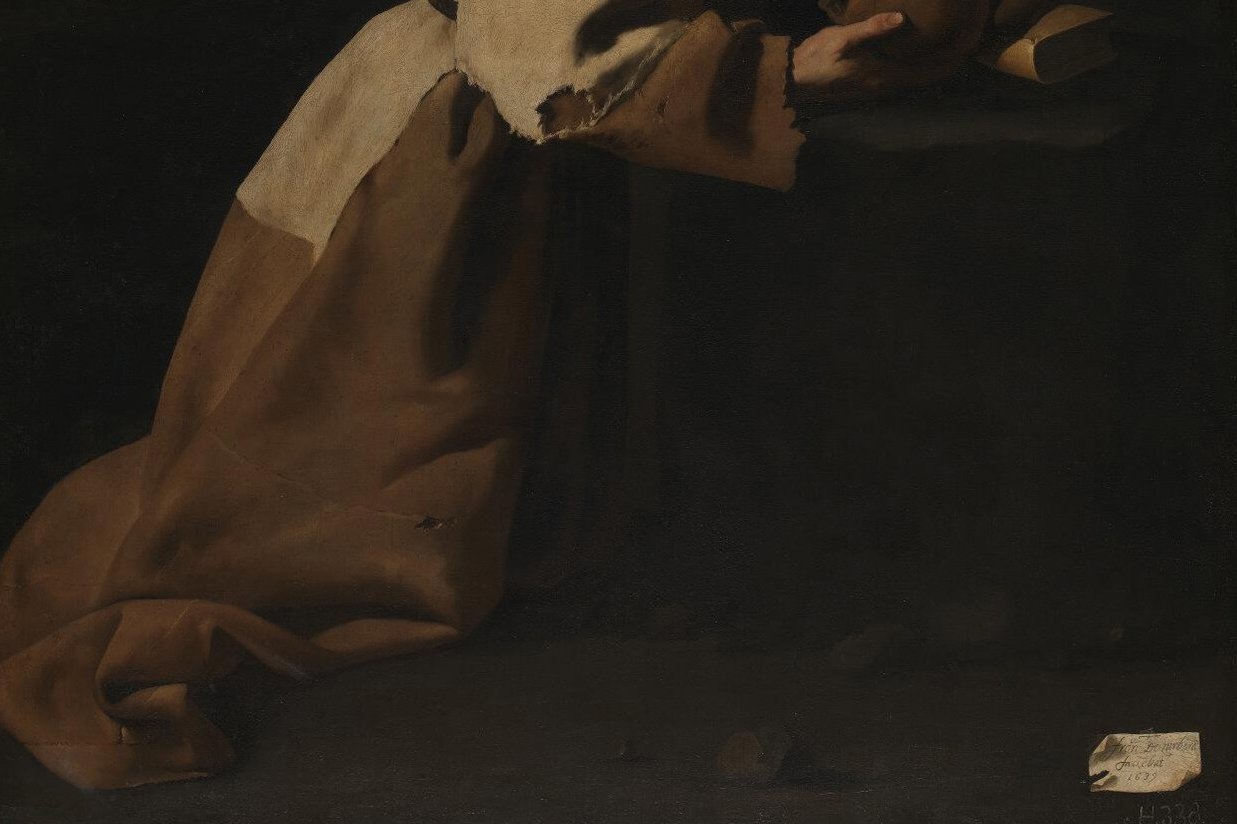
Francisco de Zurbarán, Saint Francis in Meditation, 1635-1639, The National Gallery, London — public domain.
That absence matters, because Francis died in 1226, and nothing resembling this prayer appears in any of his surviving writings — his Rule, his Testament, his letters, or the early biographies written by his companions within decades of his death. Franciscan scholars who have combed those sources for a match have found none. The prayer's vocabulary and structure also read as more modern than anything from the thirteenth century, reinforcing the same conclusion: whoever wrote it, it wasn't Francis.
How the prayer picked up his name
The trail forward from 1912 is easier to follow than the trail backward. A French Franciscan periodical, Etoile Séraphique de St. François d'Assise ("Seraphic Star of St. Francis of Assisi"), reprinted the prayer in January 1916 — this time next to an image of Francis, though again without directly crediting him as the author. From there, translations began circulating through Europe during the First World War, a period when its plea for peace amid hatred and injury clearly resonated. Each retelling nudged the prayer closer to Francis's name, until by the 1920s it was being printed in English simply as "The Prayer of St. Francis," with no question mark attached.
By the time later researchers went looking for the original attribution, the association was already too deeply set in popular devotion to dislodge — which is itself a familiar pattern in the history of Christian prayer and legend: a text's spiritual usefulness can outrun its documented origin by a wide margin.
The prayer, in full
The version most Catholics know today reads:
Lord, make me an instrument of your peace: where there is hatred, let me sow love; where there is injury, pardon; where there is doubt, faith; where there is despair, hope; where there is darkness, light; where there is sadness, joy.
O Divine Master, grant that I may not so much seek to be consoled as to console, to be understood as to understand, to be loved as to love. For it is in giving that we receive, it is in pardoning that we are pardoned, and it is in dying that we are born to eternal life.
Small variations exist between English translations — some render "console" as "comfort," for instance — but the structure of paired opposites and the closing line about dying to self are constant across nearly every version in circulation.
Why it still feels like Francis, even if he didn't write it
The mismatch between authorship and attribution rarely bothers people who pray it, and there's a reason for that beyond simple habit. Francis's own life was built around exactly the reversal the prayer describes: a wealthy merchant's son who gave away his possessions, a would-be knight who became a beggar, a man remembered for walking unarmed into the camp of Sultan al-Kamil in Egypt in 1219, during the Fifth Crusade, to seek peace rather than conquest. The prayer's central turn — that fullness comes through emptying, that receiving comes through giving — is close kin to the poverty and humility Francis actually preached and lived.
That doesn't make the prayer his. But it explains why, once his name attached to it, it never came loose. The Church has never issued an official correction discouraging the title, and Catholic devotional publishers, retreat leaders, and even several recent popes have continued to use "Prayer of St. Francis" as its working name, treating the attribution as a settled convention rather than a historical claim.
How it's prayed today
Unlike a rosary or a novena, the Peace Prayer has no fixed schedule or set number of repetitions attached to it. Catholics most often pray it as a single, complete meditation — at the start or close of the day, before a difficult conversation, or in group settings like retreats and ecumenical prayer services, where its universal language about peace and reconciliation travels well across denominational lines. It's also a common choice for funeral Masses and memorial services, since its final line — "it is in dying that we are born to eternal life" — speaks directly to Christian hope in the resurrection.
Some parishes pair it with the Divine Mercy Chaplet or morning prayer as part of a broader devotional routine, but it works just as well prayed alone, slowly, with attention to each pair of opposites — hatred and love, injury and pardon — as a kind of daily examination of where peace is still needed.
Trivia
Did Saint Francis of Assisi actually write the Peace Prayer attributed to him?
When and how did the prayer become known as the Prayer of Saint Francis?
What is the exact original text of the Peace Prayer?
Why does the prayer's message still fit Saint Francis even though he didn't write it?
Is the Peace Prayer used in official Catholic liturgy?
Related Reading