The Stations of the Cross — How to Pray Them at Home

A pilgrimage route brought home
The Stations of the Cross, also called the Via Crucis — Latin for "Way of the Cross" — trace their roots to a very literal practice: pilgrims walking the actual route in Jerusalem believed to follow Christ's path from his condemnation to his crucifixion and burial. Documentation of Christians walking this route in some form goes back to at least the 4th century, not long after Christianity became legal within the Roman Empire and pilgrimage to the Holy Land became newly practical for larger numbers of believers.

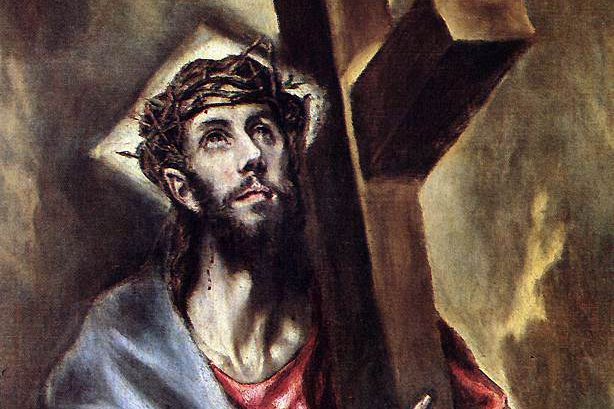
El Greco, Christ Carrying the Cross, c. 1602, Museo del Prado, Madrid — public domain.
Since traveling to Jerusalem was, for most Christians throughout history, simply impossible, the Church developed a portable alternative: a fixed set of scenes, representing key moments along that same route, that could be set up inside any local church. Franciscan friars, given official custody of the Christian holy sites in the Holy Land in 1342, played a major role in popularizing this practice across Europe, and by the 17th and 18th centuries the devotion had settled into its now-familiar form of fourteen fixed stations.
The fourteen stations
The traditional set runs as follows:
- Jesus is condemned to death
- Jesus takes up his cross
- Jesus falls the first time
- Jesus meets his sorrowful mother
- Simon of Cyrene helps carry the cross
- Veronica wipes the face of Jesus
- Jesus falls the second time
- Jesus meets the women of Jerusalem
- Jesus falls the third time
- Jesus is stripped of his garments
- Jesus is nailed to the cross
- Jesus dies on the cross
- Jesus is taken down from the cross
- Jesus is laid in the tomb
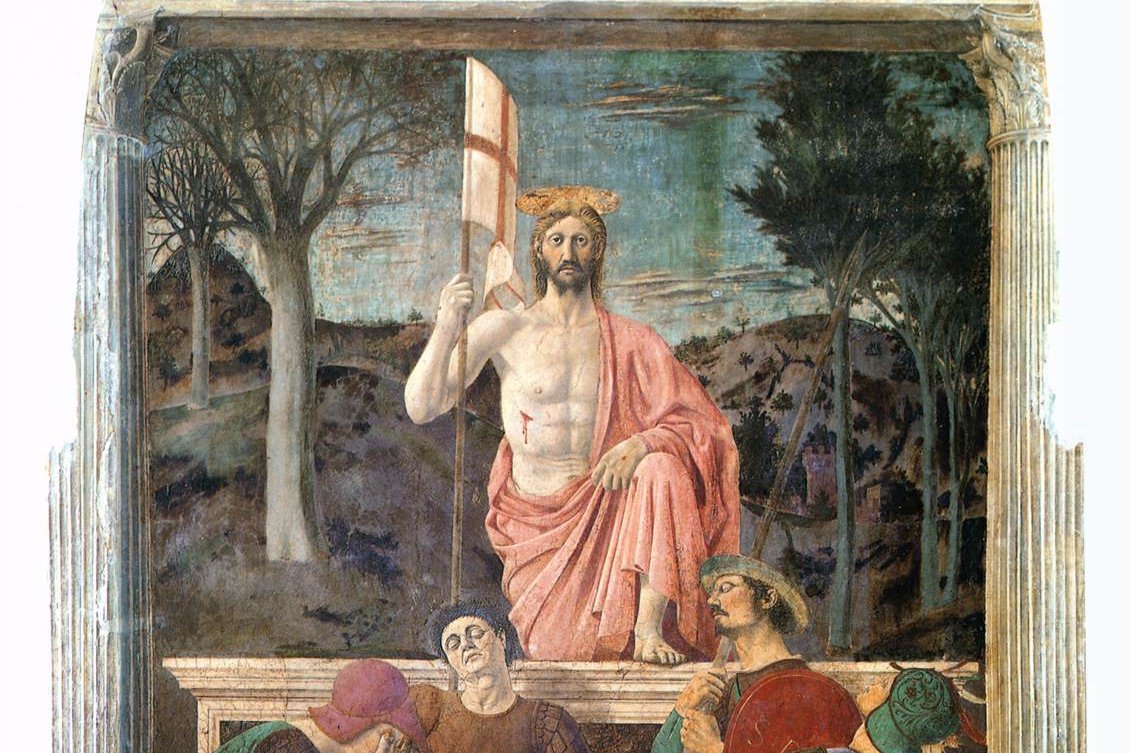
Some modern devotional sets append a fifteenth station representing the Resurrection, reflecting a pastoral impulse to close the devotion on a note of hope rather than burial — but this fifteenth station is a later addition, not part of the traditional fourteen.
Scripture and tradition, honestly distinguished
Nine of the fourteen stations rest directly on the Gospel Passion narratives — Christ's condemnation, the road to Calvary, the crucifixion and death, and the burial are all recorded in Matthew, Mark, Luke, and John. Three stations, however — Christ falling three separate times, meeting his mother along the road, and Veronica wiping his face with her veil — come from pious tradition and legend rather than direct Gospel narrative. None of these three appear explicitly in Scripture; they developed through centuries of popular devotion and later written accounts of the Passion.
This distinction matters enough that Pope John Paul II introduced an alternative version in 1991 called the Scriptural Way of the Cross, replacing the non-scriptural stations with moments drawn directly from the Gospels — the Agony in the Garden, Christ's arrest, and his denial by Peter, among others — for use alongside, not as a replacement for, the traditional fourteen. Both forms remain in active use across the Church today.
How to pray them, step by step
The Stations require no priest and no special setting beyond a set of images or markers representing each scene, which is part of why they translate so easily to home devotion. At each station, the standard pattern is:
- Pause and mentally arrive at the scene — many versions include a short verse, traditionally "We adore you, O Christ, and we praise you," with the response "Because by your holy cross you have redeemed the world."
- Read or recall a brief meditation on that station's specific event.
- Pray briefly — an Our Father, Hail Mary, or a short prayer of your own, is common.
- Move to the next station, physically if using printed images spaced around a room, or simply moving on in sequence if praying from a booklet or app.
There's no fixed length requirement — the devotion can be prayed slowly, with extended meditation at each station, or briefly, moving through all fourteen in ten or fifteen minutes. What matters devotionally is attentive movement through the sequence, not completion within any particular time frame.
Art on the church wall, not just words
Part of what makes the Stations distinctive among Catholic devotions is that they were built from the start to be visual as much as verbal. Church law requires that a set of fourteen crosses, at minimum, be present for the devotion to carry its official indulgence (a partial remission of temporal punishment, distinct from the plenary indulgences tied to other specific acts), and most parishes pair each cross with an image — a painting, carved relief, or mosaic — depicting that station's scene. This is why the Stations are often the most visually consistent devotional artwork in any given church, appearing in matched sets of fourteen and giving artists across centuries a defined subject and sequence to work within, from simple painted plaques in a small rural parish to elaborate bronze reliefs in a major cathedral. Praying the Stations, historically, meant walking physically from image to image around the nave — a movement meant to echo, in miniature, the original pilgrims' walk through Jerusalem's streets.
When they're most commonly prayed
The Stations of the Cross are especially associated with Fridays during Lent, when many parishes hold a communal service walking through all fourteen stations together, often led by a priest or deacon, and with Good Friday itself, the day the Church commemorates Christ's crucifixion directly. Outside of Lent, the Stations can be prayed at any time, individually or as a family devotion, and pair naturally with other Lenten practices like the Rosary or time spent before the Blessed Sacrament as part of a broader pattern of Lenten prayer.
Trivia
What are the Stations of the Cross?
How many Stations of the Cross are there, and what are they?
Where does the tradition of the Stations of the Cross come from?
Which stations are based directly on Scripture, and which come from tradition?
When are the Stations of the Cross most commonly prayed?
Related Reading