Saint Catherine's Monastery: The Oldest Monastery Still in Use

A fortress built around a bush
Drive for hours through the bare granite mountains of the southern Sinai Peninsula and eventually a walled compound appears, tucked into a valley at nearly 5,000 feet, dwarfed by the peak rising behind it. This is Saint Catherine's Monastery, and its location was never chosen for convenience. It sits exactly where local tradition, reaching back to at least the fourth century, places one of the most consequential encounters in the Old Testament: the moment Moses, tending sheep, saw a bush burning without being consumed, and heard a voice telling him to remove his sandals because he stood on holy ground (Exodus 3:2-5).
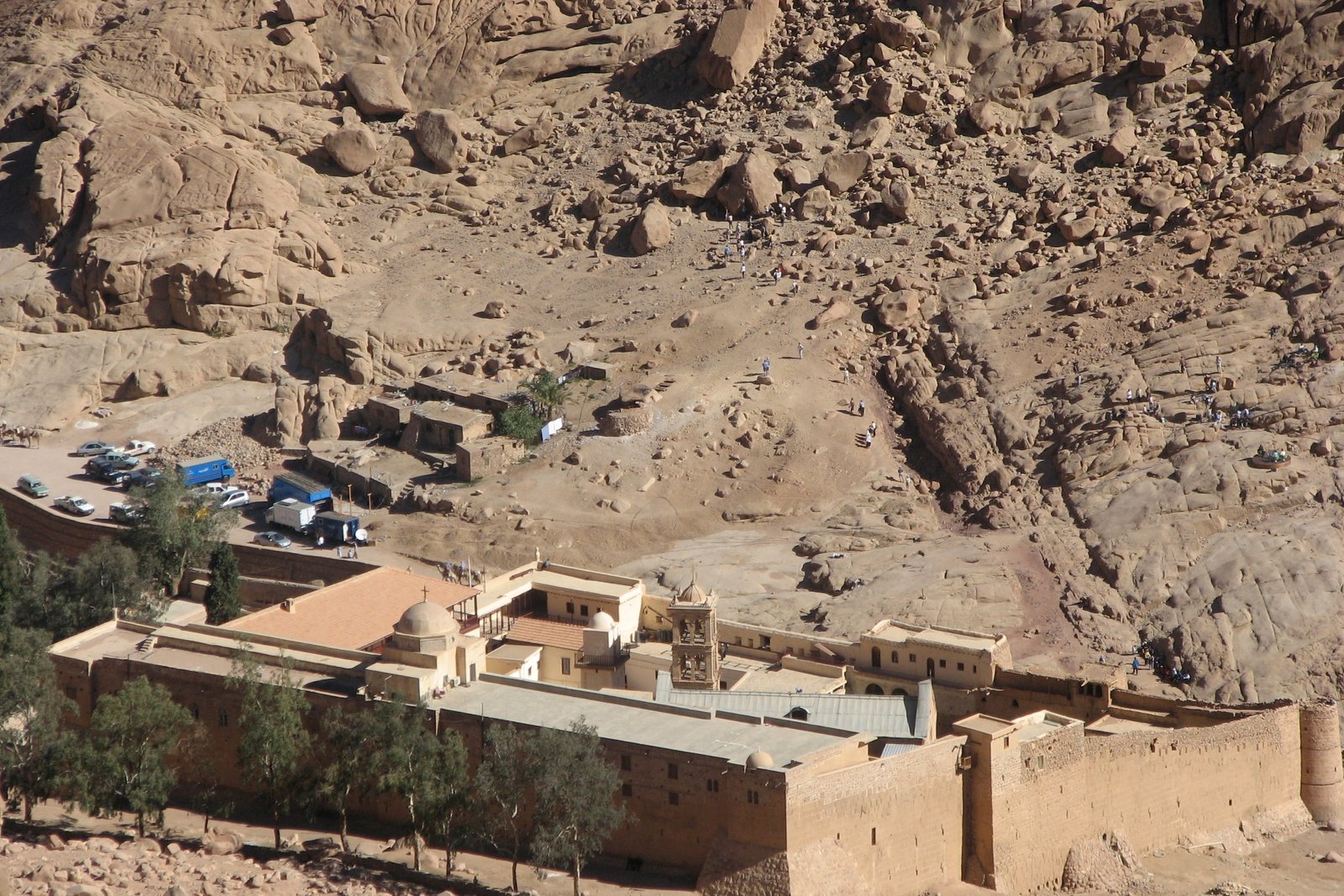
Photograph by Abraham, Saint Catherine's Monastery, Mount Sinai, 2008 — CC BY-SA 4.0, Wikimedia Commons.
The monastery as it stands today was built on the order of the Byzantine emperor Justinian I between about 548 and 565 AD, enclosing an older, smaller chapel that the empress Helena — mother of Constantine, and already responsible for identifying and marking several biblical sites in the Holy Land — reportedly had constructed near the bush around 330 AD. Justinian's builders didn't just add a chapel; they surrounded the whole site with massive granite walls, some over thirty feet high, transforming a pilgrim shrine into a fortress capable of withstanding siege in one of the most isolated stretches of desert in the ancient world.
Fifteen centuries without interruption
What sets Saint Catherine's apart from nearly every other ancient monastery isn't its age alone — there are older Christian buildings — but the fact that it has never been abandoned. Monks have lived and prayed there in unbroken succession since the sixth century, through the Persian invasion of Egypt in the seventh century, the Arab conquest that followed shortly after, the Crusades, Ottoman rule, and Napoleon's Egyptian campaign in 1798. Few ancient monastic communities anywhere in the Christian world can claim that kind of continuity.
Much of that survival owes less to the strength of the walls than to diplomacy. According to a tradition documented at the monastery itself, the Prophet Muhammad issued a document guaranteeing the monastery's protection and exempting it from taxation, a charter later monasteries and Islamic rulers largely continued to honor across centuries of changing political control. Napoleon, too, ordered his troops to protect the site during the French occupation of Egypt, and had the fortress walls repaired at his own expense.
Why the site carries the name of a fourth-century martyr
The monastery wasn't originally named for Saint Catherine of Alexandria. For its first several centuries it was known simply as the Monastery of the Transfiguration, or the Monastery of the Burning Bush, reflecting the two biblical events associated with the site — Moses at the bush, and, according to later tradition, the mountain's identification with the site of Christ's Transfiguration as well.
The dedication to Saint Catherine developed later, tied to a legend that angels carried her body, after her martyrdom in Alexandria around the early fourth century, to the summit of the mountain now called Mount Catherine, the highest peak in Egypt, located near the monastery. Monks reportedly discovered relics there several centuries afterward and brought them down to the monastery, and from that point the site increasingly took her name. Saint Catherine herself is honored in Christian tradition as a brilliant, articulate young woman who debated pagan philosophers in defense of her faith before her execution — a legend recorded in later hagiography rather than contemporary historical documentation, and one the Church presents as pious tradition rather than settled historical fact in its specific details.
A living library of Christian art and text
Saint Catherine's holds one of the most important manuscript collections in the Christian world, second in size only to the Vatican Library among institutions that have preserved their collections continuously on-site. Among its holdings was, until the nineteenth century, the Codex Sinaiticus, one of the oldest surviving complete manuscripts of the Christian Bible, dating to the fourth century — much of it was removed from the monastery in the 1800s under circumstances still disputed by the monastery itself, and portions are now held by the British Library and other institutions, a matter the monastery continues to contest.
Equally remarkable is the monastery's icon collection. Because the site was never overrun during the Byzantine Iconoclasm of the eighth and ninth centuries — a period during which large numbers of religious images across the Byzantine world were deliberately destroyed by imperial decree — Saint Catherine's preserved icons from as early as the sixth century that simply don't survive anywhere else, offering scholars and pilgrims alike a rare, unbroken window into the earliest visual traditions of Christian art.
A mountain still climbed by pilgrims
Pilgrims and hikers still climb Mount Sinai today, most beginning before dawn to reach the summit by sunrise, following a path monks and Bedouin guides have walked for centuries. The climb ends at a small chapel near the peak, built on the traditional site where Moses is said to have received the Ten Commandments — a fittingly modest structure, echoing the monastery below, where grandeur has never been the point. What has drawn visitors here for a millennium and a half isn't architectural splendor but continuity itself: a single community of monks, in one of the most forbidding landscapes on earth, keeping watch over a bush, a mountain, and a story that begins with a voice from within the fire.
Trivia
Where is Saint Catherine's Monastery located?
When was the monastery built and who ordered its construction?
Why is it called the oldest continuously inhabited monastery in the world?
What is the burning bush associated with the monastery?
What is significant about the monastery's library and icon collection?
Related Reading