Blessed Isidore Bakanja

A convert in a brutal colonial economy
Isidore Bakanja was born around 1885 or 1887 in the Boangi region of what was then the Congo Free State — the personal colonial possession of Belgium's King Leopold II, administered under a system notorious for its extraction of rubber and ivory through forced labor and violent coercion, conditions that caused massive suffering and death among the Congolese population during this period. Bakanja was baptized a Catholic as a young man by Trappist missionaries and took to his new faith with evident seriousness, becoming an active lay catechist — someone who instructs others informally in Catholic teaching — among fellow Congolese workers even without any formal clerical training or position.
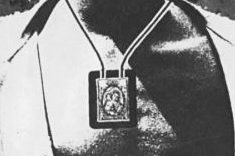
Photographer unknown, circa 1900 — public domain.
He worked as a laborer, eventually taking employment on a rubber plantation operated by a private colonial trading company, where he continued to practice his faith openly, including teaching other workers what he had learned from the missionaries, and wearing a brown scapular, a small cloth devotional item associated with Carmelite Marian devotion, visibly around his neck as a sign of that faith.
Conflict with a hostile overseer
Bakanja's overseer at the plantation, a Belgian colonial agent, held open hostility toward the Catholic missionary presence in the region — a hostility not uncommon among some colonial commercial agents of the period, who sometimes viewed missionary influence over the local workforce as a competing authority or a source of unwelcome scrutiny of labor conditions. According to the testimony later gathered for Bakanja's beatification cause, the overseer specifically ordered him to remove the scapular and stop teaching fellow workers about Catholicism. Bakanja refused to give up either practice.
A beating that proved fatal
The overseer's response, according to the beatification testimony, was to have Bakanja severely flogged with a chicotte — a hide whip used punitively in the Congo Free State's forced-labor system, sometimes reinforced with pieces of metal or wire, capable of inflicting severe lacerating wounds. The beating Bakanja received left him with extensive, poorly treated wounds to his back that never properly healed, compounded by the harsh conditions he continued to be kept in afterward, including reportedly being sent back to work and forced to travel while still severely injured.
Bakanja's condition deteriorated steadily over the following months. Catholic missionaries who visited and cared for him during this period later testified that he remained committed to his faith throughout his decline, and specifically that he expressed forgiveness toward the overseer who had ordered the beating, framing his suffering in explicitly Christian terms of forgiveness rather than bitterness — testimony recorded by those who visited him rather than a directly preserved quotation, and best understood in that light. He died from his injuries on August 15, 1909, likely still in his early twenties.
Colonial accountability and the limits of the historical record
It's worth noting directly that Bakanja's case unfolded within one of the most documented and internationally condemned systems of colonial forced labor and violence in modern history — the Congo Free State under Leopold II's personal rule, whose abuses were exposed by international investigators and journalists in the early 1900s and led to Belgium formally annexing the territory as a state colony in 1908, partly in response to the scandal. Bakanja's beatification cause treats his death specifically as a case of religious martyrdom — killed on account of his open practice and teaching of the Catholic faith — a conclusion reached through the Church's own formal investigative process, distinct from, though occurring within, that broader colonial context of systemic violence against Congolese laborers generally.
What the brown scapular meant to him
The specific object at the center of Bakanja's confrontation with his overseer is worth explaining, since its significance is easy to miss for readers unfamiliar with Catholic devotional practice. The brown scapular is a small devotional item, traditionally two small pieces of cloth connected by cords and worn over the shoulders and against the chest and back, associated with the Carmelite religious order and, through it, with devotion to the Virgin Mary under the title Our Lady of Mount Carmel. For a newly baptized layman like Bakanja, working far from any resident priest, wearing the scapular visibly was a simple, concrete, and entirely ordinary act of Catholic devotion — the kind of thing thousands of Catholic converts across the missionary world did without incident. That his overseer treated the visible scapular as a provocation serious enough to warrant a punitive flogging says far more about the overseer's own hostility to missionary influence in the colonial labor system than about anything unusual in Bakanja's own conduct or intentions. It is precisely this disproportion — a small, unremarkable act of piety met with lethal violence — that the Church's beatification process treated as central to classifying his death as martyrdom rather than as an incidental casualty of colonial labor brutality more broadly.
The path to beatification
The formal cause for Bakanja's beatification opened decades after his death, part of a broader twentieth-century effort by the Church in the Congo and in Rome to investigate and recognize local witnesses to the faith from the colonial period, alongside better-known missionary martyrs. Investigators gathered surviving testimony, much of it originating with the Trappist and other missionaries who had known Bakanja personally or cared for him during his final illness, establishing both the facts of his death and the specifically religious motive behind the beating that caused it — the combination required for the Church to recognize a death as martyrdom rather than simply an act of general violence or injustice. Pope John Paul II's 1994 beatification took place during a pontificate that placed particular emphasis on recognizing modern and non-European martyrs, situating Bakanja within a much larger twentieth-century list of beatifications meant to demonstrate the global and contemporary reach of Christian martyrdom, not merely its ancient or medieval past.
Beatification
Isidore Bakanja was beatified by Pope John Paul II on April 24, 1994, formally recognizing him as a martyr. He remains one of the earliest and most significant figures in the history of the modern Congolese Catholic Church, and his cause for canonization as a full saint continues to be pursued.
Feast day
He is commemorated on August 15, the anniversary of his death.
Related reading
Bakanja's death as a lay Catholic martyr for openly practicing his faith invites comparison with other 20th-century martyrs killed under hostile political or colonial systems — readers may also want to read about Blessed Miguel Pro, a priest executed in Mexico for continuing his ministry under an anti-Catholic government, or Saint Peter Claver, a missionary priest known for his own direct ministry among enslaved and forcibly displaced Africans.
Trivia
Who was Blessed Isidore Bakanja?
Is Isidore Bakanja a canonized saint, or is he still a Blessed?
Why was Isidore Bakanja beaten by his employer?
Did Isidore Bakanja forgive the man who ordered his beating?
When is Blessed Isidore Bakanja's feast day?
You May Also Like
Related Reading