Jonah: The Prophet Who Ran From Mercy

Running the Wrong Way
"The word of the Lord came to Jonah, son of Amittai: Set out for the great city of Nineveh, and preach against it; for their wickedness has come before me" (NABRE, Jonah 1:1-2). Nineveh was the capital of Assyria, a brutal imperial power and Israel's historic enemy — sending a Hebrew prophet there to preach repentance was, in effect, asking Jonah to offer his nation's tormentors a chance at mercy. Jonah's response is immediate and blunt: he books passage on a ship "to Tarshish, away from the Lord" (NABRE, Jonah 1:3), heading in the opposite direction entirely.
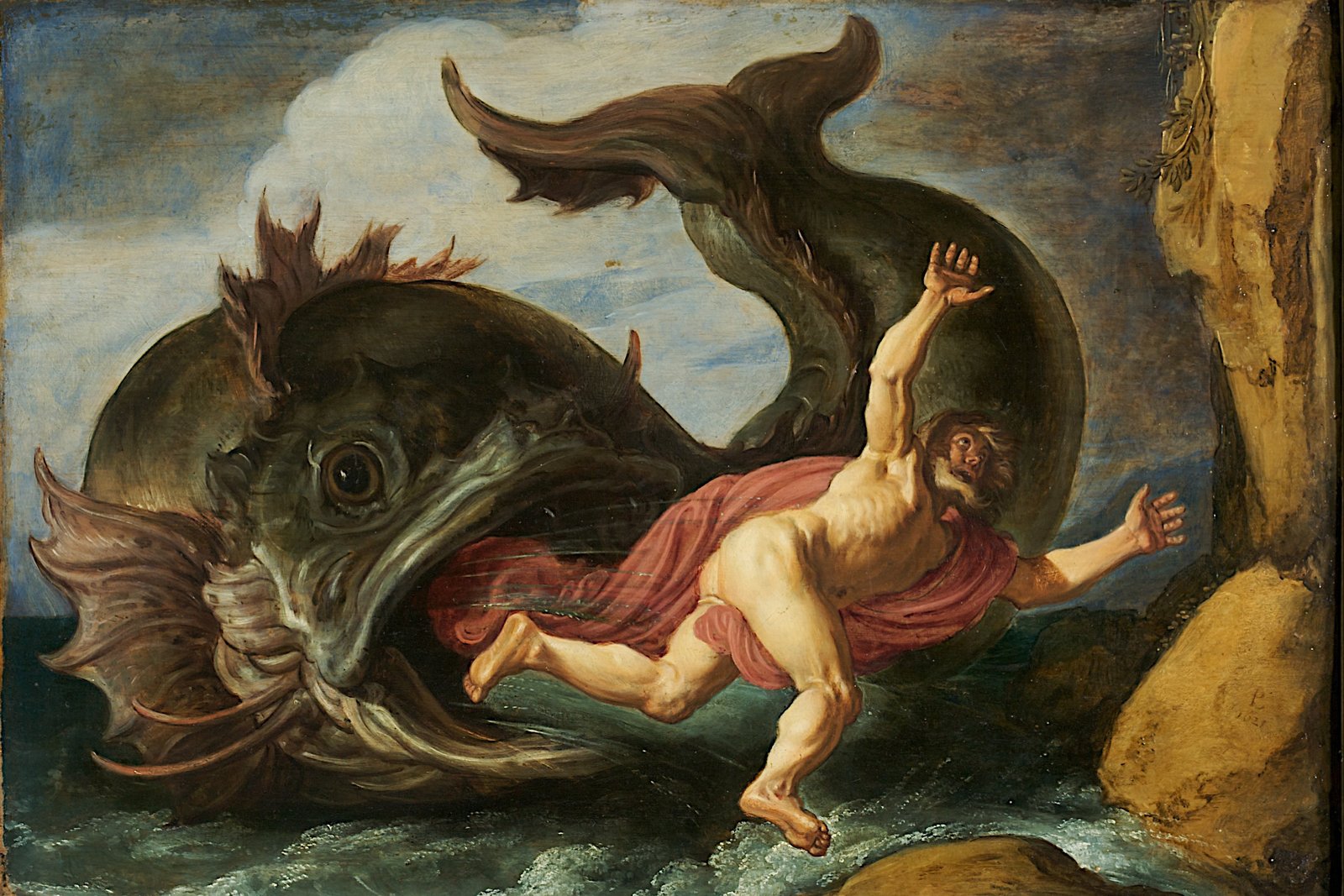
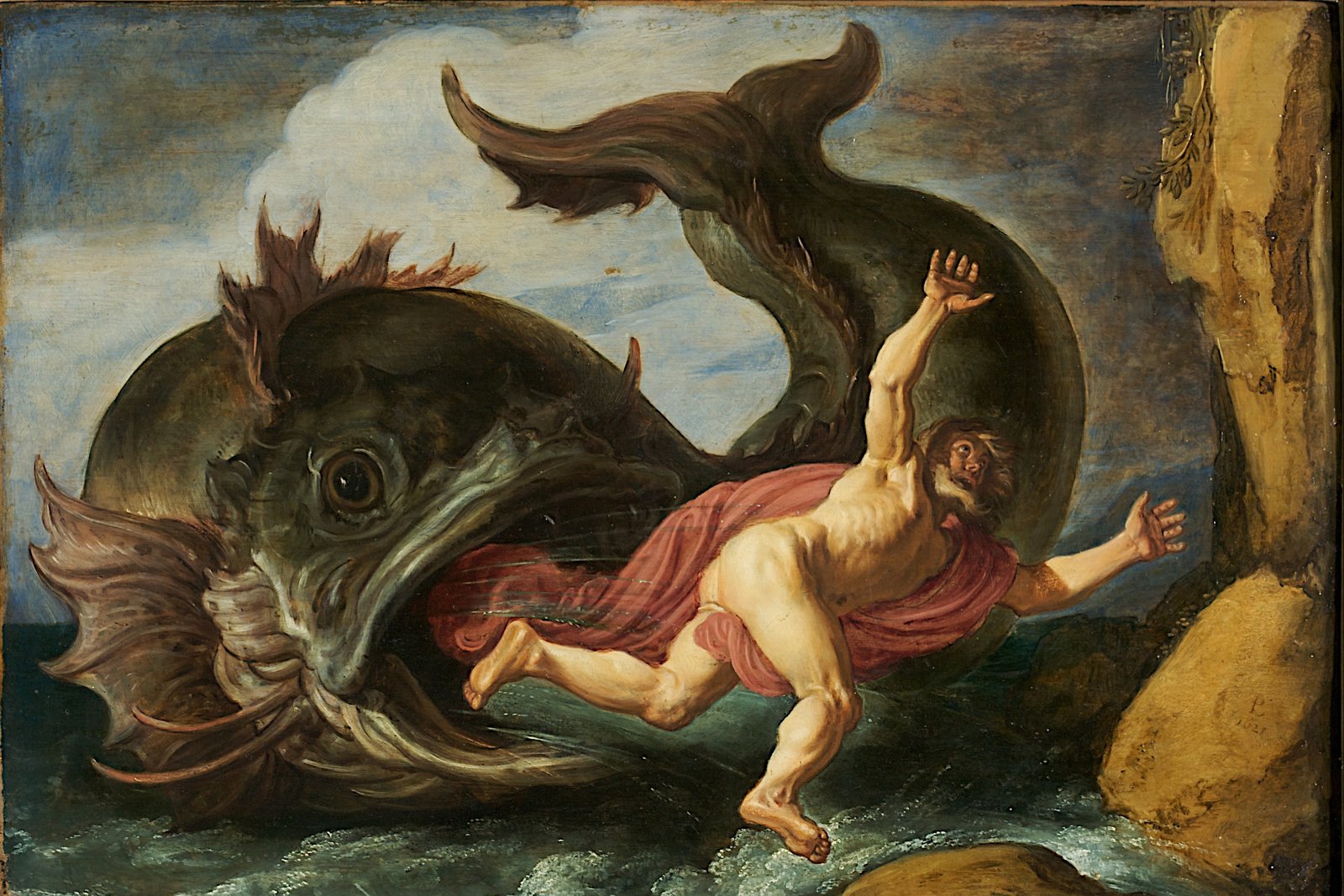
Pieter Lastman, "Jonah and the Whale," 1621, Museum Kunstpalast — public domain.
It doesn't work, of course. "The Lord... hurled a great wind upon the sea, and the storm was so great that the ship was about to break up" (NABRE, Jonah 1:4). While pagan sailors pray frantically to their own gods and throw cargo overboard, Jonah is asleep below deck — a strange, almost comic detail that has puzzled readers for centuries, whether read as exhaustion, denial, or simple resignation. The sailors cast lots to find out who's responsible for their misfortune, and the lot falls on Jonah. He tells them plainly who he is and what he's done, and then instructs them to throw him into the sea to save themselves: "Pick me up and hurl me into the sea and then the sea will calm down for you" (NABRE, Jonah 1:12). Reluctantly, after trying to row back to shore, they do — and immediately "the sea stopped raging" (NABRE, Jonah 1:15).
Three Days in the Deep
"The Lord sent a great fish to swallow Jonah, and he remained in the belly of the fish three days and three nights" (NABRE, Jonah 1:17). From inside it, Jonah prays a psalm of distress and gratitude that reads almost like it was composed for temple worship rather than a fish's stomach: "Out of my distress I called to the Lord, and he answered me; from the womb of Sheol I cried for help, and you heard my voice" (NABRE, Jonah 2:3). He acknowledges he was cast into the deep as consequence for his own flight, yet trusts that God has already begun bringing him back: "You brought my life up from the pit, O Lord, my God" (NABRE, Jonah 2:7). The chapter ends simply: "the Lord commanded the fish to vomit Jonah upon dry land" (NABRE, Jonah 2:11).
Jesus himself later points to this episode as a sign of his own death and resurrection — "Just as Jonah was in the belly of the whale three days and three nights, so will the Son of Man be in the heart of the earth three days and three nights." (Matthew 12:40) — which is part of why the Church has long treated Jonah's ordeal as more than a folk tale, reading it as a real, historically intended event that also carries prophetic, typological meaning pointing toward Christ.
Reluctant Success in Nineveh
God calls Jonah a second time, and this time he goes. Nineveh is described as enormous, "it took three days to walk through it" (NABRE, Jonah 3:3). Jonah barely gets started — one day's walk into a three-day city — and delivers arguably the shortest, least encouraging sermon of any biblical prophet: "Forty days more and Nineveh shall be overthrown" (NABRE, Jonah 3:4). No call to specific repentance, no offer of mercy, just a countdown to destruction.
And yet it works completely. "The people of Nineveh believed God; they proclaimed a fast and all of them, great and small, put on sackcloth" (NABRE, Jonah 3:5). Even the king joins in, stepping down from his throne, dressing in sackcloth, and ordering the entire city — humans and animals alike — to fast and "turn from their evil way and from the violence of their hands" (NABRE, Jonah 3:8). The result: "When God saw by their actions how they turned from their evil way, he repented of the evil he had threatened to do to them; he did not carry it out" (NABRE, Jonah 3:10). By any reasonable measure, Jonah has just delivered history's most successful one-line sermon.
Angrier at Mercy Than at Disaster
Here the book takes its strangest turn. Instead of celebrating, "this greatly displeased Jonah, and he became angry" (NABRE, Jonah 4:1). He finally admits what was behind his flight from the start: "I knew that you are a gracious and merciful God, slow to anger, abounding in kindness, repenting of punishment" (NABRE, Jonah 4:2). Jonah didn't run from Nineveh because he feared failure — he ran because he suspected exactly this outcome, and didn't want Israel's enemies to receive the same mercy Israel itself relied on. He asks God to let him die rather than watch it.
God's response is patient rather than punishing. He asks simply, "Are you right to be angry?" (NABRE, Jonah 4:4), then provides a plant to shade Jonah as he sulks outside the city, only to send a worm to destroy it the next day. Jonah, now baking in the sun, again wishes for death over the loss of a plant he never planted. God presses the point home: "You are concerned over the gourd plant which cost you no effort and which you did not grow... And should I not be concerned over the great city of Nineveh, in which there are more than a hundred and twenty thousand persons who cannot know their right hand from their left, not to mention all the animals?" (NABRE, Jonah 4:10-11).
The book ends there, without telling us whether Jonah's heart ever changed — an open question left deliberately unresolved, aimed less at Jonah than at every reader tempted to want mercy for themselves while begrudging it to others.
Trivia
What is the story of Jonah about?
Why did Jonah flee to Tarshish?
Did Jonah really survive inside a fish?
Why was Jonah angry that Nineveh repented?
What is the lesson of the withered plant in Jonah 4?
You May Also Like

Related Reading