Job: The Man Who Argued with the Whirlwind

A Wager the Sufferer Never Hears About
The Book of Job opens with a scene Job himself never witnesses. In the heavenly court, "the sons of God came to present themselves before the Lord, the satan also came among them" (NABRE, Job 1:6) — a Hebrew term meaning "the accuser" or "adversary," a prosecutorial figure rather than the later fully developed image of Satan as the source of all evil. God points to Job with evident pride: "Have you noticed my servant Job? There is no one on earth like him, blameless and upright, fearing God and avoiding evil" (NABRE, Job 1:8). The satan's challenge cuts straight to the question the whole book will spend forty chapters chewing on: "Is it for nothing that Job is God-fearing?" (NABRE, Job 1:9) — in other words, does Job serve God only because it pays well?
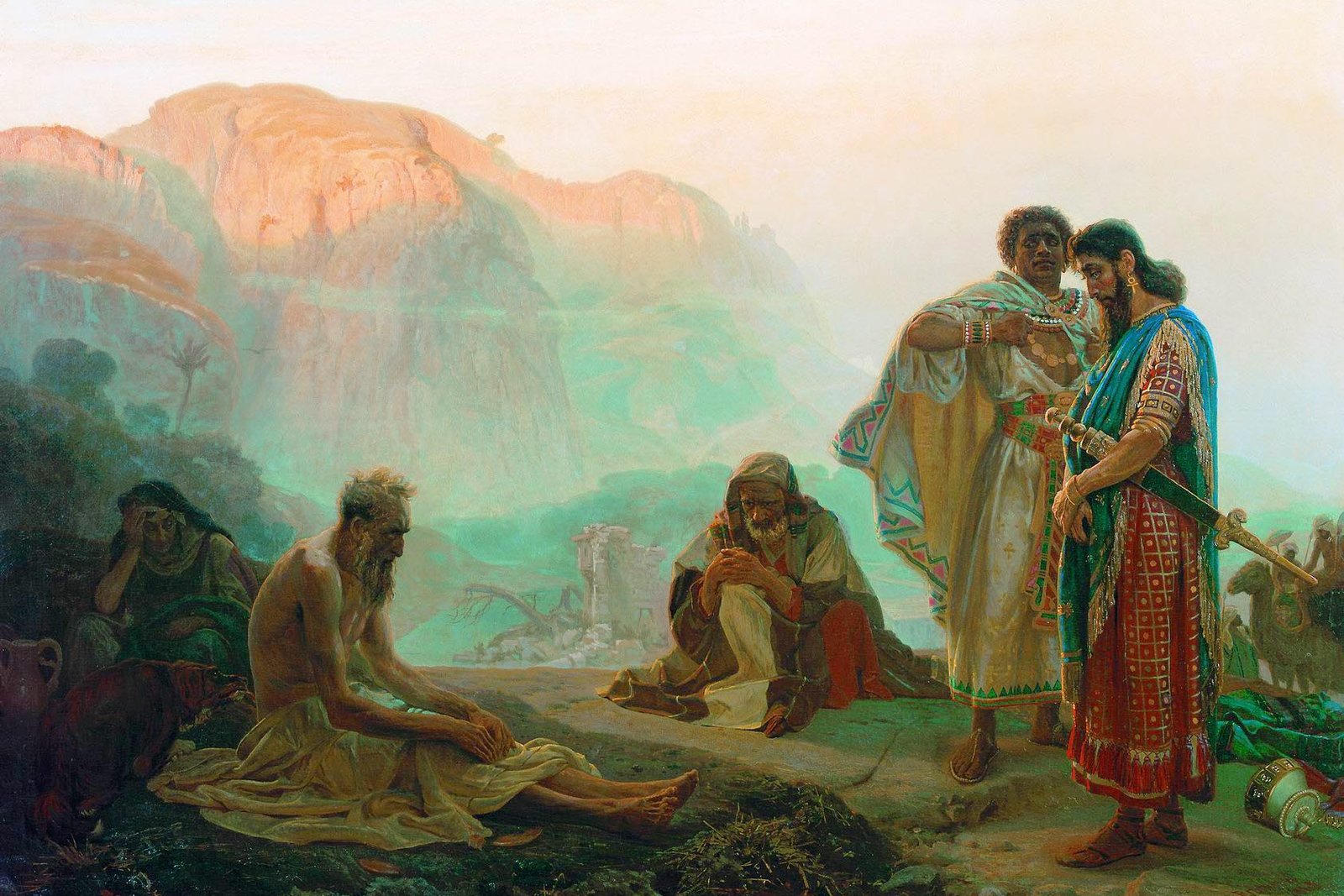
Ilya Repin, "Job and His Friends," 1869, State Russian Museum — public domain.
God permits the test. In a single day, raiders and fire and a collapsing house take Job's oxen, sheep, camels, servants, and all ten of his children. Job's response becomes one of Scripture's most quoted lines of grief and submission at once: "The Lord gave and the Lord has taken away; blessed be the name of the Lord!" (NABRE, Job 1:21). A second round of testing takes his health, covering him in "severe boils from the soles of his feet to the crown of his head" (NABRE, Job 2:7). Even his wife tells him, "Curse God and die!" (NABRE, Job 2:9). Still Job holds on: "Through all this, Job did not sin in what he said" (NABRE, Job 2:10).
Friends Who Sit in Silence, Then Talk Too Much
Three friends — Eliphaz, Bildad, and Zophar — hear what has happened and come to comfort him. Their first instinct is right: they sit with him on the ground for seven days and nights "but none of them spoke a word to him; for they saw how great was his suffering" (NABRE, Job 2:13). It is the moment in the book most people remember favorably about them, and it doesn't last. Once the conversation opens, each friend, in turn, argues a version of the same theology: suffering is the wages of sin, and Job's catastrophe must mean Job has secretly sinned. Round after round, Job insists on his innocence and demands to make his case directly to God rather than accept his friends' assumptions.
The dialogue is long, repetitive by design, and deliberately unsatisfying — the poetry keeps circling the same unresolved question because the book refuses to hand readers a tidy formula for why bad things happen to good people. That refusal is, in a sense, the book's whole point: real suffering does not arrive with a helpful explanatory footnote attached.
An Answer That Isn't an Answer
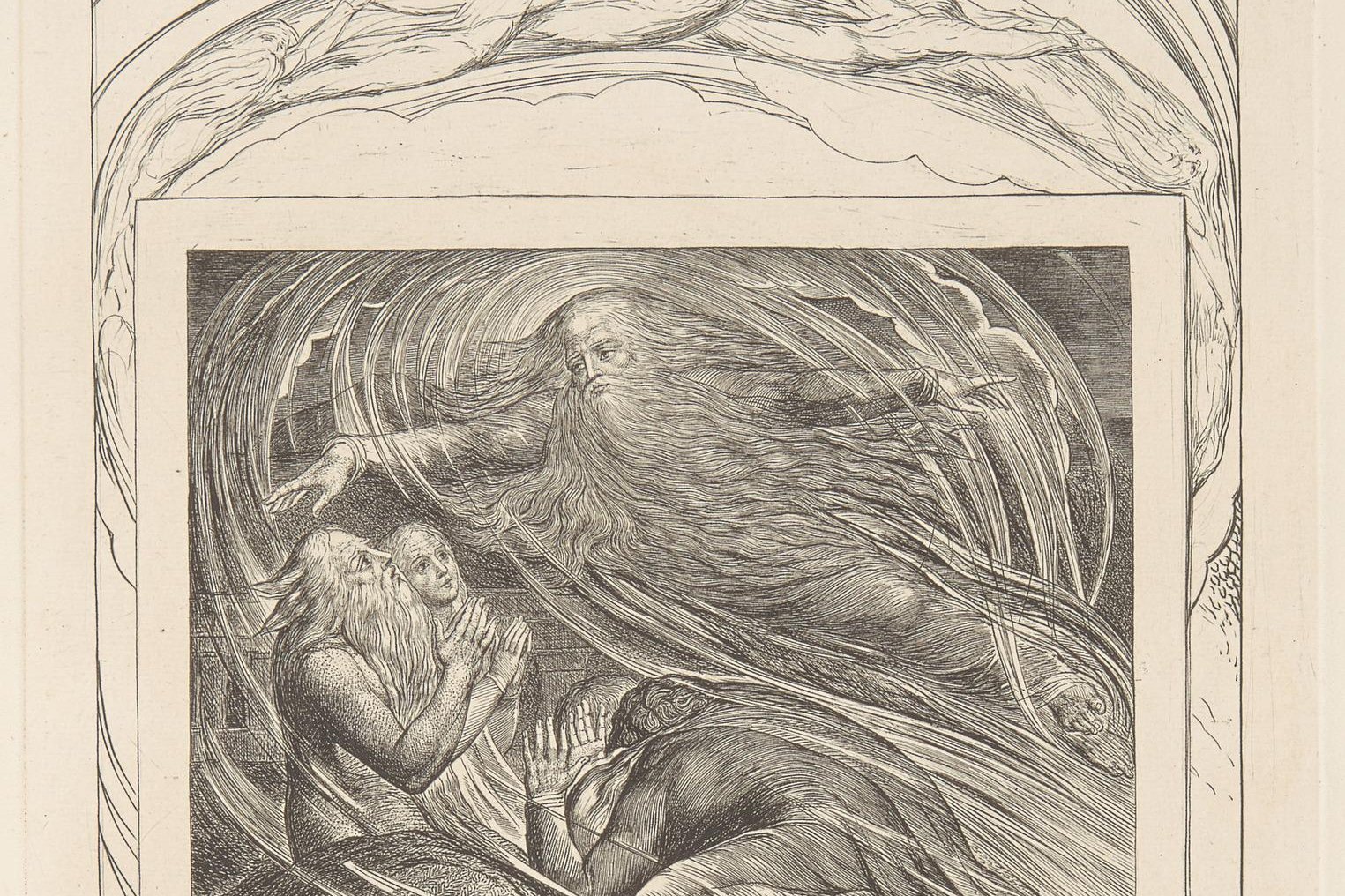
When God finally speaks, "out of the storm" (NABRE, Job 38:1), Job might expect an explanation for everything he's lost. Instead comes a barrage of questions about the created order: "Where were you when I founded the earth? Tell me, if you have understanding" (NABRE, Job 38:4); "Have you entered into the sources of the sea, or walked about on the bottom of the deep?" (NABRE, Job 38:16). Chapters of this continue — questions about constellations, wild goats, the ostrich, the warhorse, the crocodile-like Leviathan — none of it addressing Job's suffering directly.
And yet it works, in its own way. Job answers: "By hearsay I had heard of you, but now my eye has seen you. Therefore I disown what I have said, and repent in dust and ashes" (NABRE, Job 42:5-6). What changes Job is not a reasoned answer to the problem of suffering but an encounter with the sheer scale and mystery of God's ongoing work in the world — a reminder that human categories of fairness and desert are not the only lens through which creation operates. This is the theological heart of the book, and it is worth being honest about what it does and does not claim: it does not say Job's suffering made sense, or that everyone who suffers should expect a whirlwind vision. It offers, instead, the claim that God is present even in unexplained suffering, and that relationship with God can survive without every question being answered.
Vindication, and a Sting for the Friends
The epilogue delivers a sharp reversal. God turns not to Job but to his friends: "My anger blazes against you and your two friends! You have not spoken rightly concerning me, as has my servant Job" (NABRE, Job 42:7). The men who spent the book insisting Job must be guilty are told to bring a sacrifice and ask Job — the sufferer they'd lectured — to pray for their forgiveness. It's a striking inversion: the confident theological explainers are corrected, and the man in ashes is vindicated as the one who spoke rightly about God.
"The Lord also restored the prosperity of Job... the Lord even gave to Job twice as much as he had before" (NABRE, Job 42:10). New children are born, and Job lives to see four generations of his family before he dies "old and full of years" (NABRE, Job 42:17). It is a genuinely happy ending, but the book is careful not to let it retroactively explain the suffering that came before — Job's restoration is a sign of God's faithfulness, not a proof that suffering is always followed by a doubled reward. The book leaves that tension standing, which is precisely why it has remained one of Scripture's most searching meditations on faith tested by an unanswered why.
Trivia
What is the Book of Job about?
Why did Job suffer according to the Bible?
Were Job's friends right that his suffering was punishment for sin?
What does God say to Job out of the whirlwind?
Does Job get his old life back?
You May Also Like

Related Reading