Our Lady of La Salette: Tears on a Mountainside

Two Children on a Mountain
On September 19, 1846, Maximin Giraud, eleven, and Melanie Calvat, not yet fifteen, were tending cattle on the slopes of Mont Planeau above the small village of La Salette in the French Alps. Neither child had a particularly devout upbringing; both were, by their own later accounts, poorly catechized and rough around the edges. That detail matters to how the Church would eventually read the encounter — these were not children primed to invent a pious vision.
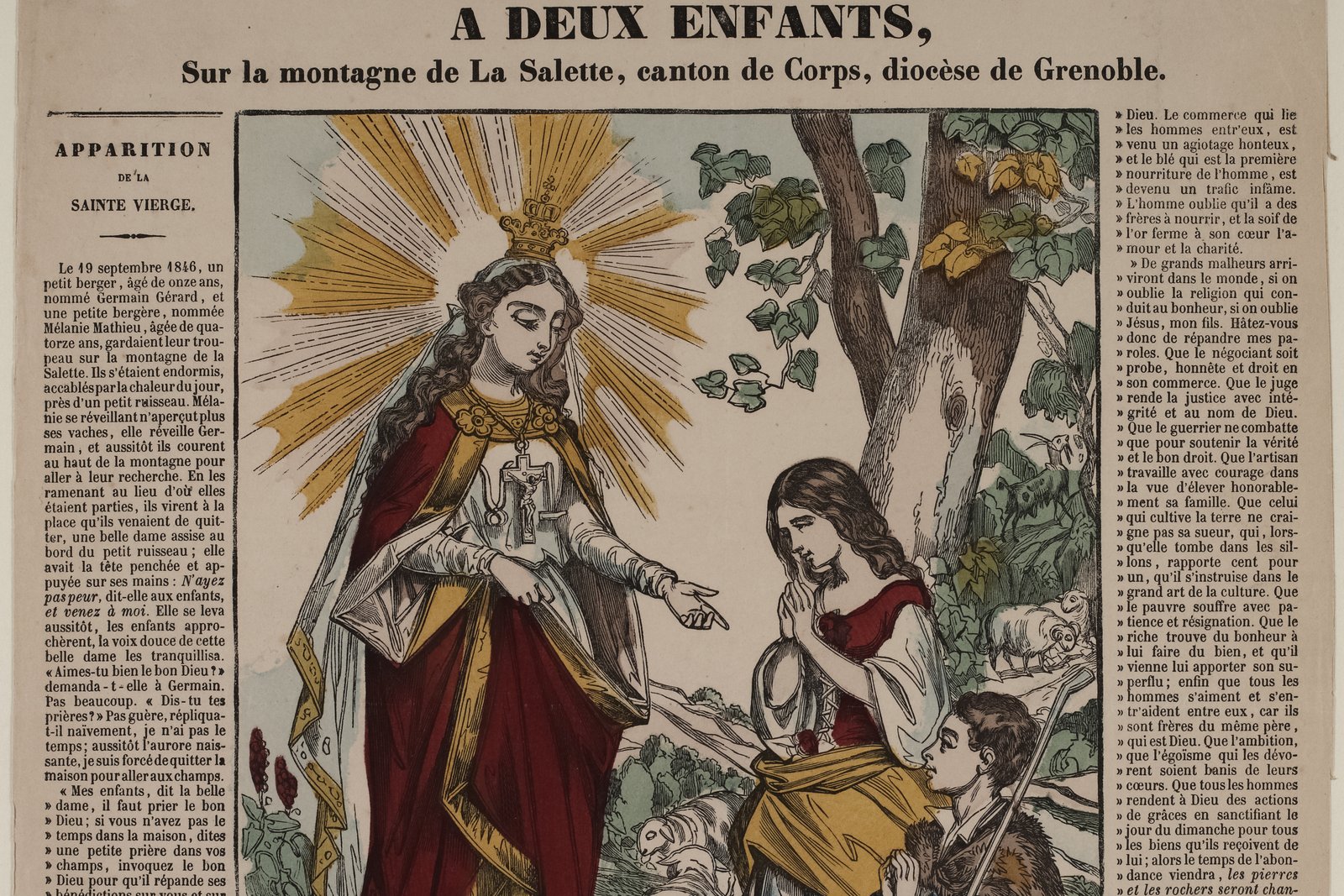
Anonymous engraver, Apparition de la Sainte Vierge a deux enfants, La Salette, Paris Musees — CC0
The two reported seeing a globe of light, and within it a seated woman, her elbows on her knees, her face buried in her hands, weeping. When she stood and spoke, her first words were gentle: "Come closer, my children; don't be afraid." What followed, according to the children's testimony, was not gentle at all — a lament over the state of the world, delivered with visible sorrow rather than anger.
A Weeping Message About Ordinary Neglect
The substance of what the Lady said, as later approved by the Church, was strikingly unspectacular in its subject matter: she grieved over the neglect of Sunday observance and the casual use of God's name in blasphemy, warning that continued unfaithfulness among her people would bring hardship — famine and scarcity are described in the children's accounts — while promising that a return to prayer and repentance would bring relief. It is a message built around the ordinary rhythms of rural Catholic life: attending Mass, keeping the Sabbath, showing basic reverence in speech. There is nothing exotic in the approved core of the La Salette message; its power lies in the image of Mary weeping over precisely these everyday failures, treating them as serious enough to warrant tears.
Before vanishing into the light, she gave each child a private message — a "secret" meant for them alone, which they were told they could reveal only under specific conditions or to specific authorities.
Rome and Grenoble Take It Seriously
Unlike many reported apparitions, which never receive formal Church review, La Salette was investigated methodically. Bishop Philibert de Bruillard of Grenoble ordered a rigorous inquiry into the children's testimony, the physical evidence at the site, and the fruits of the apparition — reports of healings and conversions connected to a spring that began flowing at the location. Five years later, on September 19, 1851, the fifth anniversary of the event, the bishop issued a formal pastoral letter declaring the apparition worthy of belief and authorizing public devotion. It remains, alongside apparitions like Lourdes, one of the relatively small number of Marian apparitions to receive this kind of explicit episcopal approval.
The Disputed Secrets
Here the story becomes more complicated, and it's worth being precise about what is and isn't part of the Church's approval. The bishop's 1851 declaration concerned the apparition itself and its public message — not the content of the private secrets given to Maximin and Melanie. Maximin's secret was eventually published without major controversy. Melanie's was different: over the following decades she released increasingly elaborate versions of her secret, culminating in a 1879 publication containing dense apocalyptic predictions about the Church and the modern world.
Church authorities never granted approval to this expanded text, and various bishops and Roman offices over the years explicitly distanced the Church from it. This is an important distinction for anyone encountering La Salette today: the approved apparition and its core call to conversion stand on solid ecclesiastical footing, while the more sensational "secret" material circulating under Melanie's name belongs to the realm of disputed private writing, never granted the Church's endorsement, and should not be treated as equivalent to Catholic teaching.
What Happened to the Two Children
The rest of Maximin and Melanie's lives make an uneasy postscript to the story, and any honest account of La Salette has to include it. Maximin drifted through a series of unsettled ventures, including a brief attempt at seminary training that did not lead to ordination, and he died in 1875 still publicly affirming what he had seen as a child, though his adult life gave the Church little further to build on. Melanie's path was stranger still: she became a nun for a time under different religious communities, none of which she settled into permanently, and spent much of her later life traveling and publishing further expansions of her "secret," growing more estranged from the guidance of Church authorities the more elaborate her claims became. Neither child's later biography is part of what the Church approved in 1851 — the approval concerns the 1846 event and its public message, not any subsequent behavior or writing by the visionaries, a distinction the Church has had to draw with other approved apparitions as well, since sanctity of message does not guarantee sanctity of the messenger's whole life afterward.
A Spring, a Basilica, and a Long Walk Uphill
Part of what convinced Bishop de Bruillard's investigators that something significant had occurred was a spring of water that began flowing from the apparition site shortly afterward, in a place where the ground had reportedly been dry before. Pilgrims soon reported physical healings connected to drinking or bathing in its water, echoing a pattern that would appear again a dozen years later and much more famously at Lourdes. A basilica was built at the remote mountain site during the following decades to accommodate the growing stream of pilgrims, an impressive feat of construction given the sanctuary's elevation and isolation; even today, reaching it typically means a cable-car ride or a genuinely strenuous climb, a detail that has itself become part of the shrine's character; the pilgrimage to La Salette has never been a casual afternoon outing.
A Shrine That Endures
A religious congregation, the Missionaries of Our Lady of La Salette, was founded to serve the shrine and spread its message, and the mountain sanctuary near Grenoble remains an active pilgrimage destination. What draws people there, across nearly two centuries, is less the mystery of the disputed secrets than the plainer image at the heart of the approved apparition: a weeping mother, asking her children for nothing more dramatic than faithfulness. Readers interested in how the Church has evaluated other reported Marian encounters can find more of them gathered in this blog's overview of Marian apparitions recognized by the Church, alongside the separate story of Our Lady of Lourdes.
Trivia
What happened at La Salette in 1846?
Did the Catholic Church approve the La Salette apparition?
What did Our Lady of La Salette say?
What are the 'secrets' of La Salette?
Where is the La Salette shrine today?
You May Also Like
Related Reading