Saint John I, Pope and Martyr

A pope caught between two powers
By the early sixth century, Rome was no longer the seat of a Western Roman emperor; that empire had collapsed decades earlier, and Italy was now ruled by Theodoric the Great, king of the Ostrogoths, who governed as an Arian Christian over a population that remained predominantly Nicene Catholic — adhering, that is, to the doctrine affirmed at the Council of Nicaea in 325 that the Son is co-eternal and of one substance with the Father, against the Arian view that treated the Son as a lesser, created being. Theodoric's regime was in practice fairly tolerant of this religious divide for most of his reign, allowing Catholic worship to continue largely undisturbed even though he and his Gothic nobility followed a different creed.
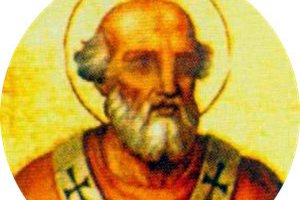
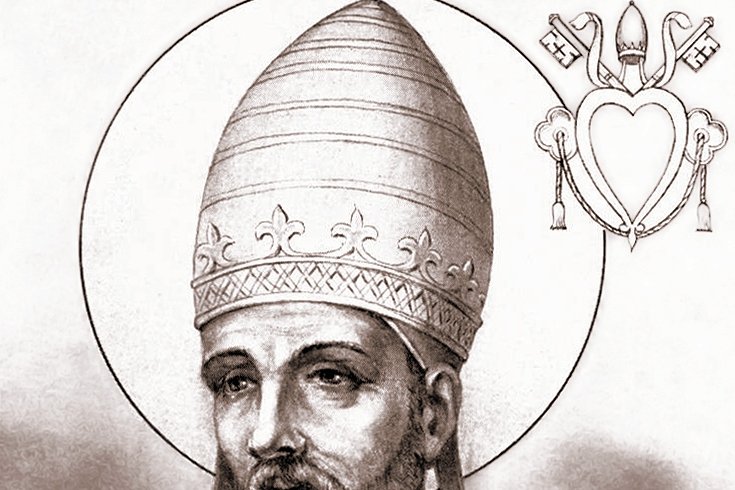
Portrait medallion of Pope John I, Basilica of Saint Paul Outside the Walls, Rome — public domain.
John was elected bishop of Rome in 523, stepping into this delicately balanced arrangement at a moment when it was about to come under serious strain. In the Eastern Roman Empire, centered in Constantinople, the emperor Justin I had begun cracking down on Arian Christians within his own territories, closing their churches and pressuring them toward conversion. Theodoric, as the most powerful Arian ruler in the West, felt the pressure of this policy directly, and in 525 he made an unusual and consequential decision: he ordered Pope John I to travel to Constantinople as his personal envoy, tasked with persuading Justin to ease the restrictions on Arian Christians in the East.
An uncomfortable errand
It was an extraordinary position for a pope to be placed in — sent by an Arian king to negotiate, essentially, on behalf of a rival Christian confession that the pope's own theological tradition considered heretical. John undertook the journey anyway, arriving in Constantinople to a reception of considerable pomp; Byzantine sources describe the emperor and the city's population greeting the bishop of Rome with striking honor, treating his visit as a significant ecclesiastical and diplomatic event in its own right. John, during his time there, also performed the coronation of Justin, a symbolically weighty act reinforcing the continuing prestige Rome's bishop carried even in a city that was, politically, thoroughly Byzantine territory.
The negotiations, though, did not go entirely as Theodoric had hoped. Justin agreed to some concessions but not to the full restoration Theodoric wanted for Arian communities in the East. John began the journey home having achieved a partial success at best — and having, in the process, been treated with a warmth by the Byzantine court that a suspicious mind in Ravenna could easily read as evidence of divided loyalty.
Suspicion, imprisonment, and death
That suspicious mind belonged to Theodoric, whose final years were marked by growing paranoia about conspiracies against Gothic rule, a period during which he also ordered the execution of the philosopher and statesman Boethius on related suspicions of treasonous correspondence with Constantinople. When John returned to Italy, rather than being welcomed for whatever diplomatic ground he had managed to gain, he was arrested on Theodoric's orders and imprisoned in Ravenna, the city that then served as the Ostrogothic capital.
John did not survive the imprisonment. He died in captivity in 526, worn down, contemporary and near-contemporary accounts suggest, by harsh treatment and the conditions of his confinement rather than by formal execution. His body was later returned to Rome and buried in St. Peter's Basilica, and the manner of his death — a bishop of Rome effectively destroyed by the will of a ruler he had been sent, against his own theological convictions, to serve — was enough for the Church to remember him among the martyrs, even though his death came through imprisonment and its consequences rather than a direct sentence for refusing to renounce the faith.
Distinguishing history from later embellishment
As with many figures from this transitional and thinly documented period of Roman history, later medieval accounts added devotional and legendary flourishes to John's story — miracles attributed to him during his imprisonment, for instance, appear in later hagiographical retellings that are not corroborated by the more contemporary Byzantine and Gothic historical sources. The core narrative, though — the mission to Constantinople, the partial diplomatic outcome, Theodoric's suspicion, the imprisonment in Ravenna, and John's death in captivity — rests on reasonably solid historical ground, described by chroniclers writing within decades of the events, including the historian Procopius, who documented the broader political turmoil of Theodoric's final years.
A death that outlived the king who caused it
Theodoric himself died within months of John's death in 526, and Ostrogothic rule over Italy began to unravel not long afterward under his successors, eventually giving way to a long and destructive war with the Byzantine Empire for control of the peninsula. John's death, in that light, reads less as an isolated tragedy than as one early casualty of a much larger and violent transition — the last uneasy years in which an Arian Gothic kingdom and a Nicene Roman Church tried, with steadily diminishing success, to share the same peninsula. What survived from it was not a kingdom, which collapsed within a generation, but a pope's name, kept on the Roman calendar as a reminder that not every early martyr died at the hands of an obviously hostile persecutor — sometimes what ended a bishop's life was simply being caught, honorably and without complaint, between two powers that no longer trusted each other.
Trivia
Why was Pope John I imprisoned?
What is Arianism, and why did it matter to Pope John I's story?
Is Pope John I considered a martyr?
What is Saint John I's feast day?
You May Also Like
Related Reading