Saint Martin I, Pope and Martyr

A pope elected without the emperor's approval
Martin was born in Todi, in central Italy, and served the Roman church as a deacon and papal envoy before his election as pope in July 649. He was consecrated without waiting for the customary imperial confirmation from Constantinople — a break with protocol that already signaled the tension building between Rome and the imperial court, and one the emperor would not forget.
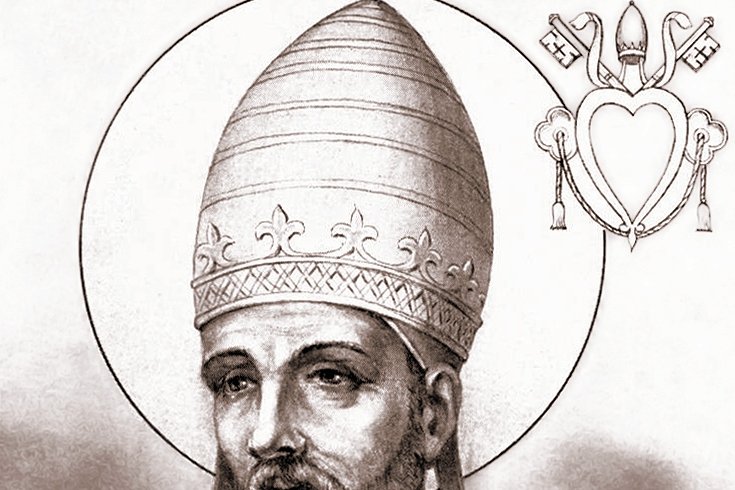
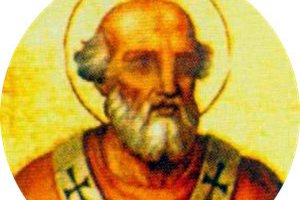
Artaud de Montor, portrait illustration of Pope Martin I, 1842 — public domain
The dispute at the center of Martin's papacy was not a minor point of church administration. It concerned how Christians should understand the person of Christ himself. A century earlier, the Council of Chalcedon (451) had defined Christ as one person with two natures, fully divine and fully human. Some Eastern Christians, known as Monophysites, rejected this teaching, insisting Christ had only a single, divine nature. By the seventh century, the imperial court in Constantinople was promoting a compromise position called Monothelitism — the idea that whatever Christ's two natures, he possessed only a single will — hoping this middle ground might reunite the empire's divided Christian populations at a moment when Byzantine territory was under severe military pressure from the rapid Arab conquests.
The Lateran Council and the Typos
Emperor Constans II had already issued a decree called the Typos in 648, which did not formally endorse Monothelitism but forbade further public discussion of the number of wills in Christ altogether — an attempt to suppress the controversy by silencing both sides. Martin viewed this as a dangerous evasion that let a theologically unsound position stand unchallenged.
Shortly after his election, Martin convened a council at the Lateran Basilica in Rome in October 649, attended by well over a hundred bishops, most from Italy but including delegates and refugee monks from the East, among them Saint Maximus the Confessor, whose own theological arguments shaped much of the council's reasoning. The Lateran Council formally condemned Monothelitism as heresy and, implicitly, condemned the Typos for tolerating it. Martin then circulated the council's decrees widely by letter, making his position unmistakably public — precisely the outcome the emperor's edict had been designed to prevent.
Arrest, trial, and a punishing voyage
Constans II regarded Martin's defiance as a political challenge to imperial authority and, in June 653, sent his official Theodore Kalliopas to Rome with soldiers to arrest the pope. Accounts from those close to Martin describe him seized while gravely ill, reportedly taken from the altar area of the Lateran Basilica itself, and hurried out of the city before Roman crowds sympathetic to him could intervene.
He was shipped first to Naxos in the Aegean, held there for roughly a year, and then transported on to Constantinople, arriving in September 654 after a journey of extreme hardship — later letters attributed to Martin describe near-starvation and filth aboard the ship. In Constantinople he was imprisoned for months, denied adequate food and medical care despite his declining health, and then subjected to a public trial before the Senate that focused almost entirely on alleged political disloyalty to the emperor rather than on the theological questions that had actually divided them. He was formally stripped of his priestly rank, paraded in chains through the city, and condemned to exile rather than execution — a sentence some historians read as a concession to his continuing popularity in Rome and to intervention on his behalf by the sitting patriarch.
Death in exile at Cherson
Martin was exiled to Cherson, a remote outpost on the Crimean peninsula on the northern edge of the Black Sea, arriving in the spring of 655. Letters attributed to him from this period describe severe deprivation — a shortage of food and basic supplies in the region, worsened by local famine, and a sense of abandonment by the church authorities in Rome, who were slow to send aid or even acknowledge his continued legitimacy as pope under pressure from the imperial government. He died there on September 16, 655, worn down by the cumulative toll of imprisonment, the voyage, and the harsh conditions of exile rather than by direct execution — which is why he is venerated as a martyr for the faith he refused to abandon, even though no single act of violence killed him outright.
A dispute the Church would finally resolve
The theological question Martin died defending was not fully settled until 681, when the Third Council of Constantinople met under more favorable political circumstances and formally condemned Monothelitism, affirming that Christ possesses both a divine and a human will in keeping with his two natures — vindicating, a generation later, the position the Lateran Council under Martin had already reached. That later council's decision is regarded as binding church teaching, distinguishing the settled doctrine from the political controversy that had made Martin's own defense of it so costly.
Martin is remembered today as the last of the early Roman pontiffs honored with the title of martyr, closing out a line of martyred popes that reached back to the persecutions of the Church's first centuries, and his story is often paired with that of Saint Maximus the Confessor, the monk-theologian whose arguments shaped the Lateran Council and who suffered his own arrest, trial, and mutilation for the same theological stand only a few years later. His feast, kept every April 13, honors a pope who paid with his life for treating a question about the person of Christ as too important to leave unsettled — even at the express command of the most powerful man in the Christian world.
Trivia
Why was Pope Martin I arrested by the Byzantine emperor?
What happened to Martin I after his arrest?
Is Martin I the last pope venerated as a martyr?
What is Monothelitism, and why did it matter so much?
What is Saint Martin I's feast day?
You May Also Like
Related Reading