Saint Braulio of Zaragoza

A student who became a lifelong correspondent
Braulio was born around 585 in Zaragoza, in the Ebro valley of northeastern Spain, part of the same generation of Visigothic churchmen who came of age as the kingdom completed its shift from Arian to Catholic Christianity, a change Saint Leander of Seville had helped bring about at the Third Council of Toledo in 589, not long before Braulio's own birth. As a young man, Braulio traveled to Seville to study under Isidore, already established as one of the leading intellectual figures of Visigothic Spain, and the relationship that developed between teacher and student became one of the more richly documented friendships of the period, preserved in a substantial surviving correspondence between the two men that continued for the rest of Isidore's life.
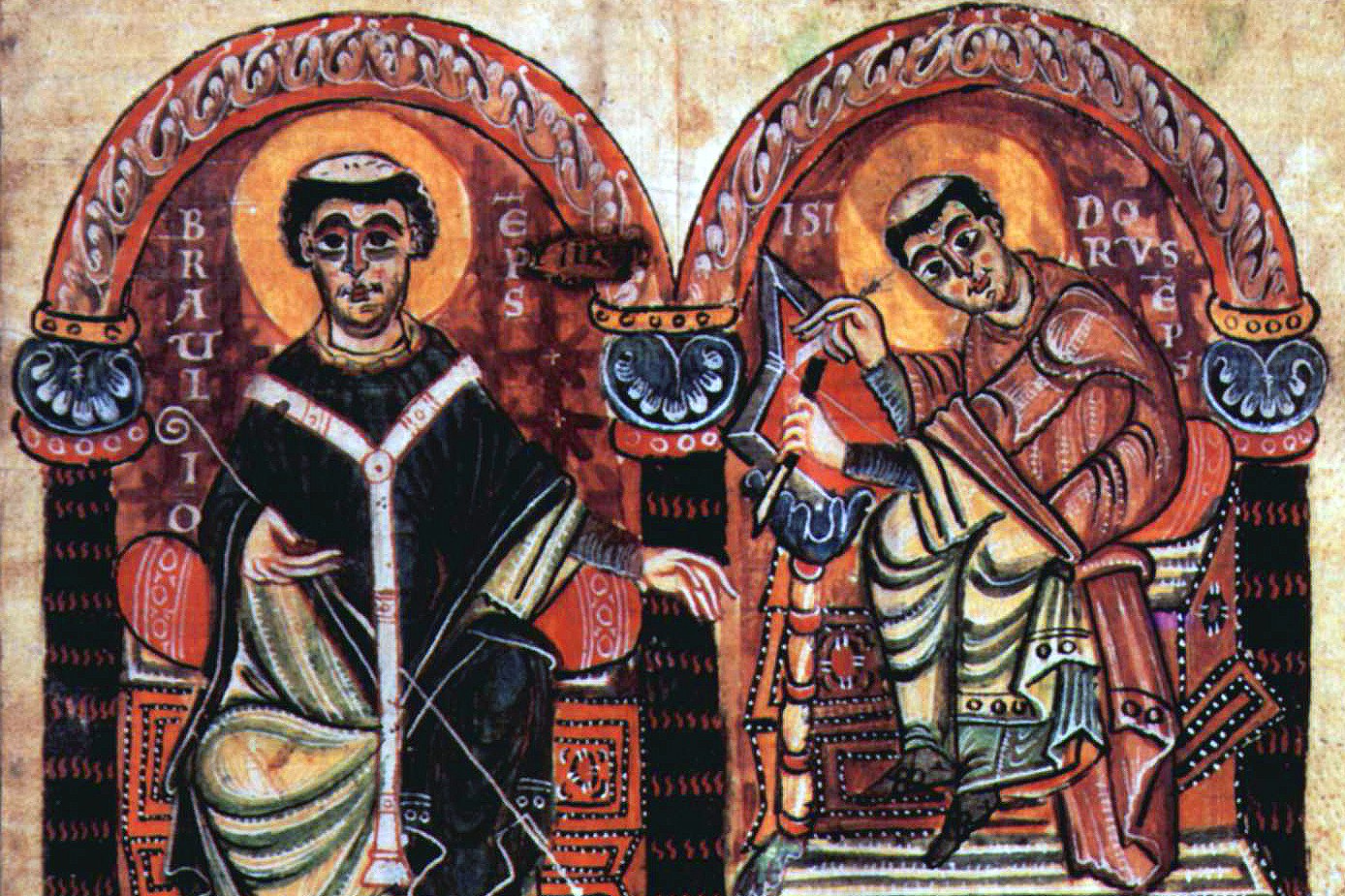
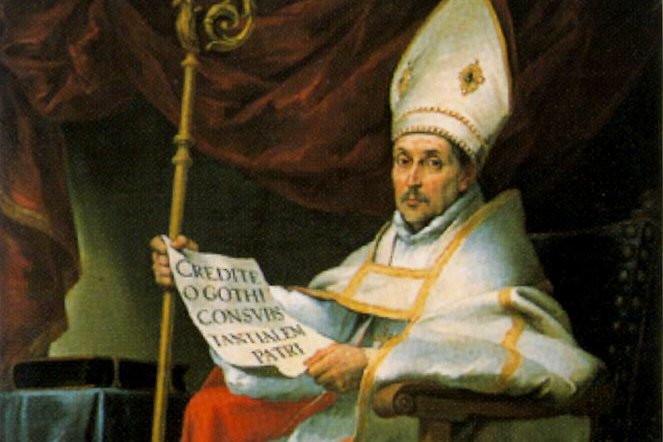
Illuminator of the Ripoll Bible tradition, medieval manuscript miniature of Saints Braulio and Isidore, public domain.
Braulio returned to Zaragoza and was ordained, eventually succeeding his own brother Juan as bishop of the city around 631. From that position, he remained closely connected to Isidore in Seville, and the letters between them — Braulio's side of the correspondence survives more fully than Isidore's replies — show a relationship of real intellectual partnership rather than simple deference from a former student. Braulio pressed Isidore repeatedly, across years of letters, to finish and send him a copy of the sprawling encyclopedic project Isidore had been working on for much of his career: the Etymologiae.
An unfinished encyclopedia and the work of finishing it
The Etymologiae was an extraordinarily ambitious undertaking for its time — twenty books attempting to organize and summarize essentially the whole of available knowledge, from grammar and rhetoric through medicine, law, zoology, geography, and technology, structured around the etymological origins of words as a way of explaining the things those words named. It drew on an enormous range of earlier classical and Christian sources, many of which no longer survive independently, which is part of why the Etymologiae became so valuable to medieval readers: it preserved, in condensed form, knowledge that would otherwise have been lost when the original works it summarized disappeared.
Isidore died in 636 with the work still not fully finished or organized to his own satisfaction — by Braulio's own account, Isidore had been reluctant to release it in its incomplete state despite years of Braulio's urging. After Isidore's death, Braulio took on the task of putting the manuscript into final, publishable order, dividing the material properly into its twenty books and arranging for its circulation. Without that editorial work, historians generally agree the Etymologiae might well have remained a scattered, unfinished set of notes rather than the coherent reference work that went on to become one of the most widely copied books of the entire medieval period, cited and excerpted by scholars across Europe for the following thousand years.
Braulio also wrote a short biographical listing of Isidore's works shortly after his death, known as the Renotatio, which remains one of the primary sources modern scholars use to establish which works are genuinely Isidore's — a scholarly service quietly as valuable, in its way, as the editorial work on the Etymologiae itself.
A network of Visigothic scholarship
Braulio's correspondence extended well beyond Isidore alone, and taken together it offers historians a genuinely valuable window into how a small, tightly connected network of Visigothic churchmen exchanged texts, questions, and encouragement across considerable distances in a period when book production and copying were slow, expensive undertakings. Manuscripts moved between Zaragoza and Seville, and later between Zaragoza and other sees, carried by messengers over routes that could take weeks, with Braulio frequently requesting or lending specific texts, correcting copies, and discussing points of doctrine and interpretation with correspondents who took the exchange every bit as seriously as he did. This kind of sustained, literate exchange between churchmen in different Spanish cities is part of what allowed Visigothic intellectual culture to remain as coherent and cumulative as it did, even without anything resembling a centralized university system.
A bishop at the center of Visigothic church and state
Braulio's own career extended well beyond his connection to Isidore. As bishop of Zaragoza for roughly two decades, he was active in the national Church councils that continued to shape Visigothic religious and legal life through the seventh century, and he maintained close ties to the royal court, reportedly serving as an advisor to King Chindasuinth on matters that included both Church affairs and questions of royal succession — a level of political influence not unusual for major Visigothic bishops of the period, but well documented in Braulio's specific case through his surviving letters. He also wrote a Life of Saint Emilian, the Spanish hermit known as San Millán de la Cogolla, based partly on eyewitness testimony Braulio had gathered himself, another example of his consistent interest in preserving accurate records of people and knowledge that might otherwise be lost.
Braulio died in 651, having spent two decades as bishop of Zaragoza and, in the process, secured the survival and spread of one of the defining intellectual achievements of the early medieval Latin world. His feast is kept on March 26. Among the network of Visigothic bishops who kept scholarship and Church governance alive through a genuinely difficult period of Spanish history, Braulio's specific and lasting contribution was making sure his teacher's greatest work reached the readers who would spend the next thousand years learning from it.
Trivia
Who was Saint Braulio of Zaragoza?
What is the Etymologiae, and what did Braulio do for it?
What was Braulio's relationship with Isidore of Seville?
What did Braulio do as bishop of Zaragoza?
When is Saint Braulio's feast day?
You May Also Like
Related Reading