Saint Callistus I, Pope and Martyr

A slave's unlikely road toward the papacy
Almost everything known about the early life of Callistus comes from a single hostile source: the Refutation of All Heresies, a work attributed to his theological rival Hippolytus, who despised Callistus and wrote his account with clear polemical intent. Historians treat the details with appropriate caution, but the broad outline is generally accepted, and it is a remarkable one regardless of who is telling it.
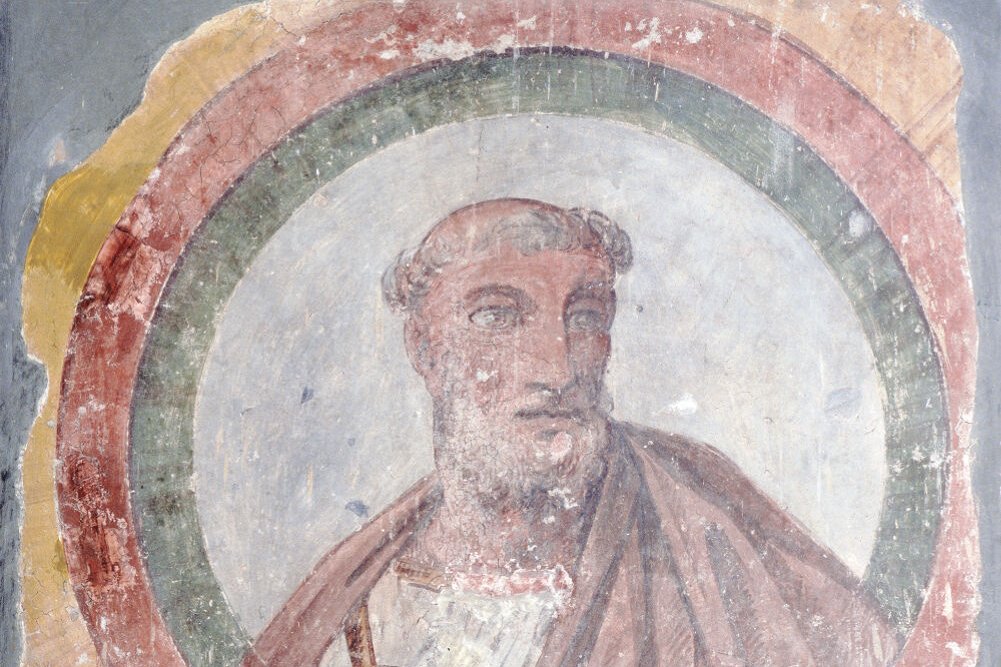
Anonymous, ancient fresco medallion, c. 450 AD, Basilica of St Paul Outside the Walls — public domain.
Callistus began life as a slave in the household of a Roman Christian named Carpophorus, who entrusted the young man with managing a banking operation on his behalf, likely a fund into which fellow Christians and widows deposited their savings. The venture failed, and the deposited money was lost, whether through mismanagement, fraud, or simple bad luck depends on which account one credits. Callistus fled Rome to escape his master's anger but was caught attempting to board a ship at the port of Portus. According to Hippolytus's account, he then caused a disturbance at a synagogue while attempting to collect debts from Jewish creditors, which led to his arrest by Roman authorities and, eventually, a sentence of hard labor in the mines of Sardinia, one of the harshest punishments the Roman penal system could impose on a man of his low legal status.
His release came through an unlikely intervention: Marcia, a mistress of the Emperor Commodus who had Christian sympathies, arranged for the release of a group of Christian prisoners from the Sardinian mines around the year 190, and Callistus's name appeared, whether by design or oversight, among those freed.
From deacon to bishop of the city where he had once been a convict
Freed but not fully rehabilitated, Callistus was for a time kept at a distance from Rome by Pope Victor I, who provided him with a modest pension in Antium rather than allowing him to resume public life in the capital immediately. That changed under Victor's successor, Pope Zephyrinus, who brought Callistus back to Rome and ordained him a deacon, entrusting him with a task that would leave a lasting physical mark on the city: administration of the Christian burial ground on the Appian Way that would come to be known as the Catacomb of Callixtus. Under his management, the catacomb grew into one of the largest and most important official Christian cemeteries in Rome, eventually becoming the resting place of numerous third-century popes and giving the site the name it still carries today.
When Zephyrinus died around 217, Callistus was elected to succeed him as Bishop of Rome, an extraordinary trajectory for a man who had begun adult life in chains and spent years condemned to one of the empire's most punishing forms of forced labor.
The mercy that scandalized Rome's rigorists
Callistus's papacy is remembered chiefly for a set of disciplinary decisions that reshaped how the Church of Rome handled serious sin. Prior to his pontificate, many Christian communities treated certain grave sins, particularly adultery, murder, and apostasy, as effectively unforgivable within the visible Church, permanently excluding those guilty of them from full communion even after evident repentance. Callistus extended the Church's power to absolve these sins, allowing sinners who underwent a period of penance to be formally reconciled and readmitted to communion.
This mercy-oriented approach drew fierce criticism from stricter factions within the Roman clergy, chief among them Hippolytus, a learned and influential presbyter who regarded Callistus's policies as a dangerous laxity that would corrode the moral seriousness of the Christian community. The dispute grew serious enough that Hippolytus is generally regarded by historians as the first antipope, having allowed himself to be set up as a rival bishop of Rome in opposition to Callistus and his two immediate successors, a schism that lasted for roughly two decades before Hippolytus was reconciled to the Church shortly before his own martyrdom.
Martyrdom and lasting influence on canon law
Details of Callistus's death are sparse and layered with later tradition, but the most widely accepted account holds that he was killed during a local uprising or riot in Rome's Trastevere district, possibly thrown from a window or down a well by a hostile crowd, sometime around 222. Whatever the precise circumstances, the early Church remembered him as a martyr, and he was buried not in his own catacomb on the Appian Way but in the nearby Cemetery of Calepodius, a detail some historians connect to the suddenness or irregularity of his death.
Callistus's real and lasting influence lies less in the drama of his biography than in the precedent his papacy set for how the Church would handle sin, repentance, and reconciliation, a foundational question for what would eventually develop into the Church's formal theology and canon law surrounding the sacrament of penance. His willingness to extend mercy to serious sinners, over the objections of rigorist critics who wanted a smaller, purer, more exclusive Church, anticipated a pastoral instinct that would recur throughout Christian history whenever the tension between discipline and mercy resurfaced. His feast day is celebrated on October 14.
Trivia
Who was Saint Callistus I and when was he pope?
Why was Callistus imprisoned before becoming pope?
What controversial policy is Callistus best known for?
What is the Catacomb of Callixtus?
How did Callistus die, and what is his feast day?
You May Also Like
Related Reading