Saint Raymond of Penyafort, Priest

A lawyer's son who chose the Church
Raymond was born around 1175 near Barcelona, into a noble Catalan family with connections, according to later tradition, to the ruling house of Aragon. He showed an early aptitude for study and pursued formal training in both civil and canon law at Bologna, then the leading center in Europe for legal education — a discipline that would shape virtually everything he accomplished across the rest of his long life. He taught law at Bologna for a period before returning to Barcelona, where he served as a canon at the cathedral and built a reputation as a skilled, principled jurist rather than a mere academic specialist.
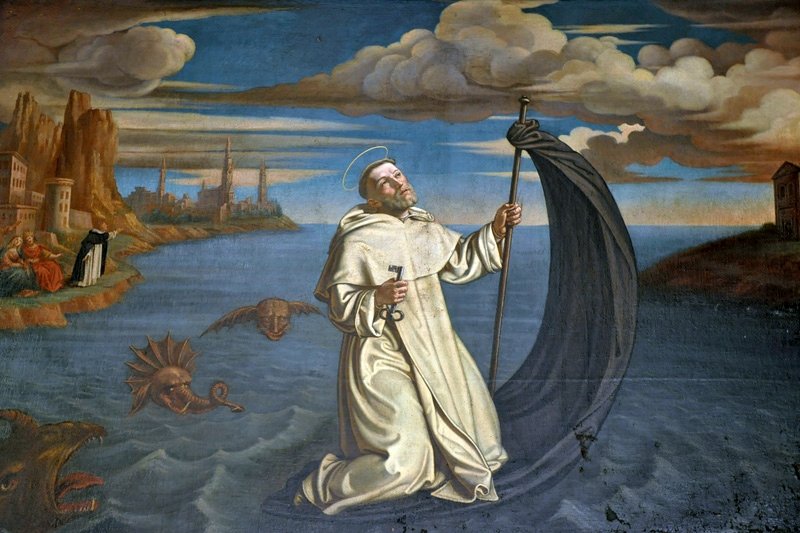
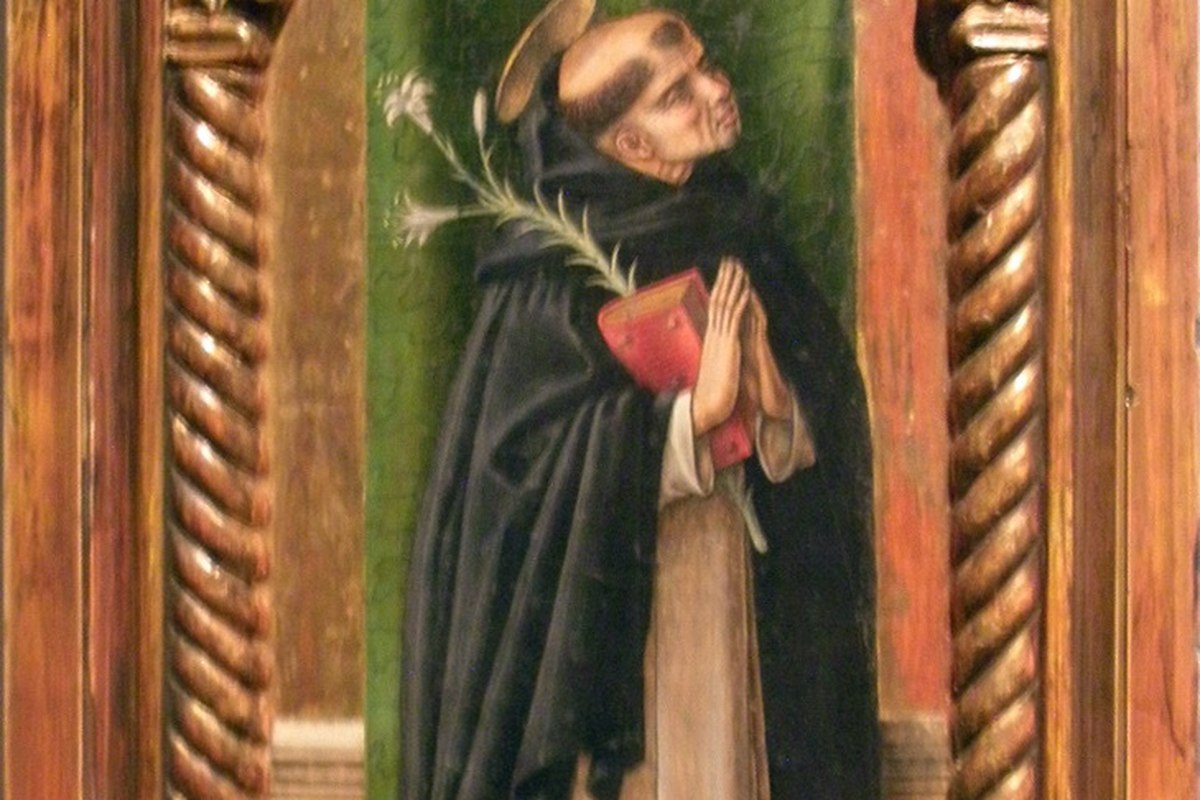
Tommaso Dolabella, Saint Raymond of Penyafort, 1627 — public domain
In his mid-forties, already an established legal scholar with a comfortable position, Raymond made a decision that surprised many around him: he joined the recently founded Dominican Order, choosing the life of a mendicant friar over the more secure ecclesiastical career his legal training had already opened to him. The Dominicans, a preaching order founded barely a few years earlier by Saint Dominic, placed heavy emphasis on study, preaching, and pastoral care — a combination that suited a man who had spent his career untangling complicated texts and would soon be asked to untangle a much larger one.
The pope's assignment: organize seven centuries of law
By the time Raymond entered religious life, canon law — the Church's own body of legal rulings governing everything from marriage cases to clerical discipline — had grown into an unwieldy sprawl. Popes and councils had issued rulings for centuries, and while earlier scholars had made partial attempts at compilation, no single, authoritative, well-organized reference existed. Anyone needing to resolve a real legal question — a bishop, a judge in an ecclesiastical court, a university lecturer — had to hunt through scattered, sometimes contradictory sources with no reliable index.
Pope Gregory IX, who had summoned Raymond to Rome to serve as his confessor and chaplain, recognized both the scale of the problem and Raymond's unusual qualification to fix it. In 1230, he commissioned Raymond to produce an official, systematic compilation of canon law. The result, known as the Decretals of Gregory IX or the Liber Extra, organized the material into five structured books covering courts, clergy, marriage, crime, and legal procedure — a framework clear enough that jurists across Europe could actually use it in practice, rather than merely admire it as a reference work. Promulgated by the pope in 1234, it became binding law throughout the Western Church and remained an official source of canon law for nearly seven centuries, until the Church's first fully modern Code of Canon Law replaced it in 1917.
That kind of durability is rare for any legal text, secular or ecclesiastical, and it reflects something about how Raymond approached the work: not simply gathering documents, but genuinely restructuring them into something usable by working clergy and judges who needed clear answers, not an archive.
Ransoming captives and shaping a missionary theology
Raymond's legal work was not the whole of his ministry. In an era when Christian captives were regularly taken and held for ransom along the contested frontiers between Christian and Muslim territory in Spain and North Africa, Raymond became closely involved in efforts to free them. He is counted among the co-founders, alongside Saint Peter Nolasco, of the Mercedarian Order — formally the Order of Our Lady of Mercy for the Redemption of Captives — a religious community whose members took a distinctive additional vow: to offer themselves as hostages in exchange for captives if ransom funds ran out.
Raymond also played a quieter but consequential role in the intellectual life of the Church through a request he made to a much younger Dominican confrere: he asked Thomas Aquinas to write a systematic work that could serve missionaries preaching to Muslims and Jews in Spain, a request that led to Aquinas's Summa Contra Gentiles. It's a small footnote in most accounts of Aquinas's towering career, but a telling one about Raymond — a man well past his own most productive scholarly years who recognized talent in a younger colleague and pointed it toward a concrete pastoral need rather than letting it go untasked.
Leading the Dominicans, then stepping back
In 1238, Raymond was elected Master General of the Dominican Order, the office once held by its founder. He used the position to revise and clarify the order's constitutions, bringing the same organizing instinct he'd applied to canon law to the governance of his own religious community. But he held the office only briefly — within two years he resigned, citing his advanced age, and returned to Barcelona, where he continued working, preaching, and serving as a confessor and advisor for several more decades.
By most accounts he lived to nearly one hundred years old, an extraordinary lifespan for the 13th century, dying in Barcelona on January 6, 1275. His feast is now kept on January 7 in the current Roman calendar. He was canonized in 1601, and the Church later named him patron saint of canon lawyers, and more broadly of lawyers as a profession — a recognition that traces directly back to the legal work that occupied so much of his long life. Readers interested in another churchman whose administrative skill left a lasting institutional legacy might also find Saint Basil the Great, who built an entire charitable complex outside Caesarea, worth reading next — a very different kind of organizational genius put in service of the same Church.
Trivia
Who was Saint Raymond of Penyafort?
What was the Decretals of Gregory IX?
Why is Raymond of Penyafort the patron saint of lawyers?
Did Raymond of Penyafort do more than legal work?
When is the feast day of Saint Raymond of Penyafort?
You May Also Like
Related Reading