Saint Swithun of Winchester

A trusted bishop in Alfred's England
Swithun became bishop of Winchester around 852, at a time when the kingdom of Wessex was the dominant power among the Anglo-Saxon kingdoms and Winchester itself was becoming one of its most important religious and political centers. He served under King Æthelwulf, father of the future King Alfred the Great, and tradition credits him with acting as a close advisor to the king, including reportedly accompanying Æthelwulf on a pilgrimage to Rome in 855 — a significant undertaking for an Anglo-Saxon monarch and a sign of how closely Swithun's episcopal career was bound up with the royal court.
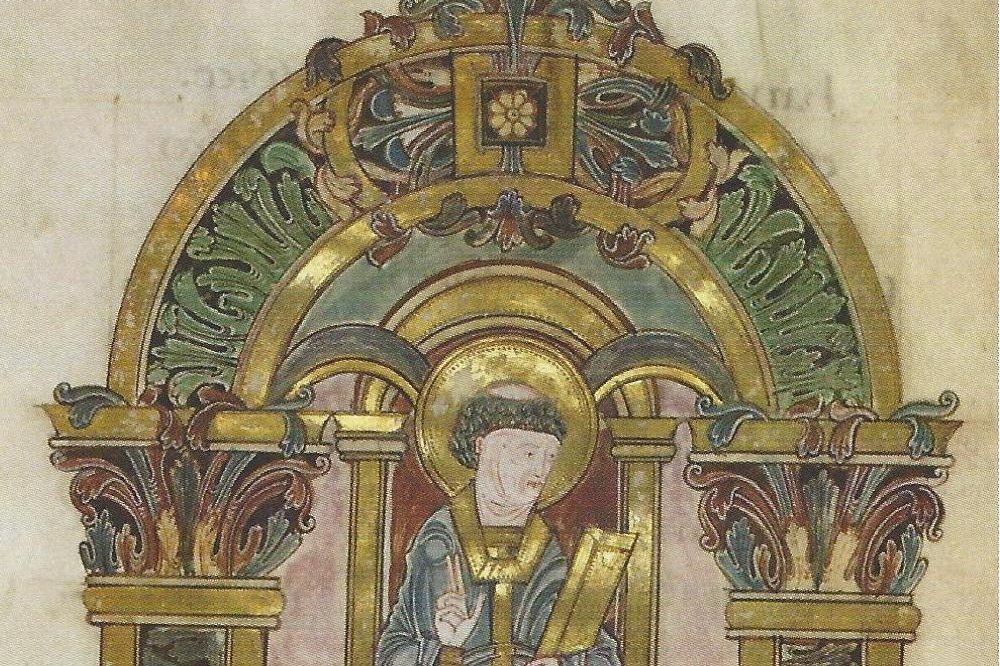
Anonymous, portrait of Saint Swithun, Benedictional of Æthelwold, c. 970s, British Library, Ms Add. 19598 — public domain.
Relatively little survives in the way of detailed contemporary documentation about Swithun's specific acts as bishop — no dramatic confrontations or theological controversies attached to his name, the way they are for some of his better-documented contemporaries. What survived instead, and what shaped his later reputation more than anything else, was the manner of his death and burial.
A deliberately humble grave
Swithun died around 862 and, according to consistent tradition, left instructions that he be buried not inside the church in the manner customary for a bishop of his standing, but outside, in the ordinary churchyard — a spot exposed to the weather and to the feet of ordinary people walking past. It was understood, even at the time, as a deliberate act of humility: a bishop choosing the same simple treatment in death that any ordinary member of his flock would receive, rather than the honored interior tomb his office would normally have earned him.
For just over a hundred years, that wish was respected. Swithun's reputation for holiness grew steadily during this period, aided by reports of miracles associated with his grave, until by the mid-tenth century church authorities in Winchester judged that so celebrated a figure deserved a more fitting resting place.
The translation of 971 and a lasting legend
On July 15, 971, Swithun's remains were formally moved from the churchyard into the interior of the Old Minster at Winchester — an act known as a translation, the standard medieval process for elevating a locally venerated figure toward more formal recognition as a saint. According to the tradition that grew up around the event, heavy rain fell either on the day of the translation itself or across the surrounding weeks, an occurrence later generations reinterpreted as a kind of protest from beyond the grave against the disturbance of the humble burial he had specifically requested.
Out of that reported downpour grew one of the most persistent pieces of English weather folklore: the belief that whatever the weather is on Swithun's feast day, July 15, it will continue unchanged for the following forty days. The rhyme built around the legend — "St. Swithun's Day, if thou dost rain, / For forty days it will remain" — has been recited in England for centuries. It should be understood plainly as folk tradition rather than anything resembling documented meteorological fact or Church teaching; no statistical study has ever found the pattern holds true, and the Church's own veneration of Swithun rests on his life and reputed miracles, not on English weather patterns.
Æthelwold's reform and a saint made useful
Swithun's rapid rise from a quietly regarded ninth-century bishop to one of Wessex's most celebrated saints owes a great deal to Bishop Æthelwold, who took charge of Winchester roughly a century after Swithun's death and became one of the leading figures of the wider tenth-century English Benedictine reform movement, alongside Dunstan of Canterbury and Oswald of Worcester. Æthelwold was rebuilding Winchester's religious life around strict monastic observance, and a locally venerated bishop whose grave had already developed a reputation for miracles was exactly the kind of figure a reforming bishop needed: a homegrown saint who could anchor the cathedral's prestige and draw pilgrims, without requiring an appeal to relics imported from elsewhere. The 971 translation that made Swithun famous was staged, in other words, at the deliberate high point of a broader campaign to remake Winchester into one of reformed Anglo-Saxon monasticism's central showcases — the same context that produced the Benedictional of Æthelwold itself, the lavish manuscript this article's hero image comes from.
Feast day and iconography
Swithun's feast is kept on July 15, marking the translation rather than his death, which is itself a telling detail about how much his later medieval reputation was shaped by that specific event rather than by the details of his life as bishop. In art, he is typically shown in full episcopal vestments, sometimes holding a broken pot of eggs — a reference to a separate miracle story in which he is said to have restored a basket of eggs an old woman had accidentally dropped and shattered.
The tenth-century illuminated manuscript portrait that anchors this article, from the Benedictional of Æthelwold — a lavishly illustrated liturgical book made for a later bishop of Winchester — is among the oldest surviving depictions of Swithun, produced within living memory of the very translation that made him famous.
An Anglo-Saxon saint among many
Swithun's story fits within a rich tradition of Anglo-Saxon episcopal sanctity, in which bishops were remembered as much for personal humility and pastoral care as for dramatic missionary exploits. Readers interested in this broader tradition of English saints from the same general era may also want to read about Saint Etheldreda of Ely, an East Anglian royal abbess whose reputation for sanctity, like Swithun's, was cemented by what happened to her remains after death, or Saint Aidan of Lindisfarne, whose earlier missionary work in Northumbria helped lay the foundations for the kind of settled, locally rooted episcopal Christianity that Swithun himself represented two centuries later in Wessex.
Trivia
Who was Saint Swithun of Winchester?
What is the legend of St. Swithun's Day and the weather?
Is the St. Swithun's Day weather legend scientifically or historically accurate?
Why did Saint Swithun ask to be buried outside?
When is the feast of Saint Swithun celebrated?
You May Also Like

Related Reading