Saint John of Capistrano, Priest

A lawyer's career cut short by captivity
John of Capistrano was born in 1386 in the small town of Capestrano in the Abruzzo region of central Italy, the son of a German knight who had settled in the area. He trained in civil and canon law, a discipline that suited his sharp, orderly mind, and rose quickly through the ranks of civil administration, eventually becoming governor of the city of Perugia while still a relatively young man, a position that placed considerable legal and political authority in his hands.
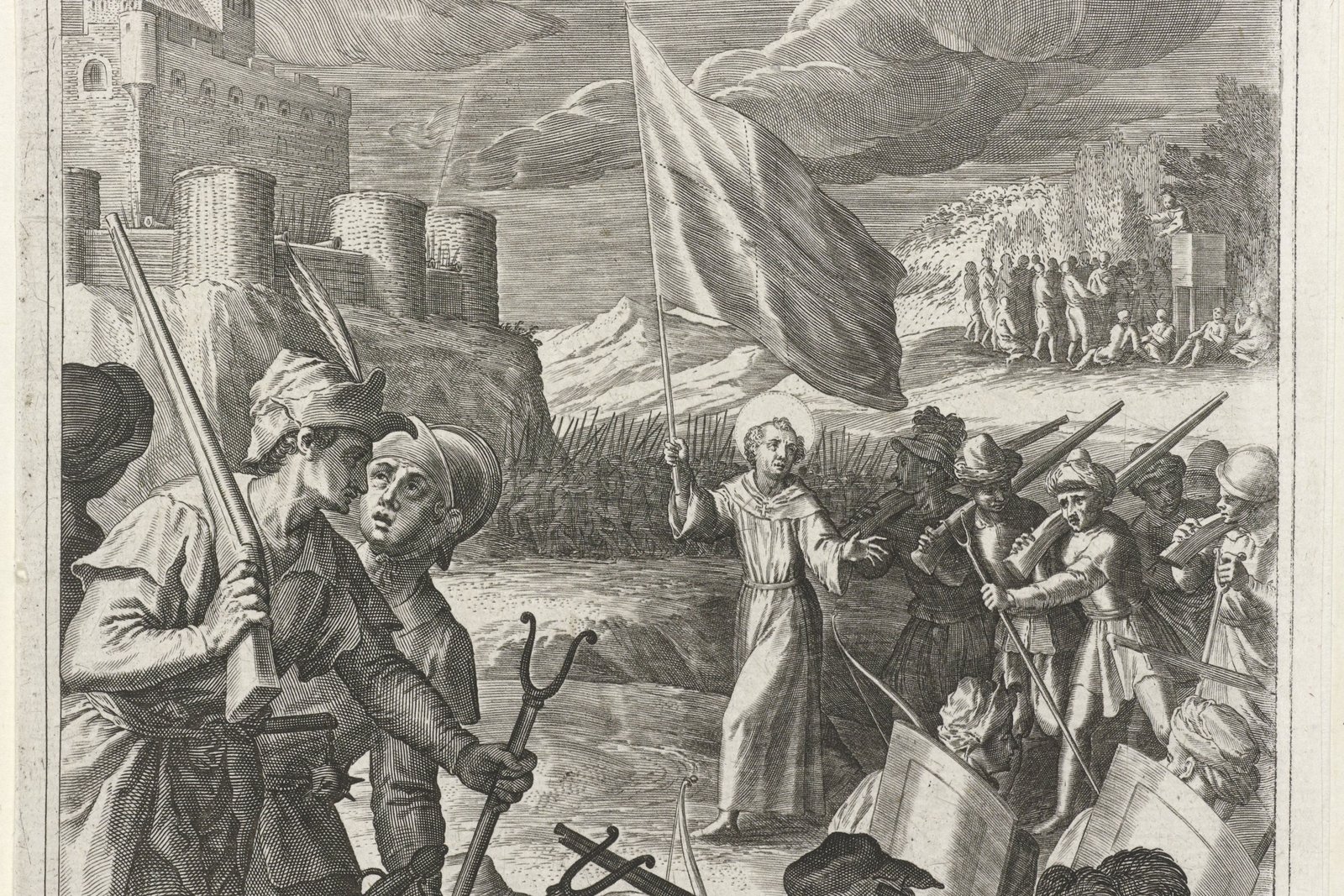
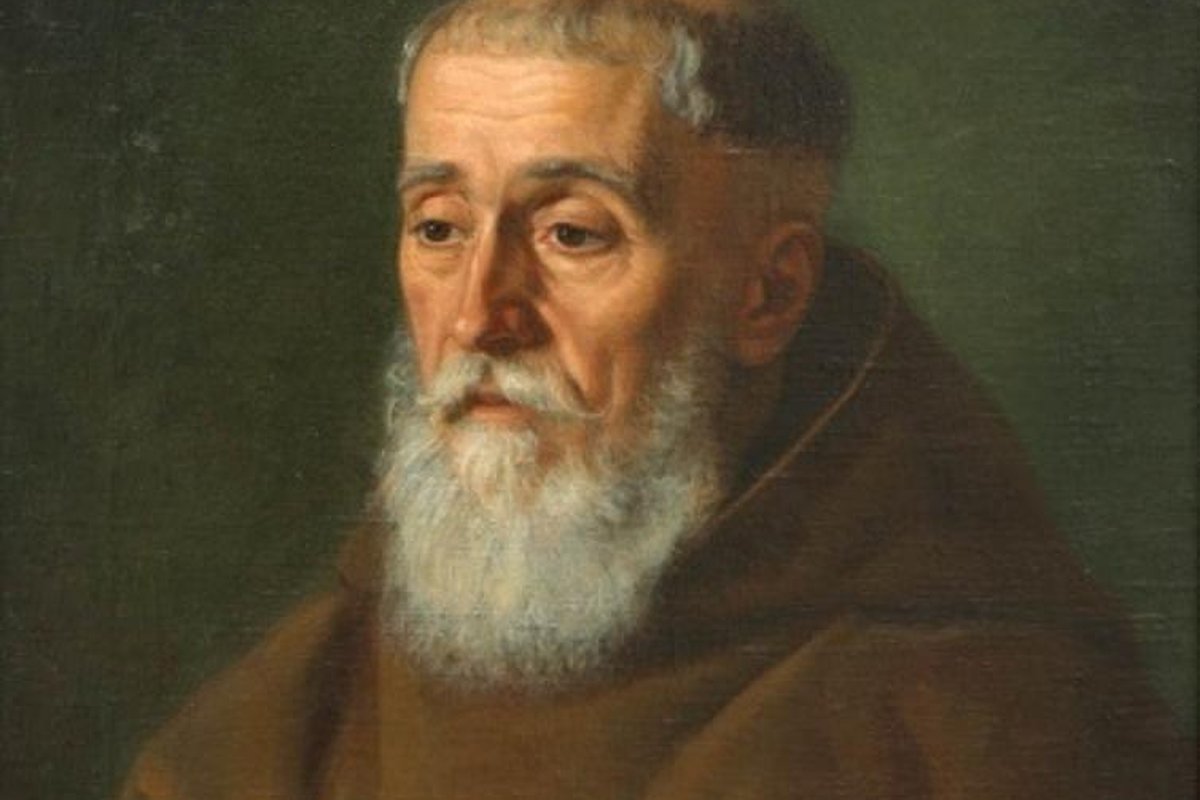
Anonymous 17th-century engraving, "B. Ioannes Capistranus," Rijksmuseum, CC0.
That promising civil career ended abruptly during a war between Perugia and the rival city of Malatesta of Rimini. John was captured and imprisoned, and the experience of confinement seems to have prompted a period of intense spiritual reflection. He resolved, upon his release, to abandon his legal and political career entirely and enter religious life instead, joining the Franciscan order in 1416 under the influence of the great reforming preacher Bernardine of Siena, whose austere, disciplined approach to religious life left a deep and lasting impression on the younger friar.
A celebrated preacher across a fractured Europe
Ordained a priest, John quickly developed a reputation as an extraordinarily effective and energetic preacher, traveling across Italy, Germany, Bohemia, Hungary, Poland, and beyond to deliver sermons that reportedly drew crowds numbering in the tens of thousands, sometimes requiring him to preach outdoors because no church building in a given town could hold the audience that gathered to hear him. His preaching addressed both ordinary moral reform and the specific religious controversies of his era, including sustained campaigns against the Hussite movement in Bohemia, a reform movement the Catholic Church regarded as heretical, and general calls for renewed discipline within a Franciscan order that had, by his lifetime, split into competing factions over how strictly to observe its founder's original vow of poverty.
John aligned himself firmly with the stricter Observant branch of the Franciscans, and much of his energy throughout his religious life went into promoting reform and greater fidelity to Francis of Assisi's original austere vision, in contrast to the more moderate Conventual branch of the order. He also served the papacy directly on numerous diplomatic missions, acting as an inquisitor in various heresy proceedings and as a papal legate sent to resolve disputes and rally support for Church initiatives across the courts of central and eastern Europe.
The Ottoman threat and the road to Belgrade
By the 1450s, the central concern of the papacy and of much of Christian Europe had shifted toward the rapid westward expansion of the Ottoman Empire. Constantinople, the ancient capital of the Byzantine Empire, had fallen to Ottoman forces under Sultan Mehmed II in 1453, an event that sent shockwaves across Europe and raised urgent fears that the Ottoman advance would continue directly into the heart of the continent. Pope Callixtus III called for a new crusade to resist further Ottoman expansion, and John of Capistrano, already in his late sixties and in declining health, was among the figures who answered that call with extraordinary energy, traveling through Hungary and neighboring lands to preach and recruit volunteers for the defense effort.
The military effort itself was led chiefly by the Hungarian nobleman and general John Hunyadi, one of the most capable military commanders of the era, who assembled a mixed force of professional soldiers and the largely untrained peasant volunteers that Capistrano's preaching had helped rally. Together they moved to relieve the fortress city of Belgrade, then under siege by a massive Ottoman army equipped with heavy artillery, positioned to open the road into Hungary and, from there, deeper into central Europe.
The Battle of Belgrade, 1456
The siege and battle unfolded over several intense days in July 1456. Hunyadi's forces broke an Ottoman naval blockade on the Danube and resupplied the besieged garrison, and in the fighting that followed, Capistrano is recorded as having played a direct and highly visible role, rallying the peasant volunteers under his command and, according to multiple contemporary accounts, personally leading a charge while holding aloft a crucifix rather than a weapon, an image that became central to how later generations remembered him. The combined Christian forces achieved a decisive and, at the time, largely unexpected victory, forcing Mehmed II's army into a costly retreat and halting the Ottoman advance into central Europe for the better part of the following seven decades.
News of the victory spread across Europe as a rare and celebrated piece of good news amid years of anxious retreat, and Pope Callixtus III ordered church bells rung at noon throughout Christendom in commemoration, a practice that survives in some places today as the tradition of ringing church bells at midday.
Death soon after victory, and later canonization
The triumph came at a cost that neither of its two chief architects survived to enjoy for long. John Hunyadi died of plague contracted in the crowded, unsanitary conditions of the siege camp barely three weeks after the battle, and John of Capistrano, already weakened by decades of ascetic living and by the physical exertions of the campaign itself, died just months later, in October 1456, likely of the same epidemic that had claimed Hunyadi.
He was canonized more than two centuries later, in 1690, by Pope Alexander VIII, and remembered in Catholic tradition as the "Soldier Priest," an unusual and somewhat uneasy title for a Franciscan friar, but one that captures the singular way his life bridged the pulpit and the battlefield during one of the most anxious moments in medieval Christian Europe's confrontation with Ottoman expansion. His feast day is celebrated on October 23, and the American town of San Juan Capistrano, California, home to one of the historic California missions, bears his name.
Trivia
Who was Saint John of Capistrano and when did he live?
What was John of Capistrano's life before becoming a friar?
What role did John of Capistrano play at the Battle of Belgrade?
Why was John of Capistrano called the 'Soldier Priest'?
When was John of Capistrano canonized and what is his feast day?
You May Also Like
Related Reading