Saint Margaret Clitherow, the Pearl of York

A convert in a city still remembering its Catholic past
Margaret Clitherow was born Margaret Middleton in York in 1556, into a Protestant family, at a moment when England's official religion had swung decisively away from Rome under the Tudor settlement. She married John Clitherow, a well-off butcher and, notably, a churchwarden in the officially Protestant Church of England, in 1571, and settled into what looked from the outside like an unremarkable middle-class life on York's Shambles, the city's old butchers' street, much of which still stands today. Around 1574, three years into her marriage, Margaret converted to Catholicism — a decision her husband apparently tolerated with real affection even as it put real legal risk on their household, since he continued paying the fines levied against Catholics who refused to attend Anglican services while quietly allowing his wife to practice her new faith.
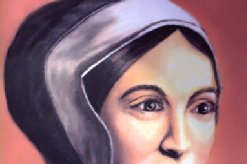
Anonymous artist, historical depiction of Margaret Clitherow, undated — public domain.
Turning a butcher's house into a refuge
York in the 1570s and 1580s was a genuinely dangerous place to be an openly practicing Catholic. Elizabethan law made it treason for an ordained Catholic priest simply to be present in England, following the priests' training abroad after the break with Rome, and it made sheltering such a priest a capital offense as well. Margaret didn't merely keep her own faith quietly; she turned her family's house into a functioning safe house, hosting Mass in secret, sheltering fugitive priests, and reportedly having a purpose-built hiding place — a "priest hole" — constructed into the property to conceal them during searches. She sent her eldest son abroad to be educated as a Catholic, a decision that eventually led to her own arrest, since authorities used it as evidence against her. She was arrested and imprisoned multiple times over the years for recusancy — the refusal to attend official Church of England services — before the charge that would ultimately kill her: the accusation of having harbored priests in her home.
A trial she chose not to have
When Margaret was brought before the York assizes in March 1586, she was asked to enter a plea to the charge. She refused, and kept refusing, understanding exactly what that choice would cost. English law of the period allowed the accused's silence — technically "standing mute" — to be answered with a specific, brutal procedure called peine forte et dure, in which the prisoner was stripped, laid on the ground, and had increasingly heavy weights placed on a board over their chest until they either agreed to plead or died. Margaret's reasoning, as later recorded by those who knew her, was not confusion about the danger but a clear-eyed calculation: a formal trial would have compelled testimony from witnesses, and among the people the prosecution intended to call were her own young children and members of her household, whose evidence could have been extracted under threat and used to convict others she had sheltered. By refusing to plead, she accepted a horrific death herself in order to protect them from being forced into that position.
Good Friday, 1586
She was executed on Good Friday, March 25, 1586 — a date whose overlap with the day of Christ's own crucifixion was not lost on later Catholic memory of her death. Reports from the time describe her final moments as composed rather than desperate; she reportedly forgave those responsible for her death and prayed for the queen even as the sentence was carried out. The execution itself took place at the Toll Booth in York, and her death made her one of the most widely remembered of the many Catholics executed in England across the decades of the Reformation and Elizabethan settlement — remembered specifically enough, and locally enough, that a shrine on the Shambles marking the site of her former home remains a place of Catholic pilgrimage in York today.
Canonization among the Forty Martyrs
Margaret Clitherow's case for sainthood moved slowly, as many English Reformation-era martyr causes did, complicated by the centuries of continued Catholic-Protestant tension in England that followed her death. She was beatified in 1929 as part of a larger group of English martyrs, and finally canonized on October 25, 1970, by Pope Paul VI, as one of the Forty Martyrs of England and Wales — a group chosen to represent the much larger number of Catholics executed under the Tudor and early Stuart penal laws, spanning clergy and laypeople, men and women, across roughly a century of persecution. Her fellow English martyrs from a slightly earlier generation, Saints John Fisher and Thomas More, faced Henry VIII's break with Rome directly at its start; Margaret's death, half a century later under Elizabeth I, shows how long and how deeply that rupture continued to cost ordinary English Catholic families, not just bishops and statesmen at court. Her feast is kept on August 30 in the general Roman calendar, and she is honored today as a patron of businesswomen, of converts to the Catholic faith, and of the Catholic Women's League — recognitions that trace directly back to the specific shape of the life she actually lived, as a married laywoman running a household and a business who chose, in the end, to protect her own family with her silence.
Trivia
Who was Saint Margaret Clitherow?
Why was hiding a priest illegal enough to warrant execution?
What execution method was used against her, and why?
Why did Margaret Clitherow refuse to plead at her trial?
When is Saint Margaret Clitherow's feast day, and what is she a patron of?
You May Also Like

Related Reading