Saint Paul of the Cross, Priest

A layman's long search before religious life
Paul of the Cross was born Paolo Francesco Danei in 1694 in Ovada, in the Republic of Genoa, the eldest of sixteen children in a merchant family that, while not wealthy, valued education and piety. His early adulthood did not follow a straightforward path toward the priesthood. As a young man he briefly considered joining the Venetian army to fight against the Ottoman Turks, a plan that ultimately came to nothing, and he spent years as a layman engaged in ordinary work and private prayer, increasingly drawn toward a life of penance and contemplation without yet having a clear sense of the specific form it should take.
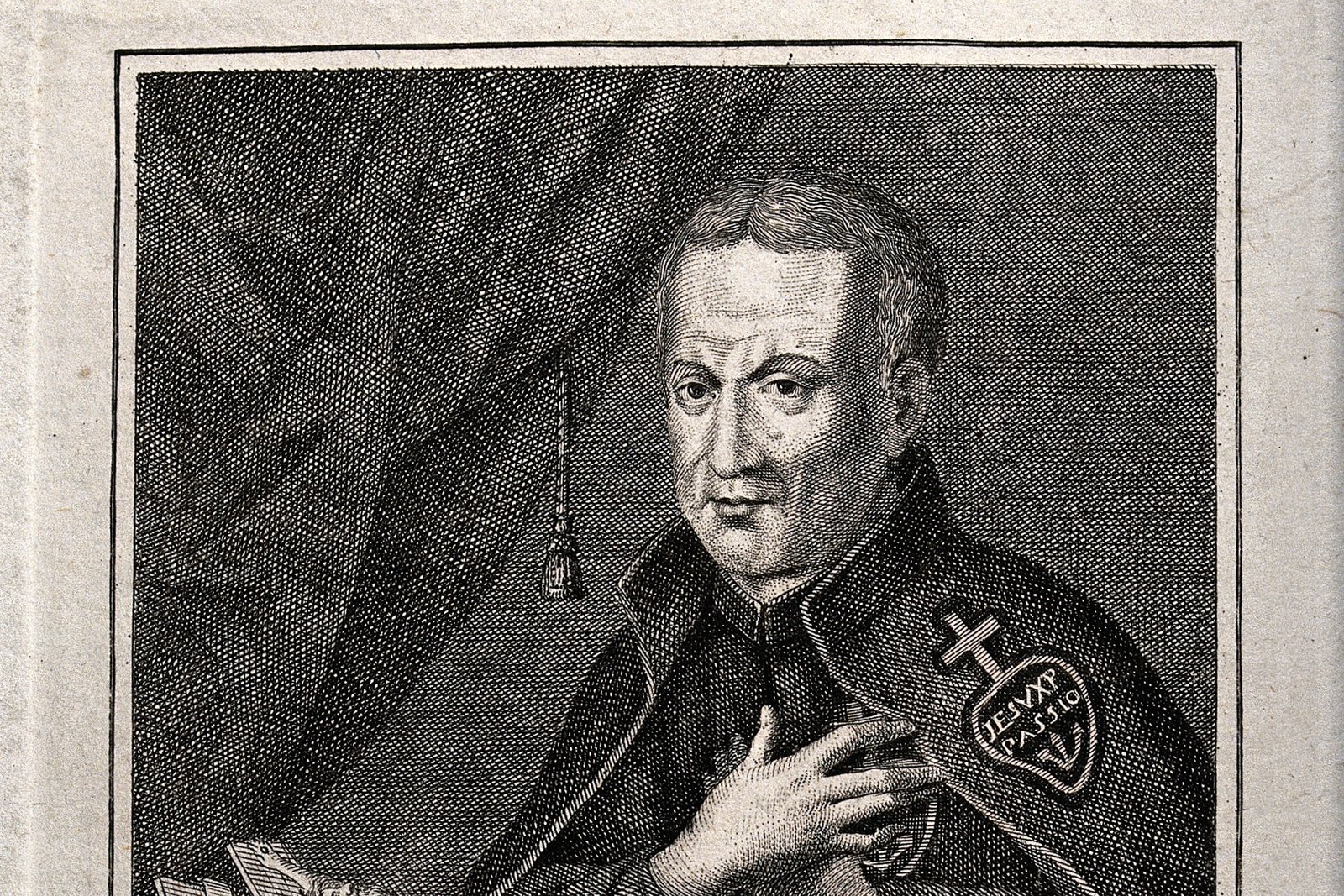
18th-century devotional engraving of Saint Paul of the Cross, Wellcome Collection, CC BY 4.0.
That clarity arrived gradually, through a series of interior experiences that Paul understood as direct spiritual guidance. He began wearing a rough black habit of his own design and living an austere, solitary existence even before founding any formal community, and by his mid-twenties he had become convinced that he was being called to establish a new religious congregation centered on a devotion that, while present throughout Christian history, had rarely been made the sole organizing focus of an entire religious order: sustained, continual meditation on the sufferings of Christ.
Forty days that produced a religious rule
In 1720, Paul undertook an intense forty-day retreat of solitude, prayer, and fasting in a small room adjoining a church in Castellazzo, near his hometown. During this period of isolation he wrote out, in a remarkably short span of time, the initial rule for the religious community he believed he was meant to found, a document he understood not as his own invention but as something communicated to him through prayer. The rule called for a life of poverty, penance, and solitude built entirely around continual remembrance of Christ's Passion, along with active preaching missions meant to bring that same remembrance to ordinary people, particularly those in remote or spiritually neglected regions of Italy.
Securing formal Church approval for the new congregation took years of patient effort. Paul traveled to Rome to present his rule to Church authorities, and while he received encouragement from various churchmen, official papal approval did not come until 1741, more than two decades after his initial retreat, when Pope Benedict XIV formally approved the Congregation of the Discalced Clerics of the Most Holy Cross and Passion of Jesus Christ, generally known simply as the Passionists.
A fourth vow centered on the Passion
What set the Passionists apart from most religious orders founded in earlier centuries was the specificity of their central devotion. Most religious communities organize themselves around a particular apostolic work, teaching, nursing, foreign mission, or around a broad spiritual tradition inherited from an earlier founder. Paul's community took the unusual step of building an entire fourth vow, alongside the traditional vows of poverty, chastity, and obedience, around a single theological focus: to promote in themselves and in others a living memory of Christ's suffering and death, understood not as morbid fixation but as the deepest possible source of hope, since it was precisely through that suffering, in Christian theology, that redemption came.
Passionist life combined the contemplative and the active in a deliberate balance. Members lived a portion of the year in retreat houses given over to silence, prayer, and penance, while also traveling in pairs to preach popular parish missions across the Italian countryside, delivering sermons on the Passion designed to move ordinary lay Catholics toward confession, reconciliation, and renewed faith. Paul himself spent decades of his life doing exactly this kind of grassroots missionary preaching, walking from town to town across central Italy, often working among poor and rural populations that larger, more established religious orders rarely reached.
Later years and expansion of the order
Paul governed his growing congregation as its first superior general for the rest of his life, overseeing the establishment of new retreat houses across Italy even as his own health declined in old age. He also founded, alongside his religious brothers' congregation, a corresponding community of contemplative Passionist nuns, extending the same Passion-centered spirituality into an enclosed, strictly contemplative form of religious life for women.
He died in Rome in 1775, having lived to see his once-fragile project grow into an established and respected religious order, though its major expansion beyond Italy, into England, Ireland, and eventually the Americas, would come only in the decades after his death, carried forward by later generations of Passionist missionaries. Pope Pius IX canonized him in 1867, formally recognizing a life that had turned one man's solitary forty days of prayer into a religious order still active on six continents today. His feast is celebrated on October 19 in the general Roman calendar, while Passionist communities themselves traditionally mark it a day later, on October 20.
Trivia
Who was Saint Paul of the Cross and when did he live?
What order did Paul of the Cross found?
What experience convinced Paul of the Cross to found his religious order?
What is distinctive about the Passionist charism?
When was Paul of the Cross canonized and what is his feast day?
You May Also Like
Related Reading