Saint Longinus, the Centurion at the Cross

What the Gospel of John actually says
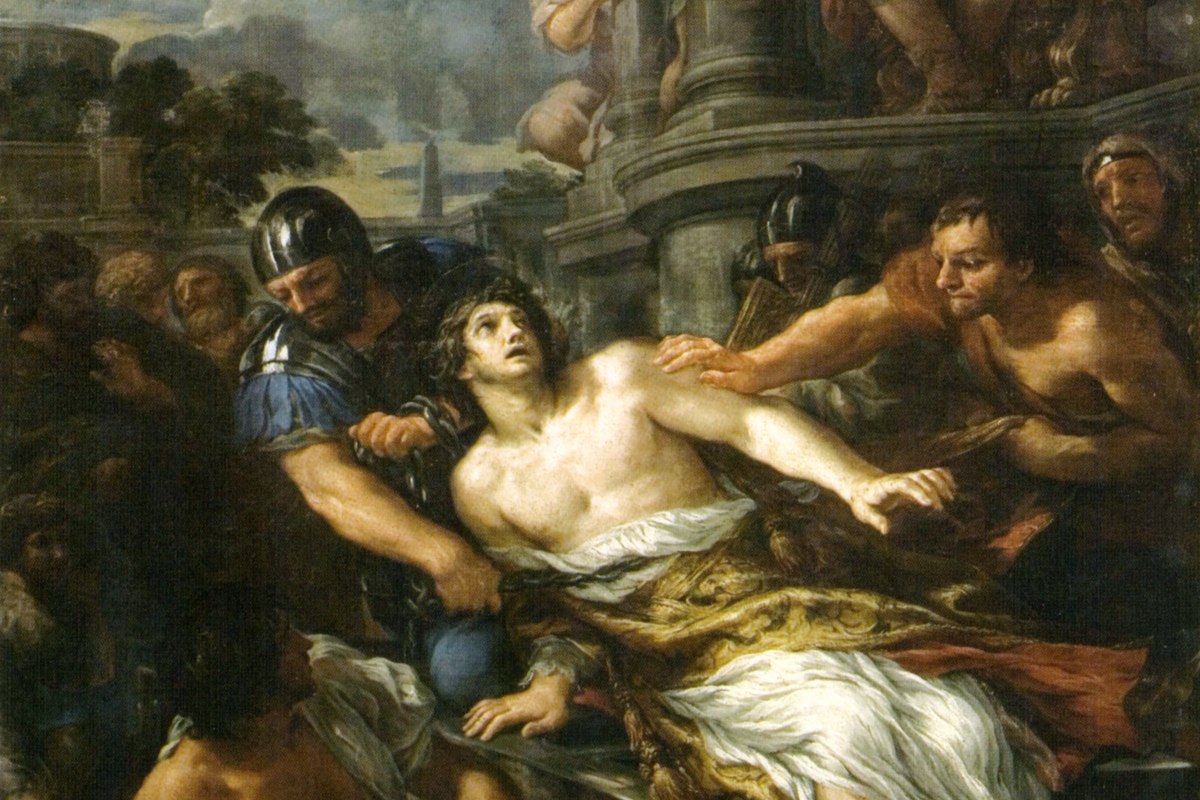
Strip away every later legend, and the biblical account is spare: a Roman soldier, executing the standard practice of confirming death before releasing a body from the cross, drives his spear into Jesus's side. "But when they came to Jesus and saw that he was already dead, they did not break his legs, but one soldier thrust his lance into his side, and immediately blood and water flowed out" (John 19:34, NABRE). John frames the detail as fulfillment of prophecy — "They will look upon him whom they have pierced" (John 19:37, NABRE) — and as evidence for his own eyewitness account, not as the origin of a saint's biography. The soldier is unnamed. He speaks no words. He has no recorded reaction at all.
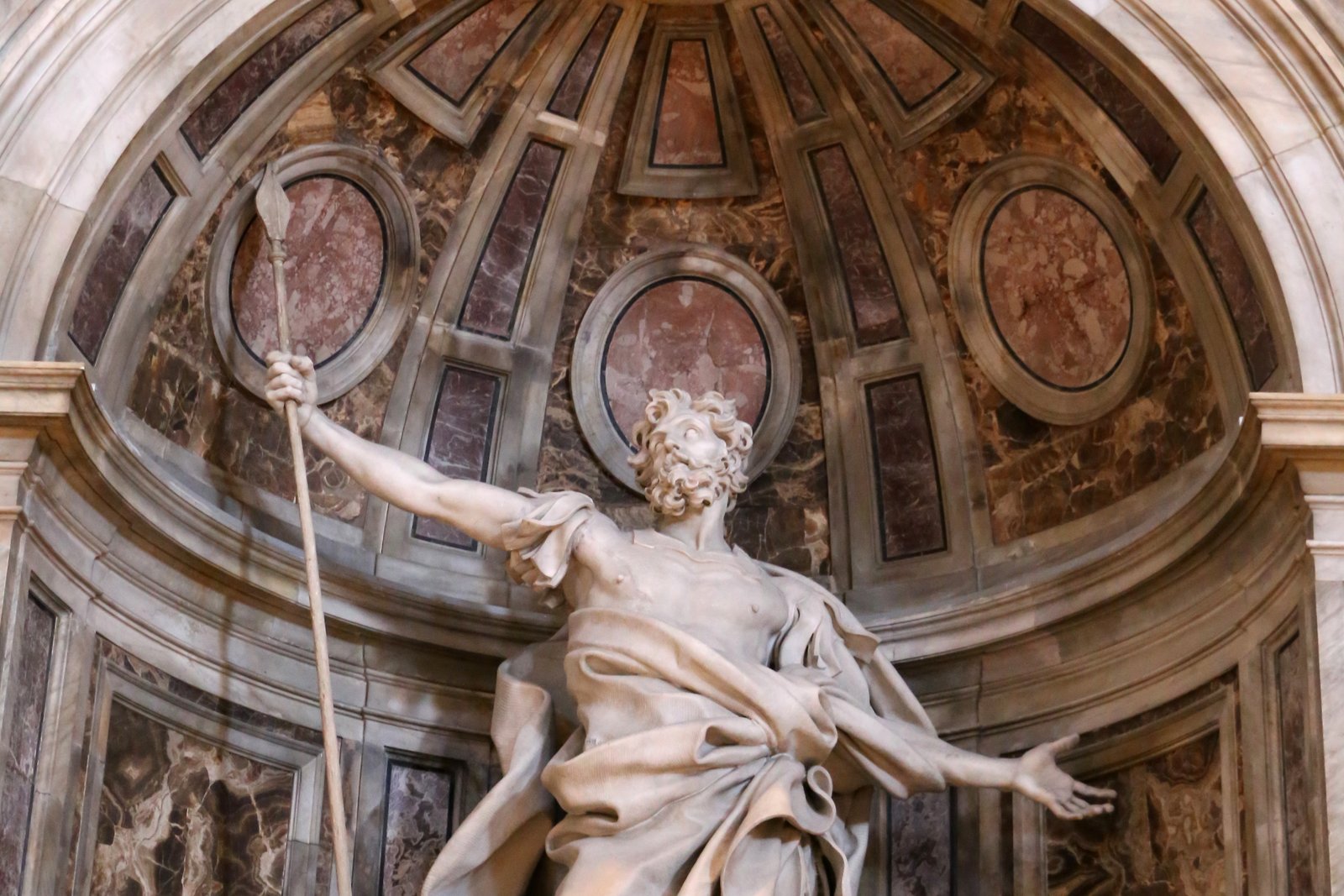
Gian Lorenzo Bernini, "Saint Longinus," 1638, St. Peter's Basilica, Vatican City — photo by Sailko, CC BY 3.0.
That single, understated verse is the entire scriptural foundation for a figure who would go on to receive one of the largest statues ever carved for a church interior.
A separate soldier, later merged into one
Complicating things further, Matthew's Gospel describes a different moment involving Roman soldiers at the cross — one that later tradition folded into the same man. After the earthquake that struck at the moment of Jesus's death, "the centurion and the men with him who were keeping watch over Jesus feared greatly when they saw the earthquake and all that was happening, and they said, 'Truly, this was the Son of God!'" (Matthew 27:54, NABRE). Nothing in either Gospel identifies this centurion with the soldier who pierced Jesus's side in John's account; they may have been the same man, two different men, or entirely unrelated details from two independent traditions about the crucifixion. Scripture simply does not say. It was popular devotion, working centuries later, that wove the piercing, the confession of faith, and eventually a name and a martyrdom into a single continuous story.
Where the name "Longinus" comes from
The name first surfaces in the Gospel of Nicodemus (also called the Acts of Pilate), an apocryphal text — meaning a work outside the official biblical canon, not accepted by the Church as inspired Scripture — that most scholars date to somewhere around the fourth or fifth century, well over three hundred years after the crucifixion itself. Some later commentators proposed that the name derived from the Greek word for spear, longche, essentially turning the soldier's weapon into his identity. That etymology is a reasonable guess rather than a documented fact, and it illustrates something important about how legends like this one grow: a striking but anonymous detail in Scripture creates an irresistible narrative gap, and pious storytelling fills it in, generation by generation, until the invented details feel as solid as the biblical ones.
By the medieval period, the legend had grown a full biography. Longinus, the story goes, was a Roman officer partially blind or suffering from failing eyesight, who was healed the instant blood from Christ's wound touched his eyes — a detail that appears nowhere in the Gospel of John and exists purely within the apocryphal and later medieval tradition. Struck by the miracle, he converted, renounced his military career, and eventually died a martyr's death for professing faith in Christ. Different versions of the legend send him to different places to die: some accounts place his martyrdom in Cappadocia, in what is now central Turkey, while others root his story more firmly in Italy. This kind of geographic disagreement between competing traditions is common with saints whose stories rest entirely on legend rather than documented history, and it's a signal, not a flaw to hide — it tells us clearly that we are in the territory of pious tradition rather than verified biography.
From an unnamed soldier to a colossal statue
Whatever the uncertainty about the man himself, devotion to Longinus became remarkably concrete in Rome. Among the greatest treasures of St. Peter's Basilica is a relic long venerated as the Holy Lance — the spearhead traditionally identified with the weapon used in John 19:34 — and to give that relic a fitting home, Pope Urban VIII commissioned the sculptor Gian Lorenzo Bernini to carve a monumental statue of the soldier now honored as its wielder. Completed in 1638, Bernini's Saint Longinus stands more than four meters tall in one of the four niches beneath the basilica's central dome, arms flung wide, robes caught in dramatic motion, his upturned face capturing the instant of recognition that legend assigns him. It remains one of the most reproduced images connected to the Passion of Christ, precisely because it gives dramatic, human form to a figure Scripture leaves almost entirely blank.
The other three niches beneath St. Peter's dome hold statues of Saint Veronica, Saint Helena, and Saint Andrew the Apostle, each likewise tied to a relic associated with the Passion — a reminder that Longinus's veneration developed as part of a broader medieval and early-modern devotional culture built around physical objects connected to Christ's suffering and death, not as an isolated cult around one obscure figure.
Why this distinction matters
None of this is meant to dismiss the tradition surrounding Longinus as unworthy of respect. The Catholic Church has long permitted and even encouraged devotion to saints known chiefly through pious legend, provided the distinction between Scripture and tradition stays clear rather than blurred into a single, undifferentiated claim. What we know for certain, from the Bible itself, is simply this: an unnamed Roman soldier, doing his job at the foot of the cross, pierced the side of a man already dead, and blood and water flowed out — a detail John considered important enough to insist upon as eyewitness testimony. Everything else — the name, the blindness healed by the touch of Christ's blood, the conversion, the specific circumstances of a martyrdom — comes from later centuries of storytelling, valuable as an expression of faith but not equivalent to the biblical record itself.
That layered relationship between a spare scriptural detail and a rich later legend is, in its own way, typical of how devotion to minor figures from the Passion developed across the early Christian centuries — figures like Saint Joseph of Arimathea and Saint Nicodemus underwent a similar process, with a handful of biblical verses expanding, over time, into full devotional biographies. Understanding where the line falls between the two is part of what makes engaging seriously with the saints rewarding rather than simply credulous.
Trivia
Does the Bible name the soldier who pierced Jesus's side?
Is Longinus the same person as the centurion who called Jesus the Son of God?
Where does the name Longinus come from?
What happened to Saint Longinus according to tradition?
Where is Saint Longinus venerated today?
You May Also Like
Related Reading