Saint Nicodemus, the Pharisee Who Came by Night

A Pharisee, and a ruler of the Jews
The Gospel of John introduces him with a title, not a story: "Now there was a Pharisee named Nicodemus, a ruler of the Jews" (John 3:1, NABRE). Both parts of that description matter. The Pharisees were a Jewish religious movement defined by strict, careful observance of the Law of Moses — not the caricature of empty legalism they're sometimes reduced to in casual retellings, but a serious and widely respected school of religious practice. Being called "a ruler of the Jews" almost certainly places Nicodemus among the roughly seventy members of the Sanhedrin, the council responsible for religious and much civil governance in Jerusalem under Roman rule. He was not a curious bystander. He was a man with real standing to lose.
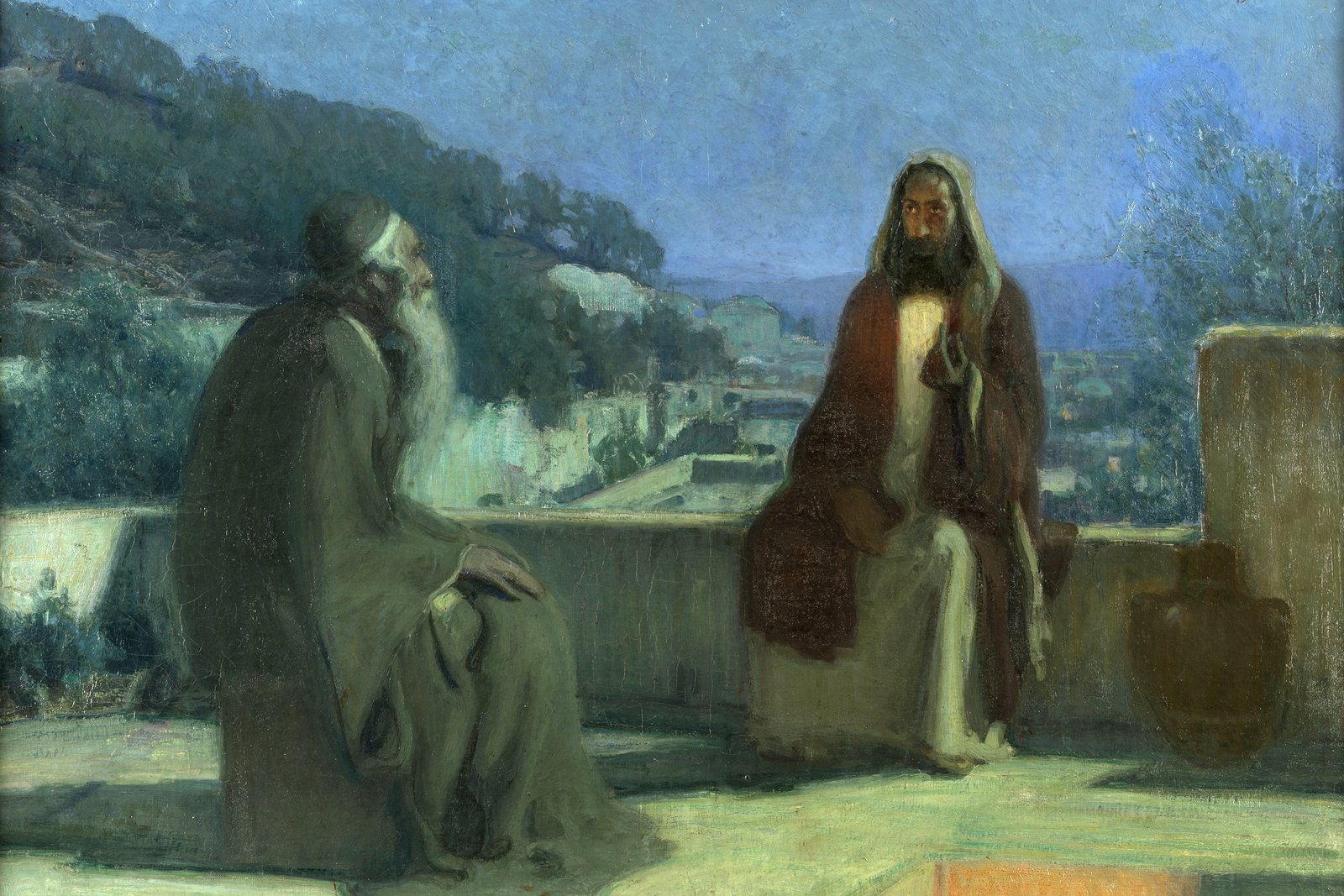
Henry Ossawa Tanner, "Nicodemus Visiting Jesus," 1899, Pennsylvania Academy of the Fine Arts — public domain.
That's what makes his opening line to Jesus so striking. He begins with open respect — "Rabbi, we know that you are a teacher who has come from God, for no one can do these signs that you are doing unless God is with him" (John 3:2, NABRE) — the sort of statement that, coming from a Sanhedrin member, was itself a small risk. And he comes "at night" (John 3:2), a detail John records without explanation but which readers across the centuries have almost universally read as caution: a public figure protecting himself from being seen, at least for the moment, associating with a rabbi already stirring controversy among Jerusalem's religious establishment.
Born from above, born of water and Spirit
What follows is one of the most theologically dense conversations in any Gospel. Jesus tells him plainly, "Amen, amen, I say to you, no one can see the kingdom of God without being born from above" (John 3:3, NABRE) — language that puzzles Nicodemus, a trained scholar of the Law, taking it at first with a kind of literal bewilderment: "How can a person once grown old be born again? Surely he cannot reenter his mother's womb and be born again, can he?" (John 3:4, NABRE). Jesus clarifies with what would become one of Christianity's foundational teachings on baptism and spiritual rebirth: "no one can enter the kingdom of God without being born of water and Spirit" (John 3:5, NABRE). The Catechism of the Catholic Church draws directly on this exchange when discussing the necessity and meaning of baptism (CCC 1215), making this quiet nighttime conversation one of the scriptural anchors for a sacrament practiced by billions of Christians since.
Nicodemus doesn't fully grasp what he's being told in the moment — his honest, slightly exasperated "How can this happen?" (John 3:9, NABRE) reads less like the doubt of a skeptic and more like the confusion of a genuinely engaged listener working through unfamiliar ideas out loud. John's Gospel simply lets the conversation trail off there, without recording a clean resolution. It's a very human way to end a first encounter with something too large to absorb all at once.
A second appearance: speaking up in public
Nicodemus does not vanish from the story after that nighttime visit. Several chapters later, when fellow members of the Sanhedrin move to condemn Jesus without a hearing, Nicodemus intervenes — no longer under cover of darkness: "Nicodemus, one of their members who had come to him earlier, said to them, 'Does our law condemn a person before it first hears him and finds out what he is doing?'" (John 7:50-51, NABRE). It's a modest intervention by modern standards, phrased as a procedural question rather than a defense of Jesus's teaching, but within the context of the scene it's a genuinely public risk — and the other Pharisees' sharp, dismissive reply ("You are not from Galilee also, are you?", John 7:52, NABRE) suggests they registered it as exactly that. The man who once came only by night is now willing to speak, however cautiously, in the light of open debate.
Burying Jesus with royal generosity
Nicodemus's third and final appearance in Scripture comes at the most consequential moment of all. After Jesus's death, alongside Joseph of Arimathea, "Nicodemus, the one who had first come to him at night, also came bringing a mixture of myrrh and aloes weighing about one hundred pounds" (John 19:39, NABRE). That is an extraordinary quantity of burial spices — far beyond what an ordinary burial required — and ancient sources associate similarly lavish quantities of myrrh and aloes with royal funerals. Whether or not John intended readers to catch that echo, the sheer scale of the gift signals both real wealth and a desire, finally unhidden, to honor Jesus without holding anything back. "They took the body of Jesus and bound it with burial cloths along with the spices, according to the Jewish burial custom" (John 19:40, NABRE) — the man who once hesitated to be seen with Jesus in daylight now handles his body publicly, preparing it for the tomb with his own hands.
From three verses to a legendary life
That's the entirety of what Scripture tells us about Nicodemus — three appearances across one Gospel, and no account of what became of him afterward. Christian tradition, unwilling to let such a compelling figure simply disappear from the story, filled the gap considerably. Later legend holds that Nicodemus was baptized by the apostles Saint Peter and Saint John, was eventually expelled from the Sanhedrin and stripped of his position for his faith, and died some years later, honored as a confessor of the faith even if not, in most traditions, as a martyr in the strict sense. An apocryphal text — meaning a writing outside the Bible's accepted canon — even bears his name, the Gospel of Nicodemus, though it was composed centuries after his lifetime and reflects later theological reflection rather than firsthand testimony from the man himself. As with so many figures who appear briefly but memorably in the Gospels, the line between what Scripture actually records and what later devotion imagined is worth keeping clear, even while both remain part of how the Church has honored his memory.
Why Nicodemus still resonates
Part of what makes Nicodemus so enduringly relatable is precisely his hesitation. He isn't one of the twelve apostles who dropped everything at a word. He's a cautious, intellectually serious man who takes real steps toward faith gradually — first in secret, then in a small public gesture, and finally in an act of open, costly devotion at the tomb. That arc, moving haltingly from night toward daylight, has made him a particularly sympathetic figure for readers who recognize their own hesitations in his — and a natural companion figure to Saint Joseph of Arimathea, with whom he shares both his final biblical scene and centuries of intertwined later legend.
Trivia
Who was Nicodemus in the Bible?
Why did Nicodemus visit Jesus at night?
Did Nicodemus defend Jesus before the Sanhedrin?
What did Nicodemus do after Jesus's death?
Is Nicodemus recognized as a saint?
You May Also Like
Related Reading