The Seven Holy Founders of the Servite Order

Seven men, one confraternity
The story of the Servite Order begins not with a single founder but with a group — a detail unusual enough in the history of religious orders that it is worth pausing on before getting to the events themselves. All seven men belonged to the same lay confraternity in Florence, a voluntary association of the kind common in medieval Italian cities, whose members gathered for prayer, mutual support, and works of charity while continuing to live ordinary civic and family lives. This particular confraternity was dedicated to devotion to Mary, and its members were drawn largely from Florence's merchant class — men of standing and financial means, several of them married, all of them established participants in the city's commercial and religious life.
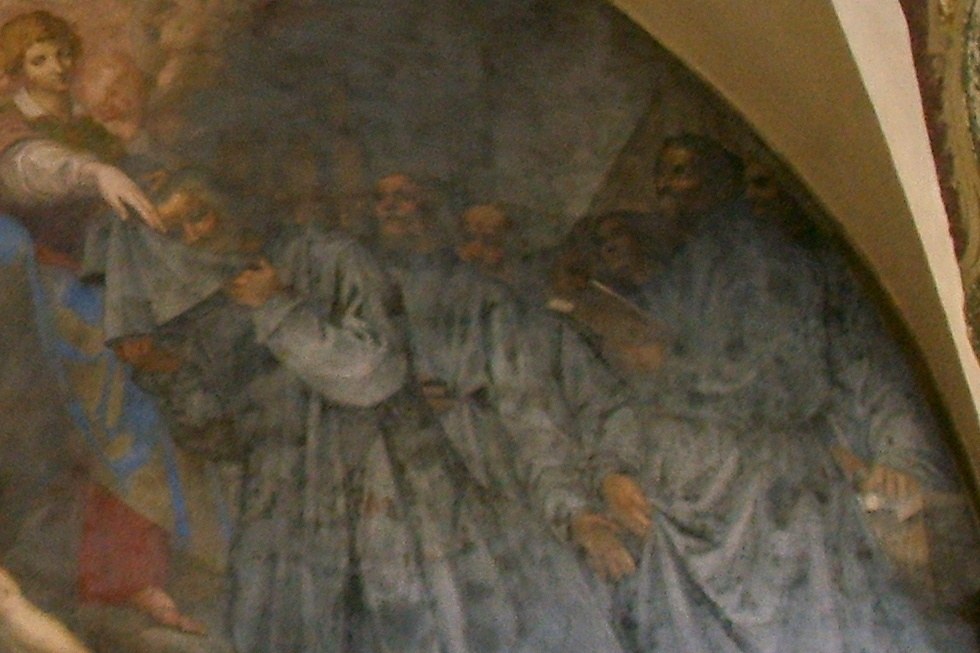
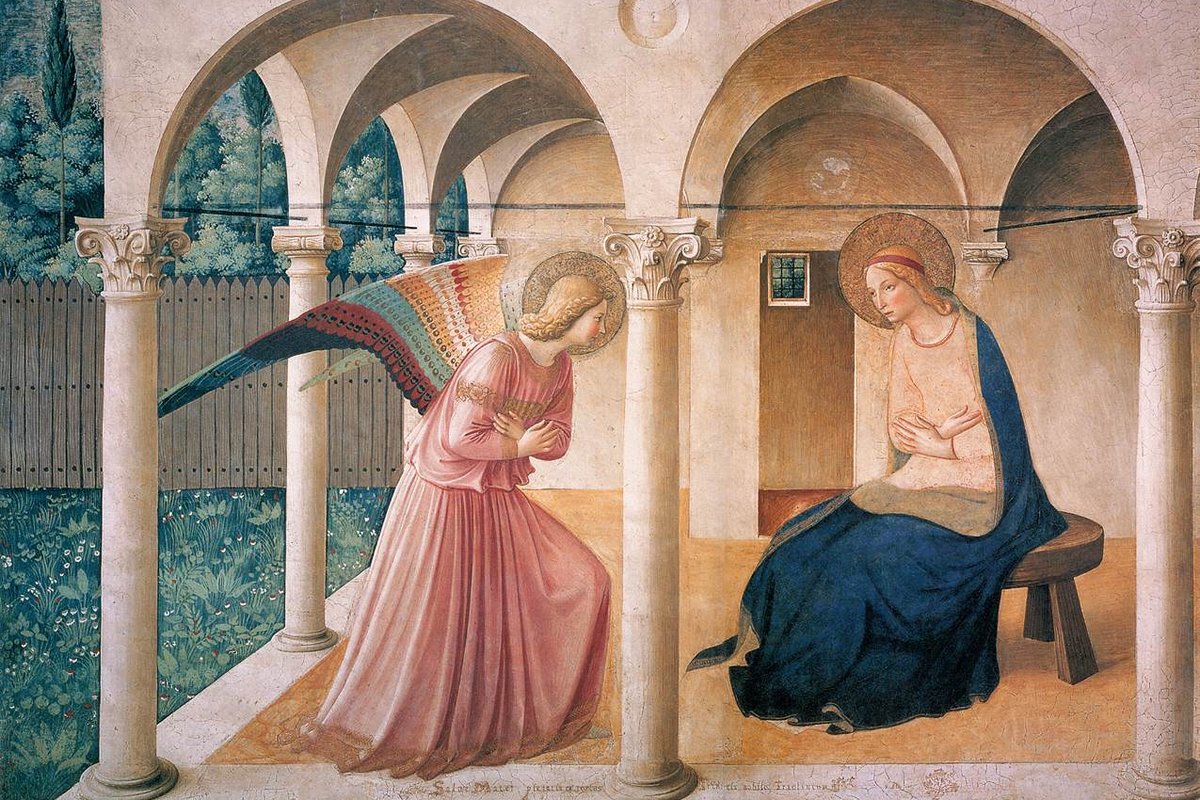
Bernardino Poccetti, The Virgin Appears to the Seven Holy Founders (detail), fresco, Chiostro dei Voti, Basilica della Santissima Annunziata, Florence. Photo: Sailko, CC BY 2.5 (cropped).
Tradition gives their names as Bonfilius Monaldi, Alexis Falconieri, Benedict dell'Antella, Manettus dell'Antella, Amadeus Amidei, Hugh Uguccione, and Sostegno de' Sostegni — though the precise list and order vary somewhat between different medieval sources, a reminder that much of what survives about the seven comes down through later Servite tradition rather than a single contemporary document. What the sources agree on is the shared, deliberate character of what happened next: this was not one man inspiring six followers, but seven peers arriving together at the same radical decision.
Florence in crisis
To understand why seven successful men might walk away from their lives simultaneously, it helps to understand what Florence looked like in the early thirteenth century. The city was being torn apart by escalating factional violence — the long conflict between Guelphs, who backed papal authority, and Ghibellines, who backed the Holy Roman Emperor, was intensifying into open street violence that would define Florentine politics for generations. Alongside the political strife, the city had also been struck by outbreaks of heresy that troubled Church authorities, and by the kind of moral corruption in civic life that reform-minded confraternities like the one these seven men belonged to had been formed specifically to counteract.
Members of their confraternity had reportedly experienced what tradition describes as visions of Mary during prayer around the year 1233, urging a deeper commitment to penance beyond what their existing devotional practice as laymen could offer. Whether this is best understood as a literal series of shared visions, a single collective spiritual experience later elaborated by devotional writers, or the natural culmination of years of shared prayer and disillusionment with the violence around them, the sources don't allow a fully confident modern answer — but the effect was concrete and immediate. The seven men resolved to renounce their possessions, distribute their wealth to the poor, and withdraw from the city together.
Withdrawal to Monte Senario
The seven initially retreated to a modest house just outside Florence's walls near the church that would later become the Basilica della Santissima Annunziata, living in extreme poverty and drawing enough attention from curious and admiring townspeople that the solitude they were seeking proved hard to find so close to the city. Seeking a more genuinely remote setting for prayer and penance, they relocated further out to Monte Senario, a rugged, largely uninhabited mountain roughly twelve miles from Florence, where they built simple huts and committed themselves fully to a life of contemplative withdrawal, extreme fasting, and prayer.
It was during this period on Monte Senario, according to Servite tradition, that the group's devotion crystallized specifically around the sorrows of Mary at the foot of the cross — the image of a mother's grief witnessing her son's death, drawn from the Gospel account of Mary standing "by the cross of Jesus" (NABRE, John 19:25) as he died. This meditation on Mary's suffering became the defining spiritual character of the community that grew up around the seven men, distinguishing it from other contemporary religious movements that centered more on poverty alone or on preaching. Their community became known as the Servi di Maria — the Servants of Mary — a name reflecting their self-understanding not as founders claiming any special authority, but as men who had simply placed themselves at Mary's service.
From hermits to an approved religious order
What began as an informal group of penitents gradually took on the structure of a formal religious order, following a pattern common to several thirteenth-century movements that started as loose lay communities and were later organized under an approved rule, much like the early Franciscans and Dominicans in the same period. The Servite community adopted the Rule of Saint Augustine as its formal framework and, over subsequent decades, received papal approval — with successive popes confirming the order's status through the thirteenth century, culminating in full approval by Pope Benedict XI in 1304.
The order grew steadily from its base at Monte Senario and the Florence convent, establishing houses across Italy and eventually across Europe, always carrying forward the founders' central devotion. The Servites are widely credited with playing a significant role in developing and spreading what became the formal Catholic feast of Our Lady of Sorrows, now kept on September 15 — a devotion tracing its roots directly back to what those seven men meditated on during their years of prayer on that mountainside.
Canonized together, remembered together
Six of the seven founders died at Monte Senario; the seventh, Alexis Falconieri, the youngest of the group, lived on for decades afterward and was present to see the order he had helped found grow and receive formal papal recognition, dying in 1310 at a reported age of well over one hundred. Rome moved slowly on their canonization, as it often did with cases resting heavily on centuries-old tradition rather than well-documented contemporary records, but Pope Leo XIII eventually canonized all seven together on January 15, 1888 — honoring them, fittingly, as a single unit rather than as individuals, just as they had lived and prayed together on that Florentine hillside more than six centuries earlier. Their shared feast falls on February 17, and Monte Senario remains an active Servite monastery today, still drawing pilgrims to the site where seven merchants once chose poverty over prosperity. Readers interested in how Marian sorrow shaped Catholic devotion more broadly may also want to read about Our Lady of Sorrows, the feast the Servite tradition helped bring into the wider Church calendar.
Trivia
Who were the Seven Holy Founders of the Servite Order?
Why did they leave Florence?
What is the Servite Order devoted to?
When were the Seven Holy Founders canonized?
Where is the Servite Order headquartered today?
You May Also Like
Related Reading