Saint Ursula

An inscription, and a story that grew around it
The one solid piece of ground under the whole Ursula legend is a stone. Sometime in the 4th or possibly early 5th century, an inscription was set up in a church in Cologne recording that the building had been restored on the site of a martyrdom — a group of virgins killed there, honored enough by that point that a church already stood over the spot. That's genuinely old evidence, and archaeologists and historians treat the underlying cult as real: Cologne venerated martyred virgins from a very early date, and their remains were kept and honored in what became the Basilica of St. Ursula.
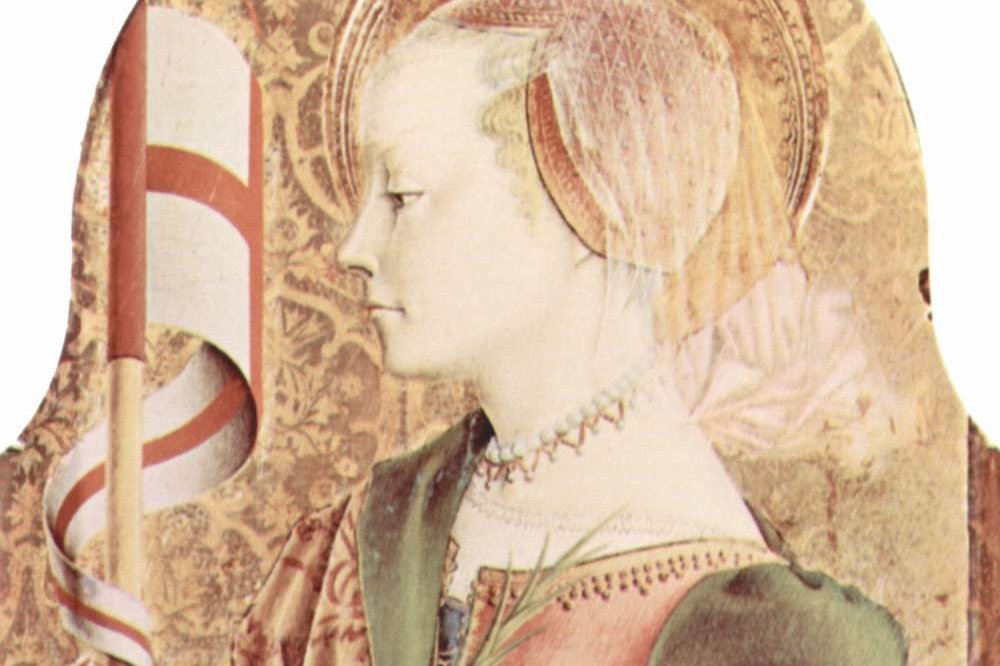
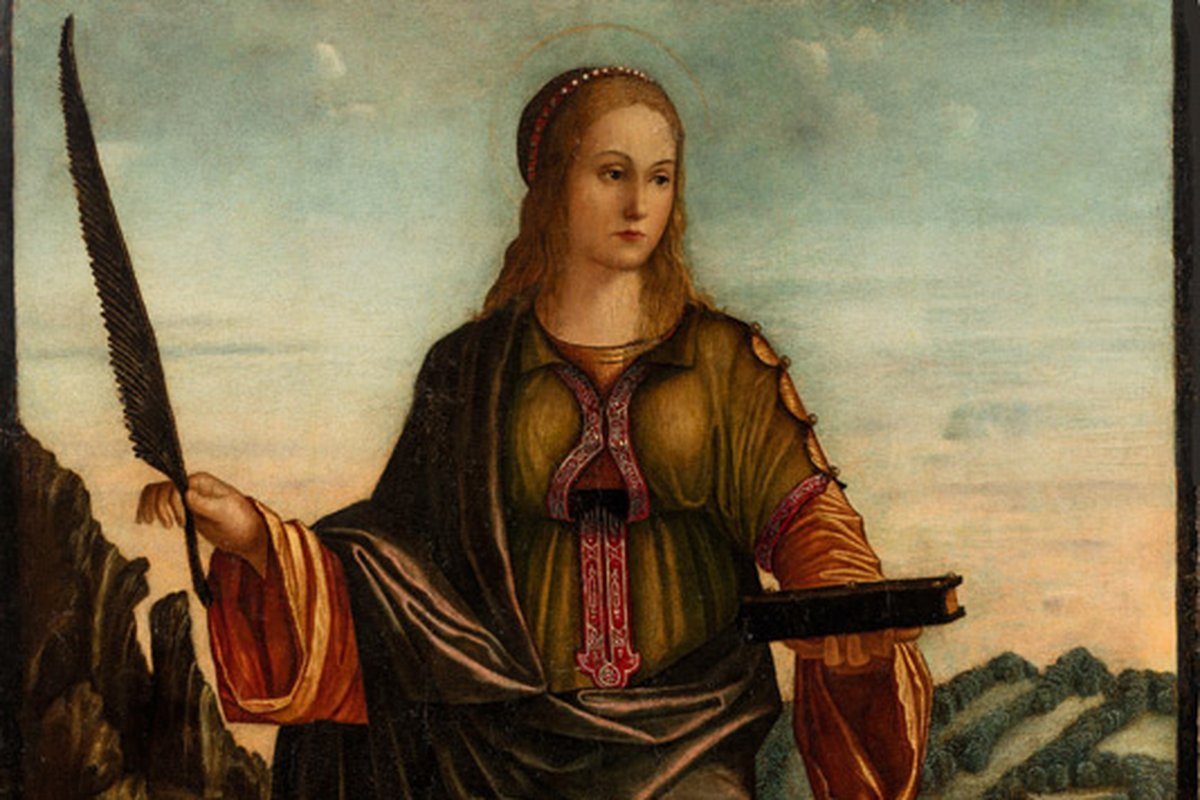
Carlo Crivelli, Saint Ursula, 1473, tempera on panel — public domain.
What that inscription did not originally include was a story. The narrative that eventually attached itself to the site — a British princess named Ursula, betrothed against her wishes, who won a delay to make a pilgrimage first, sailing with a vast retinue of companions up the Rhine toward Rome, only to be intercepted and slaughtered by a Hunnic army on the return journey near Cologne — developed gradually over the 9th and 10th centuries, centuries after the original martyrdom the inscription commemorated. By the time chroniclers like the Benedictine monk Sigebert of Gembloux were retelling it in the 11th century, Ursula had a fully formed royal backstory, a refused marriage, a miraculous fleet, and, most famously, an entourage numbered in the tens of thousands.
Where "eleven thousand" probably came from
The number attached to Ursula's companions — eleven thousand virgins — is the detail that made the legend famous and, eventually, the detail that made careful readers skeptical of the whole thing. Historians studying the textual history of the legend have proposed that it began as a scribal error: an early inscription or manuscript abbreviation, possibly reading something like "XI M V" (a shorthand that could plausibly stand for eleven martyred virgins, with M standing for martyres), got misread by a later copyist as "eleven thousand virgins," with M reinterpreted as milia, thousands. Once that misreading entered circulation, later writers had no reason to question it and every reason to embellish it, and the legend grew to match the number rather than the other way around.
It's worth being direct about this, in the way the Patron Saints Directory tries to be about legendary material generally: nothing in Ursula's traditional biography — the British royal birth, the refused prince, the pilgrimage itinerary, the precise number of companions — rests on documented history in the way a saint's life recorded by a contemporary biographer would. What's real is the early cult at Cologne and the martyrdom it commemorates; what's legendary is nearly everything built on top of it in the medieval retellings.
Cologne's shrine and the Golden Chamber
Whatever its origins, the cult of Ursula and her companions became one of the most important pilgrimage devotions in medieval Germany. The Basilica of St. Ursula in Cologne houses the Goldene Kammer, the Golden Chamber, a reliquary room lined floor to ceiling with bones arranged in elaborate patterns and inscriptions, assembled over centuries from remains found in a nearby Roman-era burial ground that medieval Cologne identified — without real archaeological basis — as the graves of Ursula's martyred companions. The chamber is a genuinely striking piece of medieval and early modern reliquary art, whatever one makes of the historical claims originally attached to the bones it displays.
The story also shaped art far beyond Cologne. Carlo Crivelli's 1473 panel painting of Ursula, crowned and holding an arrow — the traditional symbol of her martyrdom, since tradition holds she was shot rather than beheaded like her companions — is one of many Renaissance depictions of her as a solitary, dignified royal figure rather than the leader of a vast doomed fleet. Vittore Carpaccio painted an entire narrative cycle of her legend for a Venetian confraternity in the 1490s, one of the great surviving Renaissance painting cycles, evidence of how thoroughly the story had embedded itself in European devotional imagination centuries after its Cologne origins.
A cult that outlasted its own legend
The Catholic Church removed Ursula's feast from the universal Roman Calendar in the 1969 reform of the liturgical calendar, part of a broader effort to set aside saints whose biographies rested mainly on legend rather than documented history. That removal didn't end her veneration — she remains on regional and local calendars, especially in Cologne, and her feast, October 21, is still kept there and among communities with historical ties to her cult. Her most lasting institutional legacy came in 1535, when Saint Angela Merici founded a new religious order dedicated to the education of girls and named it the Ursulines in Ursula's honor, drawing on her traditional association with the protection and formation of young women. That order still exists today, still teaching, carrying Ursula's name forward long after most of her own legend had been set aside as pious embellishment rather than history — a fitting outcome for a cult that always rested more on devotion than documentation.
Trivia
Who was Saint Ursula?
Did eleven thousand virgins really travel with Ursula?
What is the historical evidence behind the Ursula legend?
What is Saint Ursula the patron saint of?
When is Saint Ursula's feast day?
You May Also Like
Related Reading