The Seven Deadly Sins and Their Opposing Virtues

From the desert to the list
The list didn't arrive fully formed from Scripture. It grew out of the lived experience of the earliest Christian monks — men and women who withdrew into the Egyptian desert in the third and fourth centuries and had, as a result, an unusually close view of their own recurring temptations. Evagrius Ponticus, one of these desert fathers, catalogued eight troublesome "thoughts" (logismoi) that ambushed the solitary ascetic: gluttony, lust, greed, sadness, wrath, acedia (spiritual apathy), vainglory, and pride. Around the year 590, Pope Gregory the Great reworked Evagrius's eight into the seven-item list still used today — merging vainglory into pride, folding sadness into what became sloth, and adding envy — and it was Gregory's sevenfold version that took hold across the Western Church, later immortalized by Dante Alighieri's Purgatorio, which structures the mountain of Purgatory itself around these seven vices.
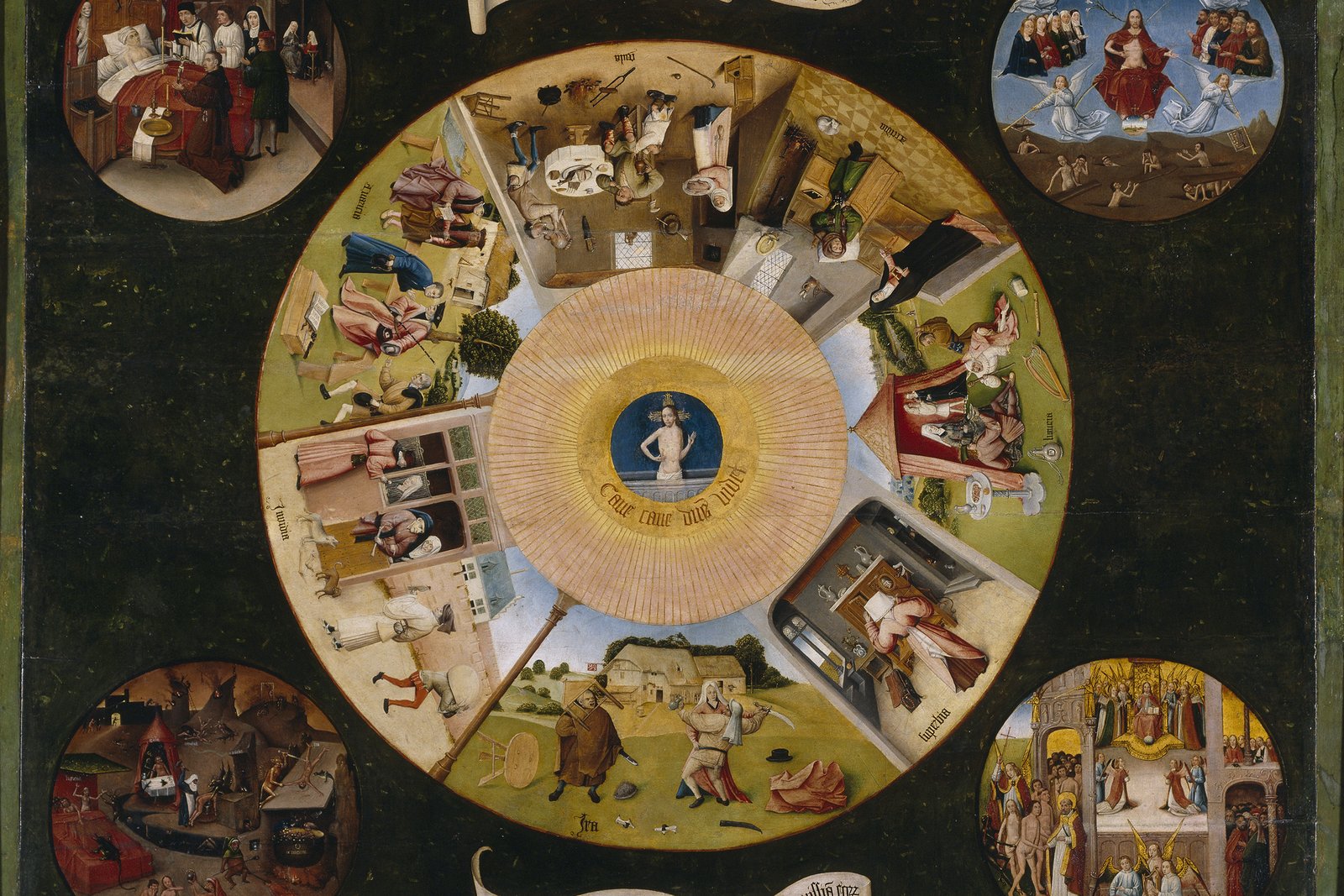
Hieronymus Bosch, The Seven Deadly Sins and the Four Last Things, c. 1505–1510 (public domain)
They're more precisely called the seven "capital" sins, from the Latin caput, "head," because the Church treats them not as an exhaustive inventory of wrongdoing but as the root vices — the heads — from which a great many other sins branch out (CCC 1866).
The seven, and what stands against each
Pride, an inordinate love of one's own excellence, is traditionally ranked first and most serious, since it was pride, in classical Christian reading, that turned an angel into the devil. Its opposing virtue is humility, an honest recognition of one's dependence on God.
Greed, or avarice, is an excessive desire for wealth or possessions beyond what justice or charity would allow. It is answered by generosity, a readiness to give rather than hoard.
Envy is sorrow at another person's good fortune, and resentment of their gifts or success. Its contrary virtue is kindness, or brotherly love, which rejoices in a neighbor's good rather than begrudging it.
Wrath is disordered anger, seeking harm or revenge rather than justice. It is opposed by patience or meekness, an anger rightly governed by reason.
Lust is disordered desire for sexual pleasure, detached from its proper place within married love. Chastity stands against it, ordering sexual desire rightly according to one's state in life.
Gluttony is excessive attachment to food or drink, beyond what nourishment or reasonable enjoyment require. Temperance answers it, moderation in the use of created goods.
Sloth, historically closer to spiritual apathy or a sluggishness of the will toward the good than mere physical laziness, is opposed by diligence, or zeal — a sustained effort toward what is genuinely good, including the effort of prayer and the practice of virtue itself.
Vices to watch, not verdicts to fear
It's worth being precise about what the list is and isn't. None of the seven capital sins is automatically a mortal sin in the strict theological sense — that requires grave matter, full knowledge, and deliberate consent, conditions a single moment of vanity or a plate of food eaten in excess won't usually meet. The list functions instead as a diagnostic tool, a way of naming the underlying inclinations that, left unchecked, tend to produce graver sins downstream. That's precisely why it has proven so durable across fifteen centuries of Christian moral reflection: it names not every possible wrongdoing, but the handful of roots most other wrongdoing tends to grow from — and, just as usefully, names the seven virtues capable of pulling each one out.
Why Evagrius was tracking his own thoughts at all
It helps to understand what Evagrius Ponticus was actually doing out in the Egyptian desert, since his original project looked less like moral philosophy and more like a field notebook. The desert fathers and mothers who withdrew from cities like Alexandria in the third and fourth centuries lived largely alone, with hours of silence and manual labor between periods of prayer — conditions that gave them an unusually detailed, almost clinical view of which thoughts kept resurfacing uninvited. Evagrius wrote extensively about logismoi, the specific mental temptations that recurred in solitude, treating them less like abstract sins to condemn and more like patterns to recognize early, before they grew into action. His list wasn't handed down as doctrine from the top — it emerged from generations of monks comparing notes on what actually tempted them, which is part of why it reads less like a legal code and more like a psychology of temptation, something later writers like Dante and the medieval Scholastics inherited and refined rather than invented from nothing.
Dante's mountain, built out of these seven vices
No later work did more to fix the seven capital sins in popular Christian imagination than Dante Alighieri's Purgatorio, the second part of the Divine Comedy. Dante structures the entire mountain of Purgatory as seven ascending terraces, one for each capital sin, with the proud bent low under enormous stones, the envious with their eyelids sewn shut, and the slothful running ceaselessly to counteract the sluggishness that had defined their earthly lives. Rather than simply punishing, each terrace is designed to retrain the soul's disordered love back toward its proper object — Dante's own theological framework holds that every sin, capital or otherwise, ultimately comes down to loving the wrong things, loving the right things too little, or loving the right things too much and in the wrong order. That framework, more than the vivid punishments themselves, is why Dante's version of the seven deadly sins became so influential: it turned Gregory the Great's list into a coherent map of how disordered love actually works, one terrace at a time.
The sins as art has imagined them
Painters found the seven deadly sins just as useful a subject as poets did, and the hero image accompanying this article — Hieronymus Bosch's tabletop painting The Seven Deadly Sins and the Four Last Things — is one of the most striking examples. Bosch arranged the seven sins as scenes within a great painted eye, imagining God's own gaze watching each vice play out in ordinary domestic and village settings rather than in hell itself: gluttony at a crowded table, envy exchanged between neighbors, pride admired in a mirror. The choice to place the sins inside an eye, with the Latin words "Cave, cave, deus videt" ("Beware, beware, God sees") circling the pupil, reflects the same diagnostic spirit Evagrius brought to the desert centuries earlier — not a courtroom verdict, but a call to notice what's actually happening in the ordinary moments of daily life, before those patterns harden into something worse.
Trivia
What are the seven deadly sins?
Are the seven deadly sins in the Bible?
What is the difference between the seven deadly sins and mortal sin?
What virtues correspond to the seven deadly sins?
Who first organized the seven deadly sins into a list?
You May Also Like
Related Reading