Saint Mary Magdalene de' Pazzi, Virgin

A Florentine heiress chooses the cloister
Caterina de' Pazzi was born in Florence in 1566, into a family whose name alone signaled wealth and political weight in Renaissance Italy — the Pazzi were one of the city's great noble houses, prominent enough that a failed conspiracy bearing their name had rocked Florentine politics less than a century earlier. A daughter of that family could expect an advantageous marriage and a comfortable, prominent life. Caterina wanted neither. From an early age she showed an intensity of religious devotion that alarmed and puzzled her relatives, and by her mid-teens she had made clear that she intended to enter religious life regardless of what the family's social position would normally have arranged for her.
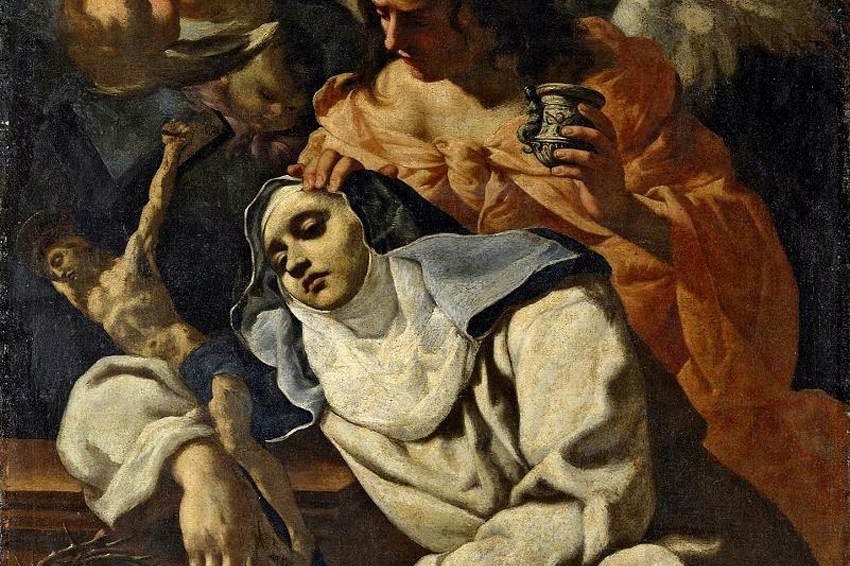
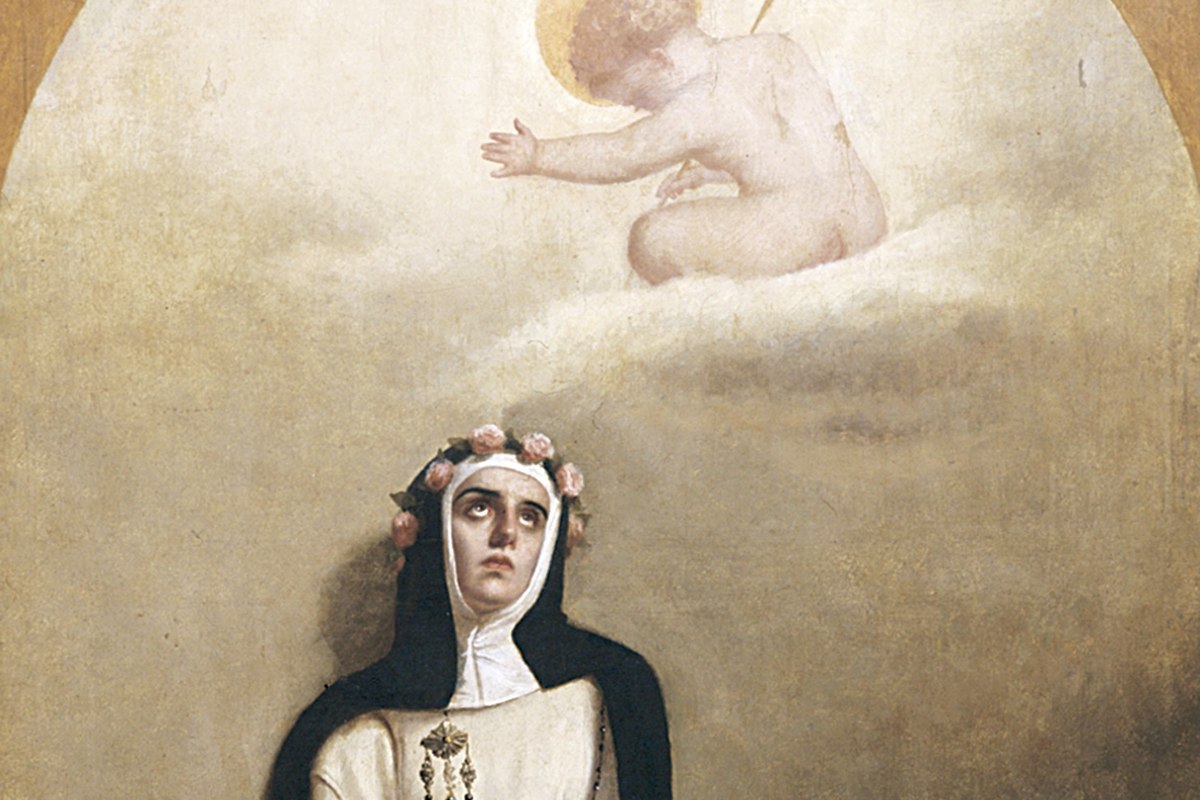
Alessandro Rosi (1627-1697), Ecstasy of Saint Mary Magdalene de' Pazzi — public domain
In 1583, at seventeen, she entered the Carmelite convent of Santa Maria degli Angeli in Florence, choosing this community in part because its relatively relaxed rule allowed frequent reception of the Eucharist, something she considered essential to the life she wanted to live. She took the religious name Maria Maddalena — Mary Magdalene — and made her formal profession the following year, after a serious illness that at one point seemed likely to prevent her from ever taking final vows at all.
Visions that filled volumes
Not long after her profession, Mary Magdalene began experiencing intense mystical states that her community came to call her ecstasies — periods, sometimes lasting hours, during which she appeared to enter a state of rapture, speaking aloud about divine love, the sufferings of Christ, and the workings of the Holy Trinity in language her sisters found startlingly vivid and theologically sophisticated for a young nun with no formal theological training. These experiences intensified around major feasts of the liturgical calendar, particularly Easter and Pentecost, when the convent's spiritual life was already at its most heightened.
The most remarkable episode came over roughly forty consecutive nights, during which Mary Magdalene's superiors arranged for sister-scribes to sit with her continuously, writing down what she said while in these states of rapture. The material they produced was substantial enough to fill several volumes, later published and studied under titles including I Quaranta Giorni ("The Forty Days") and collections of her Colloqui ("Dialogues") — records that remain among the more extensively documented mystical writings to survive from the Counter-Reformation period, the era following the Council of Trent when the Catholic Church placed renewed emphasis on interior spiritual reform. It is important to distinguish, as the Church itself has always insisted with mystical phenomena of this kind, between the substance of Mary Magdalene's teaching on divine love and the specific visionary experiences that accompanied it — the Church has approved and valued the former as a genuine contribution to Catholic spiritual literature, while treating the extraordinary phenomena themselves, as with any private mystical experience, as something the faithful are free to hold with appropriate reverence rather than obligatory belief.
Five years in the dark
What makes Mary Magdalene's spiritual life more than a simple record of consolations is the period of trial that followed her early raptures. Beginning around 1585, she entered roughly five years of what she and later writers on her life describe as profound spiritual aridity — a state in which the sense of God's presence that had marked her earlier experiences seemed to vanish almost entirely, replaced by interior darkness, temptation, and a persistent sense of abandonment. Tradition surrounding her life holds that she experienced this trial as a genuine spiritual desert, comparable in kind, though not necessarily in exact form, to the "dark night" described by Saint John of the Cross, a near-contemporary Carmelite mystic writing in Spain during roughly the same decades.
This extended trial matters for understanding Mary Magdalene's holiness precisely because it complicates any simple picture of her as a nun who merely floated from one ecstatic vision to the next. Carmelite spiritual tradition — reflected also in the writings of Saint Teresa of Ávila, the order's great reformer — has long held that authentic mystical growth typically passes through exactly this kind of purifying darkness, and Mary Magdalene's own life became, for later generations of Carmelites, a documented case study of that pattern.
Governance, death, and recognition
Mary Magdalene did not spend her decades in the convent purely as a mystic set apart from ordinary community life. She held real positions of practical responsibility, serving at different points as novice mistress, responsible for forming young women entering the order, and as subprioress, sharing in the convent's day-to-day governance. Sisters who lived alongside her during these years described her as demanding but deeply caring in her formation of younger nuns, someone who took the ordinary, unglamorous work of running a religious community as seriously as she took her interior spiritual life.
She died in Florence on May 25, 1607, at forty-one, after a long final illness that her community understood, in keeping with the pattern of her whole religious life, as one more trial to be endured rather than resisted. Word of her sanctity spread quickly enough that the process toward her canonization began within years of her death; Pope Clement IX formally canonized her in 1669, a little over six decades after she died. Her feast is kept on May 25, the anniversary of her death, and she remains one of the most extensively documented mystics of the early modern Carmelite tradition — remembered less for spectacle than for a spiritual life that moved, in full view of her community, from ecstatic consolation through years of genuine darkness and back into a quiet, disciplined holiness.
Trivia
Who was Mary Magdalene de' Pazzi before she became a nun?
What were Mary Magdalene de' Pazzi's ecstasies?
Did Mary Magdalene de' Pazzi only experience spiritual consolation?
What roles did she hold within her convent?
When was Mary Magdalene de' Pazzi canonized, and what is her feast day?
You May Also Like
Related Reading