Saint Catherine de Ricci

Born into Florentine wealth, drawn toward the convent early
Catherine de Ricci was born Alessandra Lucrezia Romola de' Ricci in 1522 in Florence, into one of the city's wealthy and politically connected banking families, at the height of the Italian Renaissance. Her mother died when Alessandra was young, and she was raised for a time by an aunt who was herself a Dominican nun — an early, formative exposure to religious life that left a lasting impression. Despite her family's evident hope that she would eventually make an advantageous marriage befitting their social standing, Alessandra felt drawn instead to the Dominican order from adolescence, entering the convent of San Vincenzo in the nearby town of Prato in 1535, at just thirteen years old, and taking the religious name Catherine — a deliberate echo of Catherine of Siena, the great fourteenth-century Dominican mystic whose own intense visionary prayer life Catherine de Ricci's would later come to resemble in striking ways.
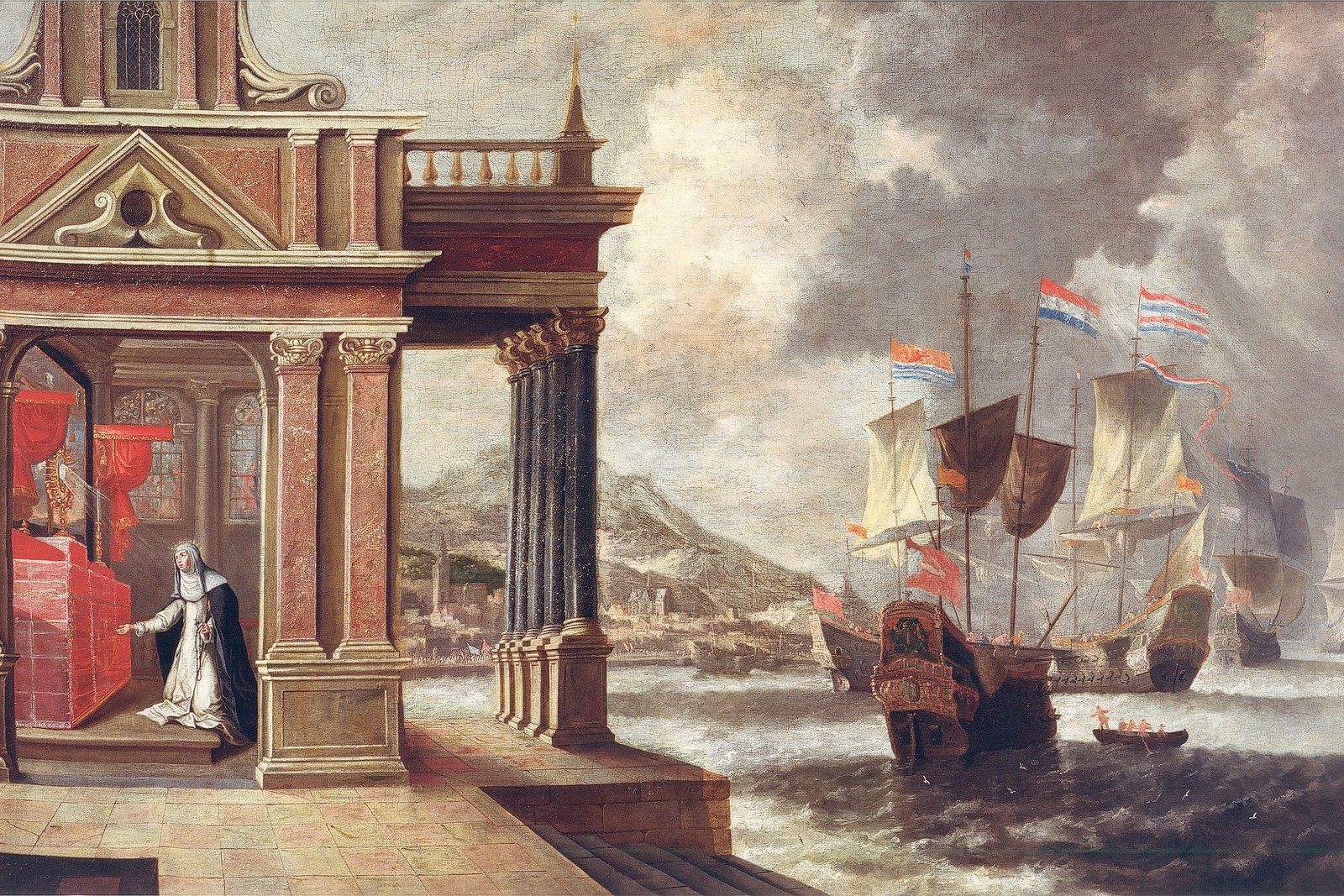
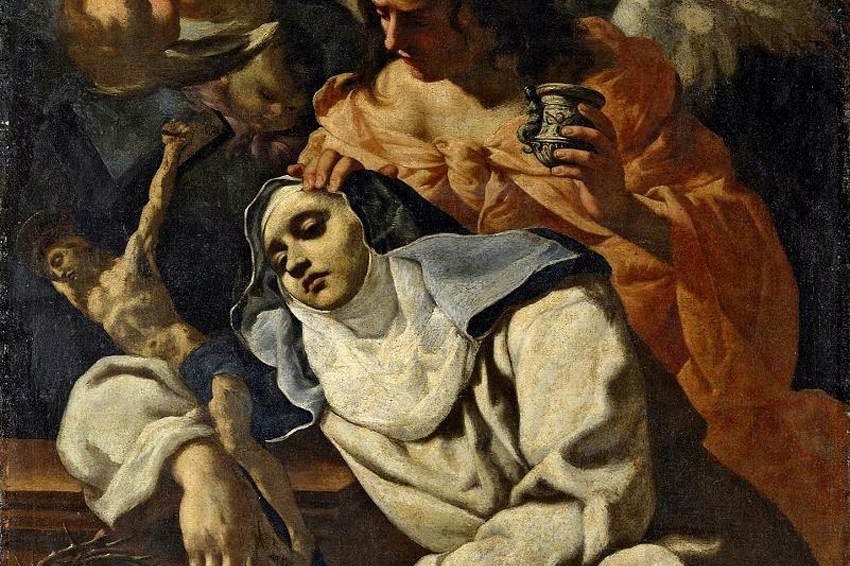
Jan Peeters the Elder, devotional scene connected to Saint Catherine of Ricci, c. 1675, Wikimedia Commons — public domain.
Her early years in the convent were marked by serious illness and periods of intense spiritual struggle, difficulties her biographers describe as genuinely severe rather than merely conventional trials of religious formation. Despite this rocky start, she made her final profession as a Dominican nun in 1536, and it was in the years immediately following that the mystical experiences for which she would become best known began to develop.
Twelve years of weekly ecstasy
Beginning around 1542, Catherine began experiencing what her community described as a sustained weekly ecstasy, occurring almost without interruption every Thursday afternoon and continuing until Friday, for roughly the next twelve years. During these episodes, witnesses described her as appearing to relive, in vivid and visibly overwhelming fashion, the events of Christ's Passion — his arrest, scourging, and crucifixion — remaining in a trance-like state that left her physically unresponsive and, according to numerous accounts from within her own community, impossible to move or rouse until the experience had run its course, sometimes lasting nearly twenty-eight consecutive hours.
Word of these sustained, repeated ecstasies spread well beyond the walls of the Prato convent, and over the years a considerable number of outside visitors — clergy, scholars, and members of prominent families — arranged to observe them directly, a level of external scrutiny that, if anything, worked in Catherine's favor: the sheer consistency and duration of the phenomenon over more than a decade, witnessed repeatedly by so many independent observers, gave it a documentary weight that shorter or less frequently observed mystical claims often lack. As is standard with any reported mystical phenomenon, the Church's own position treats these accounts as part of Catherine's approved cultus and private revelation rather than as binding matters of faith — the historical record of what was widely witnessed is nonetheless considerable.
A trusted administrator, not only a visionary
What kept Catherine's reputation from being defined solely by her mystical experiences was the practical trust her own community placed in her outside of them. She was elected subprioress of the Prato convent while still quite young, and went on to serve multiple terms as prioress, the convent's chief superior, a role demanding the ordinary, unglamorous work of financial management, community discipline, and pastoral oversight of her fellow sisters — responsibilities her community would hardly have entrusted to her repeatedly across decades if they had regarded her primarily as a source of spectacle rather than sound judgment.
Catherine also maintained an extensive correspondence throughout her life with a wide circle of religious and secular figures across Italy, including several cardinals and, notably, Alessandro de' Medici, a churchman from a family with deep ties to her own, who visited her at Prato and would later be elected pope, briefly, as Leo XI in 1605 — well after Catherine's own death, though the connection between the two, formed during her lifetime, was long remembered within Dominican circles as evidence of the breadth of her influence beyond the convent walls.
Later years and canonization
The intense weekly ecstasies that marked Catherine's early religious life gradually subsided after roughly twelve years, giving way to a somewhat quieter, though still deeply prayerful, later period focused increasingly on her administrative responsibilities and correspondence. She died in Prato on February 2, 1590, having spent virtually her entire life, from age thirteen onward, within the same Dominican community.
Devotion to her grew steadily among Dominicans and within Florence and Prato in the decades following her death. She was beatified in 1732 and formally canonized in 1746, and her feast is kept on February 13. Her extensive surviving correspondence, alongside the well-documented accounts of her decade-plus of weekly ecstasies, has made her a particularly well-studied figure among historians of early modern Italian mysticism.
A life bridging cloister and city
Part of what makes Catherine de Ricci's story unusual within the Dominican tradition is how thoroughly her interior life and her external responsibilities remained intertwined rather than separated into distinct phases. She did not experience a period of dramatic mystical phenomena followed by a quieter administrative career, or the reverse — for the better part of two decades, she was simultaneously the community's chief administrator and its most closely watched mystic, with her sisters and outside visitors alike accustomed to a woman who could move between the practical demands of convent governance and hours of profound, visible absorption in prayer, sometimes within the same week.
That combination gave the Ricci family's already considerable standing in Florentine civic life an additional religious dimension that outlasted Catherine herself: the convent of San Vincenzo in Prato remained closely tied to Dominican intellectual and spiritual life in Tuscany for generations afterward, and Catherine's own writings and recorded conversations continued to circulate among Dominican communities well beyond Italy long after her death, cited alongside those of earlier Dominican mystics such as Catherine of Siena as part of a shared tradition of intense, visionary prayer combined with practical religious leadership.
Trivia
Who was Saint Catherine de Ricci?
What were the weekly ecstasies Catherine de Ricci experienced?
Did Catherine de Ricci correspond with anyone who later became pope?
What role did Catherine de Ricci hold in her Dominican community?
When was Catherine de Ricci canonized?
You May Also Like
Related Reading