Saint Peregrine Laziosi, Patron of Cancer Patients

A rebellious youth in a divided city
Peregrine Laziosi was born around 1260 in Forlì, a city in the Romagna region of northern Italy, at a time when Italian towns were violently split between factions loyal to the Pope (Guelphs) and factions loyal to the Holy Roman Emperor (Ghibellines). Forlì leaned Ghibelline, and as a young man, Peregrine — by most accounts a strong-willed and even violent youth caught up in the city's factional street politics — was reportedly among a crowd that confronted a papal legate sent to the city, an encounter tradition says turned physically hostile.
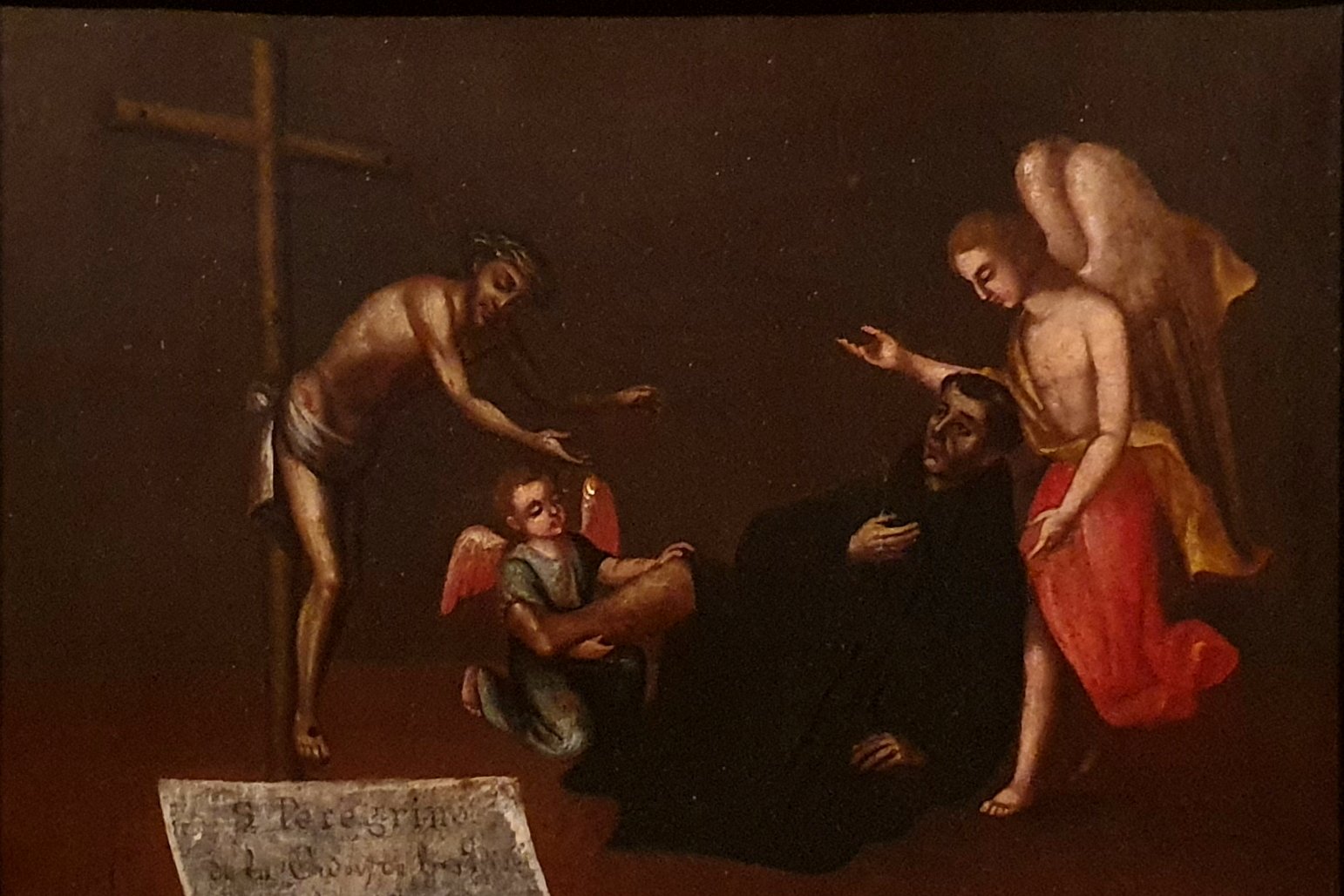
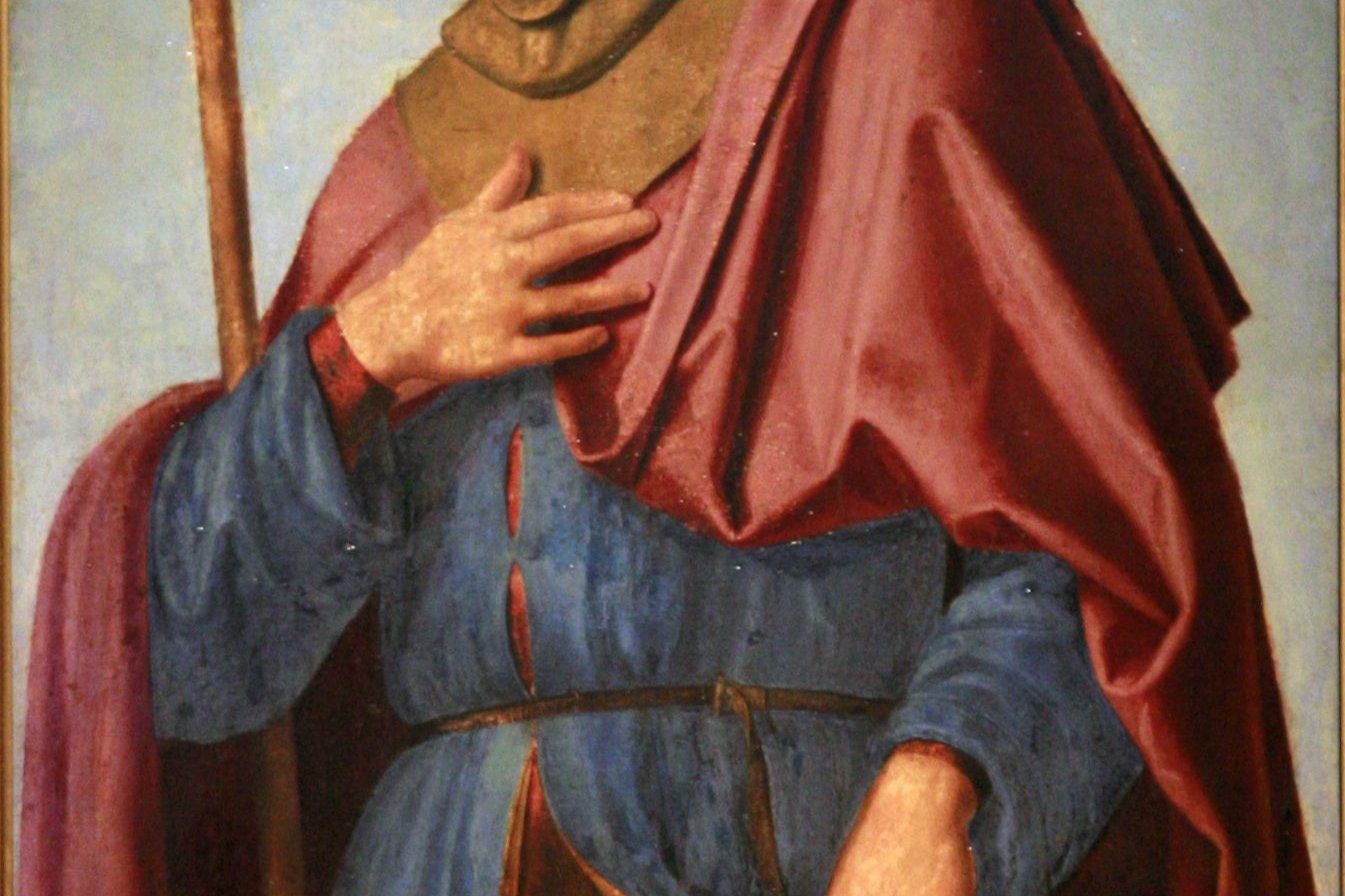
'San Peregrino,' 18th century, unknown painter, Museo de Antioquia, Medellín — photo CC BY-SA 4.0.
The turning point, as later hagiography — the traditional biographical literature written about saints, often composed generations after their deaths — tells it, came through Saint Philip Benizi, a leading figure of the Servite Order who happened to be preaching in Forlì at the time and was reportedly struck by the young man during the unrest. Rather than respond in kind, Philip is said to have offered forgiveness, a gesture tradition credits with shaking Peregrine enough to reconsider the direction of his life entirely. Whatever the precise historical details, Peregrine abandoned his old life, sought out the Servite community, and was eventually received into the Order of the Servants of Mary, founded roughly a century earlier by seven Florentine merchants devoted to the Virgin Mary under her title as Our Lady of Sorrows.
Decades of quiet, demanding service
Once received into the Servites, Peregrine's biography settles into a pattern common to many medieval friars: years of disciplined, largely undocumented religious life, marked by austerity, preaching, and care for the poor and sick of his region. He was eventually ordained a priest and returned to serve in his native Forlì, where tradition credits him with an extraordinarily demanding personal discipline — including, according to later accounts, standing rather than sitting whenever it wasn't strictly necessary to do otherwise, a practice that some hagiographers connect to the leg ailment that would later define his story, though the causal link is tradition rather than documented medical history.
What set Peregrine apart from many of his Servite brothers, according to the accounts that circulated after his death, was an unusually attentive, patient style of pastoral care — visiting the sick personally, sitting with the dying, and building a local reputation for compassion that outlasted him by centuries. That reputation is part of why, when the story of his own illness began circulating, it found an audience already primed to see him as someone whose suffering, and whatever followed it, mattered.
The night before the amputation
The event that made Peregrine's name known well beyond Forlì is, by any measure, the central story of his life — and it belongs, in its most dramatic details, to hagiographical tradition rather than to any contemporary medical record. As it's told: a tumor developed in Peregrine's leg, and by most retellings it advanced far enough, and caused pain severe enough, that a physician recommended amputation as the only way to keep the disease from spreading and killing him. Surgery of this kind in the fourteenth century was performed without anesthesia beyond whatever crude sedation was available, and carried a substantial risk of death from blood loss or infection even when successful — a genuinely desperate last resort, not a routine intervention.
Tradition holds that on the night before the scheduled operation, Peregrine dragged himself before a crucifix in prayer and, exhausted, fell into a kind of trance or sleep in which he experienced a vision of Christ reaching down and touching the diseased leg. When he woke, the tumor and the disease it represented were reportedly gone entirely, leaving the surgeon with nothing left to operate on. This is precisely the kind of claim the Church treats carefully and distinctly from confirmed doctrine: it functioned within his eventual canonization process as part of the traditional record supporting his reputation for sanctity, but it should be understood as devotional tradition passed down through Servite sources rather than a clinically documented miracle by the standard of evidence the Church applies to modern canonization causes.
A long road to canonization
Peregrine died in 1345, reportedly at the advanced age of roughly 85 — itself notable for the period — having spent decades continuing his ministry in Forlì after the healing tradition attributes to him. Devotion to him grew steadily within the Servite Order and across the Romagna region in the centuries that followed, but formal canonization took a long time to arrive: Pope Benedict XIII did not canonize him until 1726, nearly four hundred years after his death. That gap is not unusual for saints whose causes rest primarily on sustained local devotion, reported healings, and the internal records of a religious order rather than on the kind of extensively documented public life that speeds other canonization processes along.
Why cancer patients turn to him today
The specific connection between Peregrine and cancer, as understood in the modern sense of the disease, developed gradually rather than instantly. Medieval and early modern medicine did not distinguish cancer from other tumors and growths with anything like current precision, and many serious growths of any kind were described in the broad language of "cancer" available at the time. As that language solidified into its modern medical meaning over the following centuries, Peregrine's story — a friar healed of a leg tumor on the eve of amputation — became the natural anchor point for Catholic devotion specifically directed toward people facing cancer diagnoses, treatment, and the fear that comes with both. Hospitals, cancer support groups, and individual patients across the world now invoke him by name, and Servite-run shrines dedicated to him, including well-known ones in the United States, continue to draw visitors seeking comfort rather than a guaranteed cure — a distinction that reflects how the Church generally frames devotion to healing saints: as an invitation to hope and prayer alongside medical treatment, not a substitute for it.
Alongside patron saints of physical illness such as Saint Camillus de Lellis, patron of the sick and of nurses, Peregrine occupies a particular place in Catholic devotion precisely because his story centers on the specific, dreaded experience of facing amputation and, in the tradition surrounding him, finding an alternative to it. That specificity — not a general patronage over illness, but a focused connection to one particular kind of suffering — is much of why his cult has remained so personal and enduring across nearly seven centuries.
Trivia
Who was Saint Peregrine Laziosi?
Why is Saint Peregrine the patron saint of cancer patients?
Is Saint Peregrine's healing officially confirmed as a miracle by the Church?
When is Saint Peregrine's feast day?
When was Saint Peregrine canonized?
You May Also Like
Related Reading