Do Angels Have Free Will?

A Question the Fall of Satan Forces You to Ask
If Christian tradition holds that some angels rebelled against God and became demons, then a basic logical question follows almost immediately: how could that happen unless angels are capable of choosing freely? A being with no will of its own, simply following instructions, cannot properly be said to sin — sin, in Catholic theology, requires a free rejection of the good. So the doctrine of the fallen angels, discussed in passages like Revelation 12 and 2 Peter 2:4, is itself indirect evidence for angelic freedom: the Church could not coherently teach that angels fell without also teaching that angels are free.
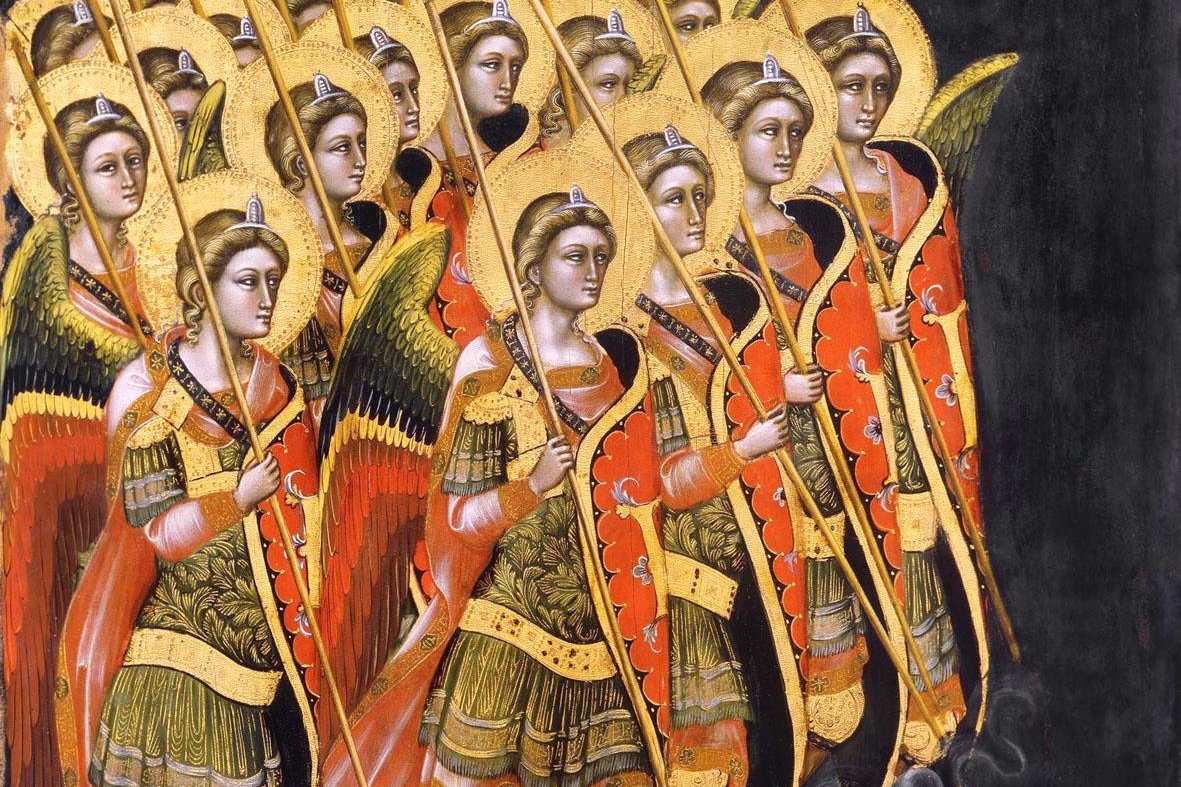
Guariento di Arpo, Angels' Army, c. 1360, Musei Civici, Padua — public domain.
The Catechism states plainly that "the irrevocable character of their choice, and not any defect in the infinite divine mercy, that makes the angels' sin unforgivable" (CCC 393) — language that presupposes a real, deliberate act of will, not an automatic malfunction. Good angels, by the same logic, remain faithful not because they are incapable of anything else, but because they freely and permanently embraced the good.
Why Aquinas Says Angelic Freedom Works Differently Than Ours
The most sustained theological treatment of this question comes from Saint Thomas Aquinas, the 13th-century Dominican friar and doctor of the Church, in the Summa Theologiae. Aquinas devotes an extended series of questions to angelic nature, will, and knowledge, and his central argument is that angels know truth differently than human beings do. Humans reason discursively — moving from premise to premise, gathering evidence, weighing options, often changing our minds as new information arrives or as we simply grow older and see things differently. Angels, Aquinas argues, are pure intellects who grasp truth through direct intuition, all at once, rather than piecing it together over time.
This difference in how angels know has a direct consequence for how they choose. A human decision is almost always made with incomplete information and can be revisited — which is precisely why Catholic moral theology places such emphasis on repentance and conversion as ongoing, lifelong possibilities. An angel's decision, Aquinas argues, is made with total clarity about what is being chosen and what it means; there is no fog of uncertainty left to reconsider later. Once an angel chooses, for or against God, with that degree of comprehension, the choice is total, and therefore stable in a way no human choice quite is.
No Body, No Wavering
A second piece of Aquinas's argument concerns embodiment. Human beings are composites of body and soul, and the body constantly introduces variables into our decisions: hunger, fatigue, illness, hormones, the passage of years, the pull of competing desires that rise and fall with mood and circumstance. Much of what looks like "changing your mind" in human life is really the changing conditions of an embodied life reshaping how we feel about a past decision.
Angels, in traditional Catholic theology, are pure spirits — created intelligences without bodies, unlike human beings, who are body and soul together (CCC 328-330 discusses angels as purely spiritual creatures). Without a body's shifting states to contend with, an angel's will is understood to follow directly and permanently from what its intellect grasps, with none of the friction that makes human resolve waver over a lifetime. This is part of why Catholic tradition speaks of the angelic choice as something closer to a single, defining act rather than an unfolding story — the very thing that makes a human life, with its capacity for repentance and change, so different in kind.
So Were the Angels Ever "Tested"?
Catholic tradition, though not formal dogma on this specific point, has long held that angels underwent some kind of trial or testing period immediately after their creation — a moment in which their will was, in effect, put to the choice that would define them permanently. This idea appears in various forms across medieval theology, often connected to reflection on why some angels, seeing the future plan of the Incarnation (God becoming human), might have rebelled out of pride at the thought of a human nature being exalted above the angels. This particular explanation for why Satan fell is theological speculation built on scattered texts, not a directly revealed teaching, and readers should hold it more loosely than the core doctrine that angels are free and that their choice, once made, does not change.
Freedom Without a Second Chance
The upshot is a genuinely striking theological claim: angels are more free than human beings in one sense — their intellect is clearer, their will more direct, unclouded by the confusion and competing pressures that make human choice so often tentative — and yet less free in another, because that same clarity removes the possibility of the kind of gradual, revisable, repentance-shaped freedom that defines human moral life. It is a reminder that "free will" is not a single, uniform thing across all of God's creation, but takes different shapes depending on the nature of the creature exercising it.
For the doctrine's most consequential application — how this framework explains the fall of Satan and the rebel angels — see Fallen Angels and the War in Heaven. The traditional hierarchy angels are organized into, itself a product of the same theological tradition that produced Aquinas's account of angelic will, is laid out in The Nine Choirs of Angels.
Trivia
Do angels have free will according to Catholic teaching?
Why can't angels change their mind after choosing, unlike humans?
Does having no body affect an angel's free will?
If God created angels good, how could any of them choose evil?
Is angelic free will different from human free will?
Related Reading