The Calling of the First Apostles

An Ordinary Morning on the Water
Matthew's Gospel places this scene right at the start of Jesus's public ministry, immediately after his forty days in the desert and the beginning of his preaching in Galilee. "As he was walking by the Sea of Galilee, he saw two brothers, Simon who is called Peter, and his brother Andrew, casting a net into the sea; they were fishermen" (Matthew 4:18). There is nothing dramatic about the setup — two working men doing their trade on an unremarkable day, the kind of labor that would have filled most of their waking hours.
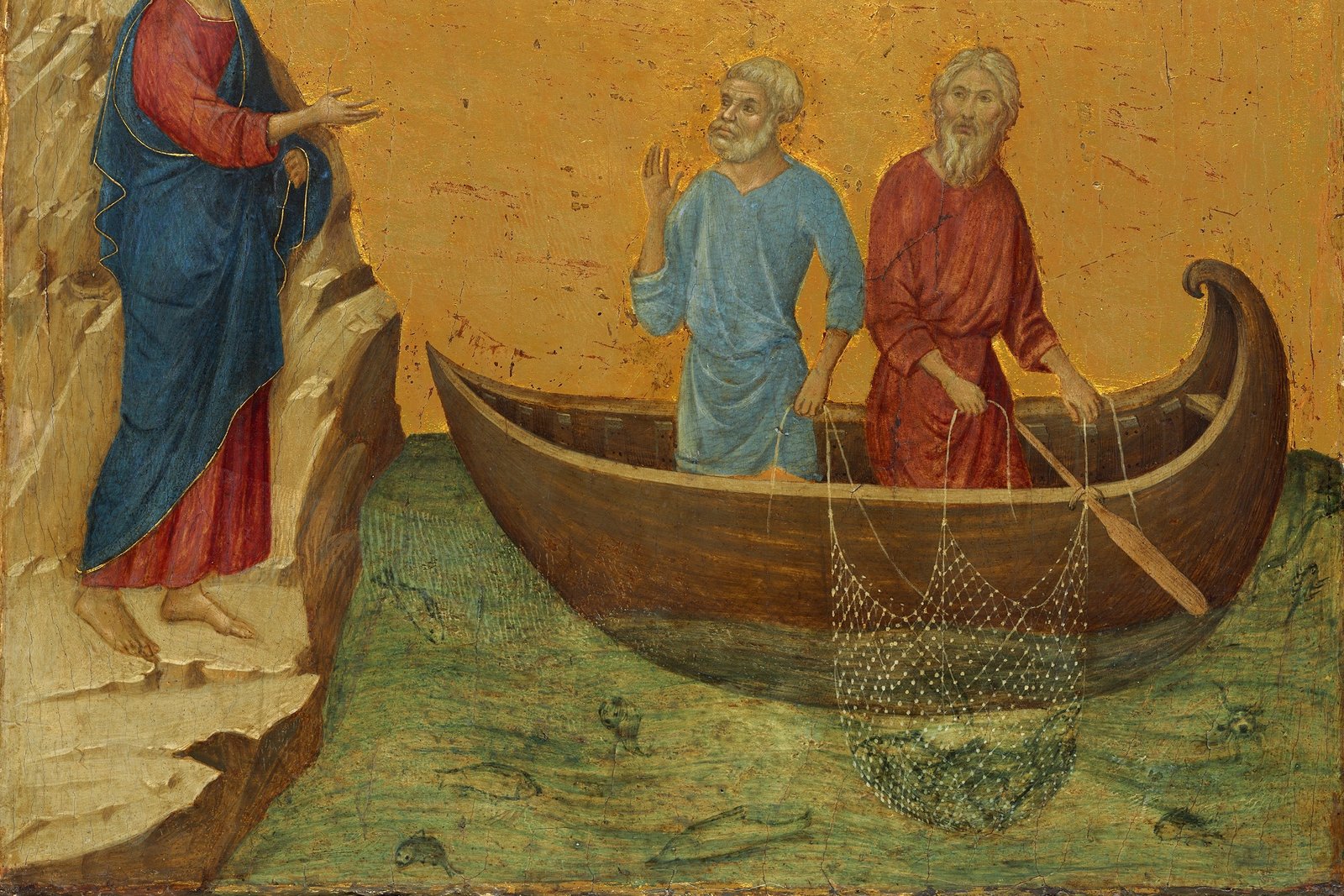
Duccio di Buoninsegna, The Calling of the Apostles Peter and Andrew, 1308-1311 — public domain.
"Come After Me"
Jesus's call is strikingly brief, given everything that follows from it: "Come after me, and I will make you fishers of men" (4:19). It is built directly on the men's own occupation — not asking them to abandon their skill, but to redirect it entirely, toward gathering people rather than fish. What Matthew records next is almost jarring in its speed: "At once they left their nets and followed him" (4:20). No negotiation, no clarifying questions about where they were going or what it would cost them. Just an immediate departure.
Leaving the Family Business
The pattern repeats and intensifies just a little further along the shore. "He walked along from there and saw two other brothers, James, the son of Zebedee, and his brother John. They were in a boat, with their father Zebedee, mending their nets. He called them, and immediately they left their boat and their father and followed him" (4:21-22). James and John's departure carries an extra weight — they leave not only their tools and trade but their own father, standing right there in the boat, mid-task. The family fishing business simply loses two of its workers in an instant.
What Made the Call So Compelling
The Gospel of John offers a possible piece of the background Matthew leaves out. In John's account, Andrew (and likely Peter, though the text is ambiguous about the second unnamed disciple) had already encountered Jesus earlier, pointed toward him by John the Baptist's own testimony — "Behold, the Lamb of God" (John 1:36) — and had spent time with Jesus before this moment on the shore. Read alongside Matthew, the two accounts suggest the apparent suddenness of the calling by the sea may have followed an earlier introduction, even if the final call itself still required a complete, immediate response.
Whatever the exact sequence, the Gospels consistently emphasize the authority carried in Jesus's summons itself rather than any argument or extended persuasion. The call functions almost sacramentally — spoken, and effective the moment it is received.
Luke's Version: A Miraculous Catch First
Luke's Gospel tells the same calling with an added scene that Matthew and Mark leave out entirely. Before Peter, Andrew, James, and John walk away from their nets, Luke describes Jesus first teaching from Peter's boat, then telling him to push out into deeper water and let down the nets again after a fruitless night of fishing. The catch that follows is so large it nearly breaks the nets and swamps two boats. Peter's reaction isn't excitement but fear and shame: "When Simon Peter saw this, he fell at the knees of Jesus and said, 'Depart from me, Lord, for I am a sinful man'" (Luke 5:8). Jesus answers not with reassurance about the fish but with the same call found in Matthew, reframed: "Do not be afraid; from now on you will be catching men" (5:10). Only then does Luke record the same immediate response: "When they brought their boats to the shore, they left everything and followed him" (5:11).
Read alongside Matthew's spare, quick account, Luke's version adds a layer Matthew doesn't supply: a concrete demonstration of Jesus's authority, delivered through the very trade he is about to ask these men to abandon, that helps explain — without fully resolving the mystery of — why the response was so total and so immediate.
Catholic Reading: The Pattern of Vocation
The calling of the first apostles has shaped how the Catholic Church has understood the nature of vocation ever since. The call comes first, entirely as gift — Peter, Andrew, James, and John do nothing to earn or deserve it; Jesus simply approaches them where they are, in the middle of ordinary work. The response, though, is total: not a partial accommodation of discipleship alongside an unchanged life, but a complete reordering of priorities, symbolized by nets and a boat left behind mid-task.
This pattern — unearned call met with total response — has served as the theological template for every subsequent Christian vocation the Church recognizes, from ordained priesthood and religious life to the general call to discipleship extended to every baptized believer. Peter in particular, called first among these men, becomes in Catholic tradition the rock on whom Christ builds his Church (Matthew 16:18), his ministry beginning not with any credential or preparation but with an interrupted fishing net and an immediate walk away from everything familiar.
Related reading: see Doubting Thomas for how one of the apostles' faith was tested after the Resurrection, and Peter's Denial of Jesus for the fuller, harder arc of the disciple called first on this shore.
Trivia
Who were the first apostles Jesus called?
What exactly did Jesus say to Peter and Andrew?
What did James and John leave behind to follow Jesus?
Why did the disciples respond so immediately, with no hesitation described?
How does the Catholic Church understand this calling today?
Related Reading