Exaltation of the Holy Cross

A temple built to bury a memory
By the early fourth century, the site in Jerusalem where Christian tradition located Christ's crucifixion and burial had been physically transformed almost beyond recognition. In the second century, the emperor Hadrian, rebuilding Jerusalem after suppressing a major Jewish revolt and renaming the city Aelia Capitolina, had constructed a temple to Venus directly over the traditional site of Golgotha and the nearby tomb, a project some ancient Christian writers understood, whether accurately or not, as a deliberate attempt to erase Christian memory of the location by covering it with pagan construction.
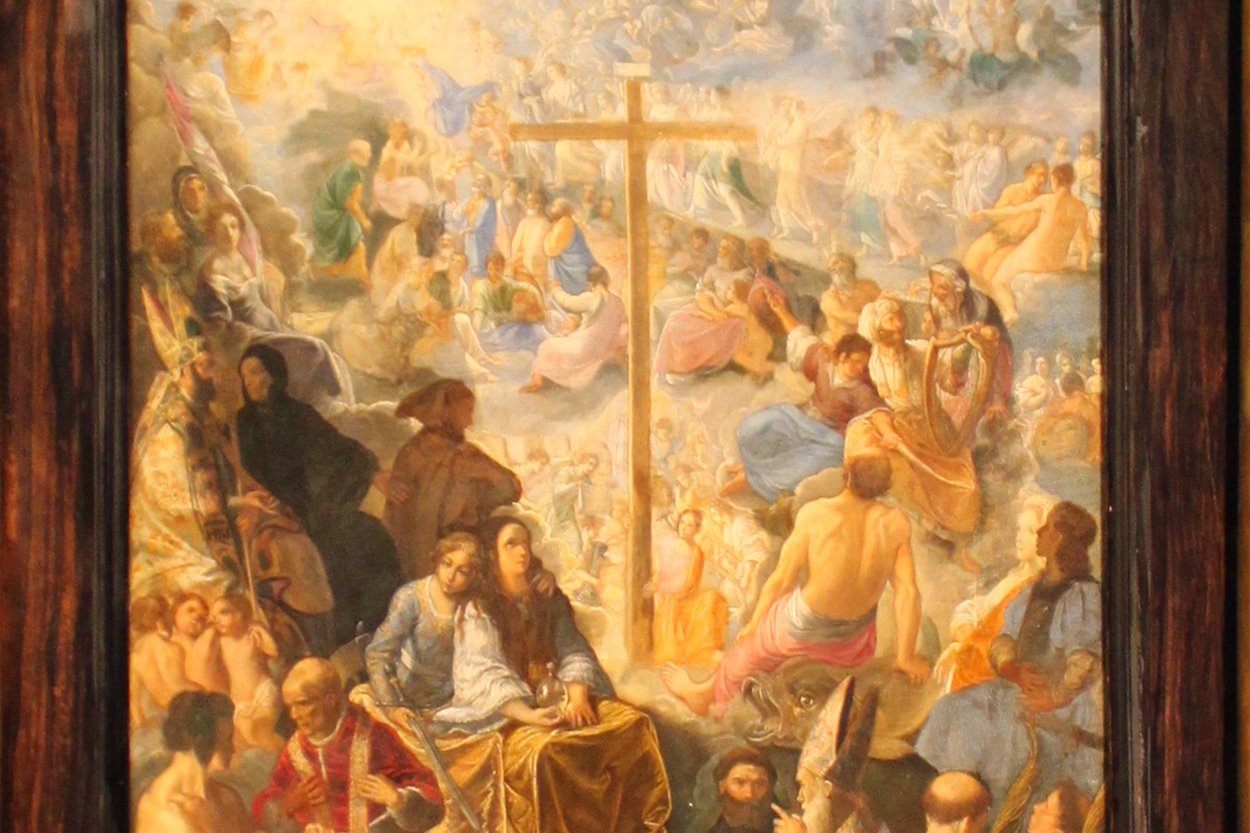
Adam Elsheimer, panel from the Kreuzaltar (Exaltation of the Cross), c. 1603–1605 — public domain.
That situation changed dramatically after Constantine's conversion to Christianity and his legalization of the faith throughout the empire in the early fourth century. Constantine ordered Hadrian's temple demolished so that a church could be built on the site it occupied, a major undertaking that, according to the historical tradition surrounding it, uncovered far more beneath the rubble than anyone building the new church had necessarily expected to find.
Helena's journey and the discovery
Helena, Constantine's mother, had converted to Christianity later in life and undertook a pilgrimage to the Holy Land in the 320s, by then a woman in her late seventies, according to the ancient sources that describe her journey. Multiple early Christian historians, writing within decades of the events, including Eusebius of Caesarea and, somewhat later, Rufinus of Aquileia, describe Helena's involvement in building churches at sites associated with major events in Christ's life, though the specific, vivid story of her personally overseeing the discovery of the True Cross develops with more narrative detail in slightly later sources than in Eusebius's own contemporary account, a gap that has led historians to treat the precise details of the discovery narrative with appropriate caution while still recognizing Helena's genuine, well-documented involvement in the broader building projects at Jerusalem's holy sites during this period.
According to the fuller tradition recorded by Rufinus and later writers, the excavation beneath the demolished temple uncovered three separate wooden crosses along with the nails used in crucifixion, presumably remnants of the site's continued use for Roman executions in the period following Christ's own death. Since no inscription clearly marked which cross, if any, belonged to Christ, tradition holds that Bishop Macarius of Jerusalem devised a test to determine the true relic: the crosses were brought, in most versions of the story, to a woman who was gravely ill or, in an alternate telling, to a corpse being carried for burial, and contact with one particular cross was said to have produced a miraculous cure or resurrection, distinguishing it decisively from the other two.
A relic divided and dispersed
Whatever the precise historical accuracy of the discovery narrative in all its detail, a relic venerated across the Christian world as the True Cross does appear reliably in the historical record from the mid-fourth century onward, described by pilgrims visiting Jerusalem, including the pilgrim Egeria in her detailed travel account from the 380s, which describes an elaborate annual veneration ceremony already well established in Jerusalem by that date, with crowds queuing to kiss and venerate the relic under close clerical supervision, reportedly because of an earlier incident in which a pilgrim had attempted to bite off and steal a fragment.
Over the following centuries, portions of the relic were distributed as gifts to churches and rulers across the Christian world, a practice that, combined with the relic's fragmentation and multiplication of pieces claimed as authentic across numerous European churches by the Middle Ages, has made modern historians understandably cautious about assessing the material authenticity of any specific surviving fragment today, even while the broader devotional and liturgical tradition surrounding the relic's veneration remains a matter of long, continuous historical record independent of that question.
Heraclius and the recovery of the relic
The feast's specific character as an "exaltation," a ceremonial lifting up of the cross for veneration, owes much to a second major historical episode centuries after Helena's time. In 614, Persian Sassanid forces captured Jerusalem and seized the relic of the True Cross along with much of the city's other treasure, carrying it off as a prize of war, a serious blow to Christian communities throughout the Byzantine Empire.
The Byzantine emperor Heraclius eventually defeated the Persian forces and negotiated the relic's return, and in 630 he is said to have personally carried the recovered cross back into Jerusalem in a solemn ceremonial procession, restoring it to the church built on the site of its original discovery three centuries earlier. That dramatic act of restoration and public veneration reinforced and, in the view of many liturgical historians, helped further popularize the already-existing feast commemorating the cross's discovery and the original 335 dedication of the Church of the Holy Sepulchre, both threads of history converging into the single feast of the Exaltation of the Holy Cross kept across the Christian world today.
A feast kept across East and West
The feast, observed on September 14, is kept with particular solemnity in the Eastern Christian churches, where it ranks among the most significant feasts of the liturgical year, marked by distinctive rituals including the elevation of a cross before the assembled congregation and, in some traditions, a period of fasting. In the Western Church, the feast holds a comparatively quieter but still well-established place on the calendar, a reminder that runs alongside Good Friday's own commemoration of the crucifixion that the instrument of Christ's death, in Christian theological understanding, became paradoxically also the instrument of the world's redemption, worthy in that light of solemn veneration rather than simple mourning.
Trivia
What is the feast of the Exaltation of the Holy Cross?
Who was Saint Helena, and what did she do in Jerusalem?
How did tradition say the True Cross was identified among the crosses found?
What happened to the relic of the True Cross after its discovery?
Why is the feast called an 'exaltation'?
Related Reading