The Most Holy Name of Jesus

A name given by an angel, not a family
In most cultures, a child's name is chosen by the parents, sometimes after a grandparent, sometimes for its sound, sometimes for tradition's sake. Jesus's name arrived differently. Matthew's Gospel records that an angel appeared to Joseph in a dream and instructed him directly: "She will bear a son and you are to name him Jesus, because he will save his people from their sins." (Matthew 1:21, RSV-CE). Luke's Gospel records a parallel scene at the Annunciation, where the angel Gabriel gives Mary the same instruction before the child is even conceived. Between the two Gospel accounts, both parents receive the name from a divine messenger, not from personal preference — a detail the Church has never treated as incidental.
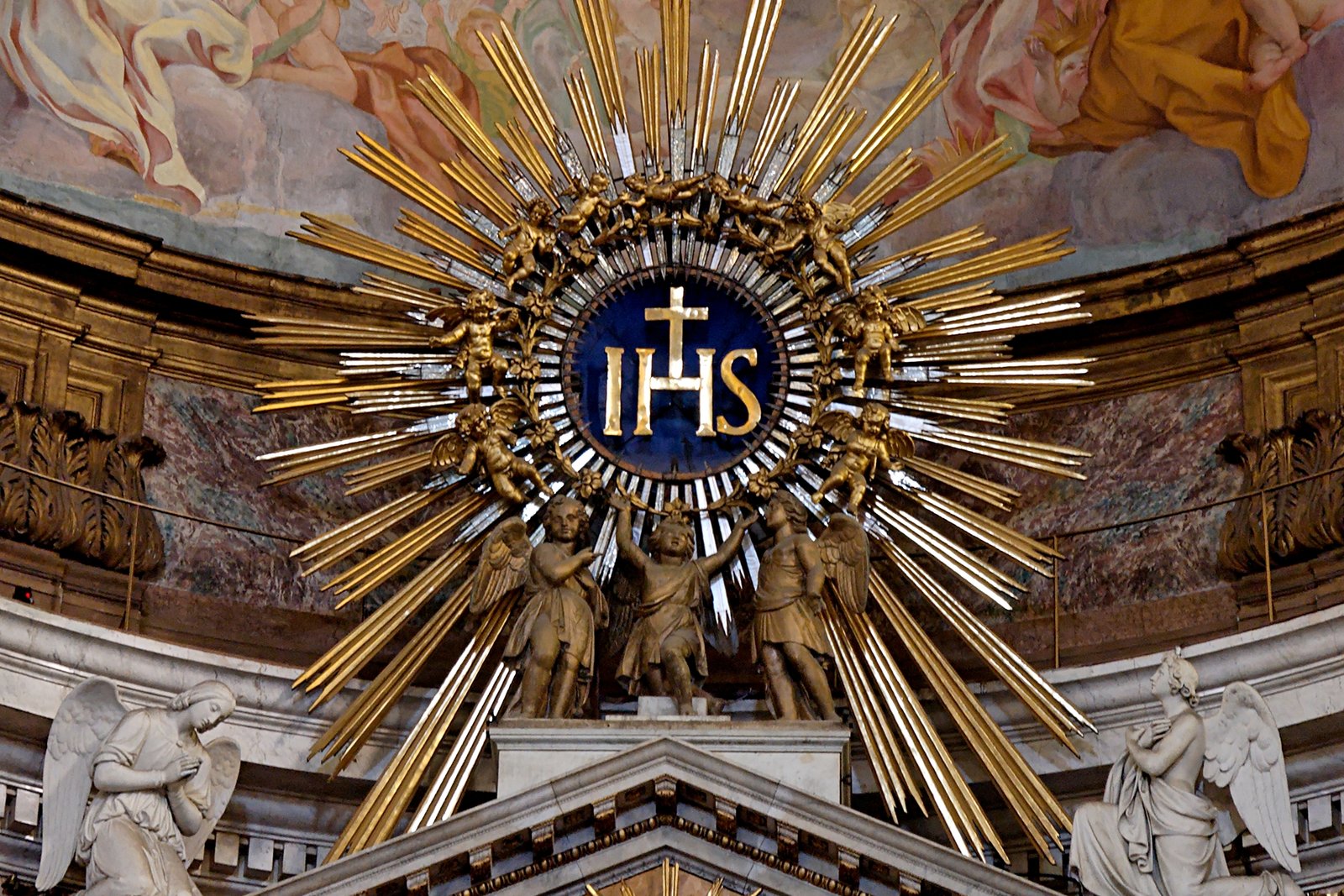
IHS monogram, high altar, Church of the Gesù, Rome. Photo by Jastrow, Wikimedia Commons — public domain.
The name itself carries the instruction inside it. "Jesus" is the Greek and Latin form of the Hebrew Yeshua, itself a shortened form of Yehoshua — the same name rendered in English as Joshua elsewhere in the Old Testament. Its root meaning is "the Lord saves" or "Yahweh is salvation," which is precisely why the angel's explanation to Joseph reads almost like a definition rather than a prophecy: the child would be named Jesus because he would save his people from their sins. The name and the mission are, in the Hebrew, essentially the same statement said two different ways.
Eight days after Bethlehem
Jewish custom required that a male infant be circumcised and formally named on the eighth day after birth, following the pattern established in Genesis with Abraham's line. Luke's Gospel records that this is exactly what happened for Jesus: "When eight days were completed for his circumcision, he was named Jesus, the name given him by the angel before he was conceived in the womb." (Luke 2:21, RSV-CE). That timing is why the Church has traditionally kept the naming of Jesus close to the Christmas season — the feast now falls on January 3, within the same liturgical stretch that includes both the Nativity and the Solemnity of Mary, Mother of God, itself observed on the octave day of Christmas, January 1.
It's worth pausing on how deliberately ordinary that first naming ceremony would have looked to anyone watching. There was no grand public announcement, no gathering of dignitaries — just a family following the same Jewish ritual observance that every other infant boy in the region underwent in that era. The extraordinary claim attached to the name only becomes visible in hindsight, through what the rest of the Gospel goes on to show about who this particular child turned out to be.
"The name above every name"
The New Testament doesn't stop at recording how Jesus received his name — it makes a striking theological claim about the name itself. Writing to the church at Philippi, Saint Paul describes Christ's self-emptying obedience unto death, and then continues: "Because of this, God greatly exalted him and bestowed on him the name that is above every name, that at the name of Jesus every knee should bend, of those in heaven and on earth and under the earth, and every tongue confess that Jesus Christ is Lord, to the glory of God the Father" (Philippians 2:9-11, NABRE). This passage, likely adapted by Paul from an even earlier Christian hymn, treats the name of Jesus as inseparable from his identity and authority — invoking the name is treated as engaging with the person himself, not merely using a convenient label.
The Acts of the Apostles makes a similarly bold claim in narrative form. After Peter heals a crippled man "in the name of Jesus Christ the Nazorean" (Acts 3:6, NABRE), he's brought before the Jewish council and pressed to explain the source of his authority. His answer is direct: "There is no salvation through anyone else, nor is there any other name under heaven given to the human race by which we are to be saved." (Acts 4:12, RSV-CE). For the earliest Christians, the name of Jesus wasn't treated as a polite formality attached to prayer — it carried real, functional weight, invoked for healing, for exorcism, and for the entire framework of salvation the apostles preached.
How devotion to the Name grew and took visible form
Devotion to the Holy Name developed its own visual shorthand over the centuries: the monogram IHS, drawn from the first three letters of Jesus's name in Greek capital letters, IHΣΟΥΣ (iota, eta, sigma). In the Latin West, those same three letters were later given devotional Latin expansions such as "Iesus Hominum Salvator" — Jesus, Savior of Mankind — even though the monogram's origin is Greek, not an original Latin acronym. The 15th-century Franciscan preacher Saint Bernardine of Siena did more than almost anyone else to popularize the symbol, displaying it prominently during his sermons and encouraging its use on church facades, banners, and civic buildings across Italy as a visible sign of Christian devotion distinct from the factional symbols that divided Italian cities at the time.
That same monogram would later become closely associated with the Society of Jesus, the Jesuit order founded by Saint Ignatius of Loyola in the 16th century, whose crest still features the IHS symbol at its center — a continuation of the same devotion Bernardine had spread a century earlier, now carried by missionaries across the globe. The devotion also gave rise to distinct liturgical prayers and litanies addressed to the Holy Name, used in both public worship and private piety, treating repeated, reverent invocation of the name itself as a legitimate form of prayer rather than mere preamble to it.
A feast that keeps a name close to Christmas
The Feast of the Most Holy Name of Jesus has moved around the calendar more than once across Church history, sometimes celebrated separately, sometimes folded into other Christmastide observances. In the current Roman calendar it holds a fixed date, January 3, sitting between the octave of Christmas and the approach of Epiphany. Its placement keeps the feast tethered to the Nativity narrative it comes from — a reminder, near the start of each new year, that the child whose birth the Church has just finished celebrating was given a name that was never meant to be ordinary, chosen specifically to declare, before he had done anything else at all, exactly what he had come to do.
Trivia
What does the name Jesus actually mean?
Who chose the name Jesus, and why?
What does Saint Paul mean by calling it 'the name above every name'?
What does the monogram IHS on churches and vestments stand for?
When is the feast of the Holy Name of Jesus celebrated?
Related Reading