The Rich Man and Lazarus — Luke's Parable Explained

A gate, a table, and a great deal of silence
Jesus tells this story in the middle of a longer teaching about money and stewardship in Luke's Gospel, and it opens with two lives set side by side with almost no commentary. "There was a rich man who dressed in purple garments and fine linen and dined sumptuously each day" (Luke 16:19, NABRE). Purple dye was famously expensive in the ancient world — reserved for royalty and the wealthiest households — so the detail isn't decoration. It's Jesus telling his listeners, in one sentence, exactly how much this man had and exactly how visibly he wore it.
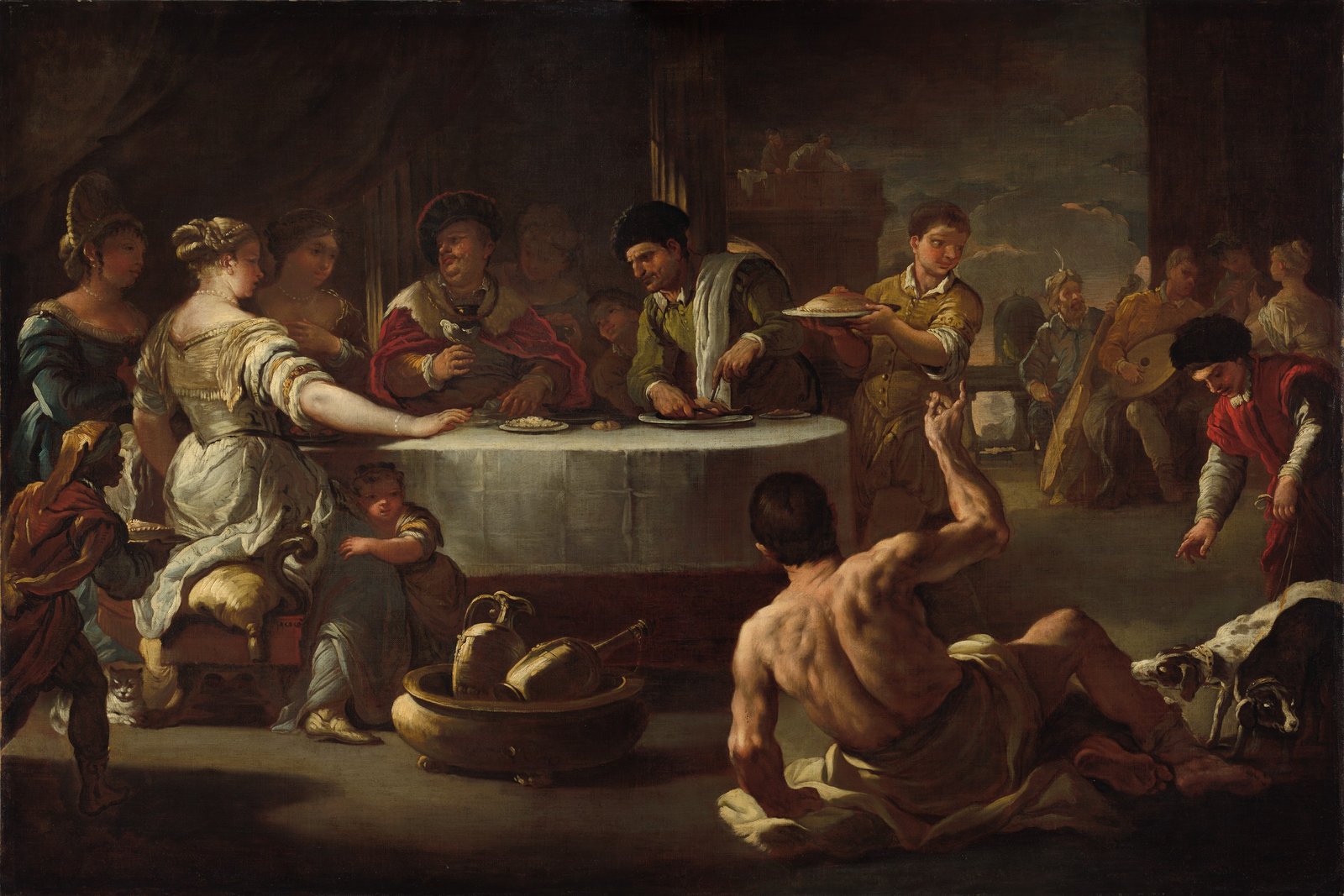
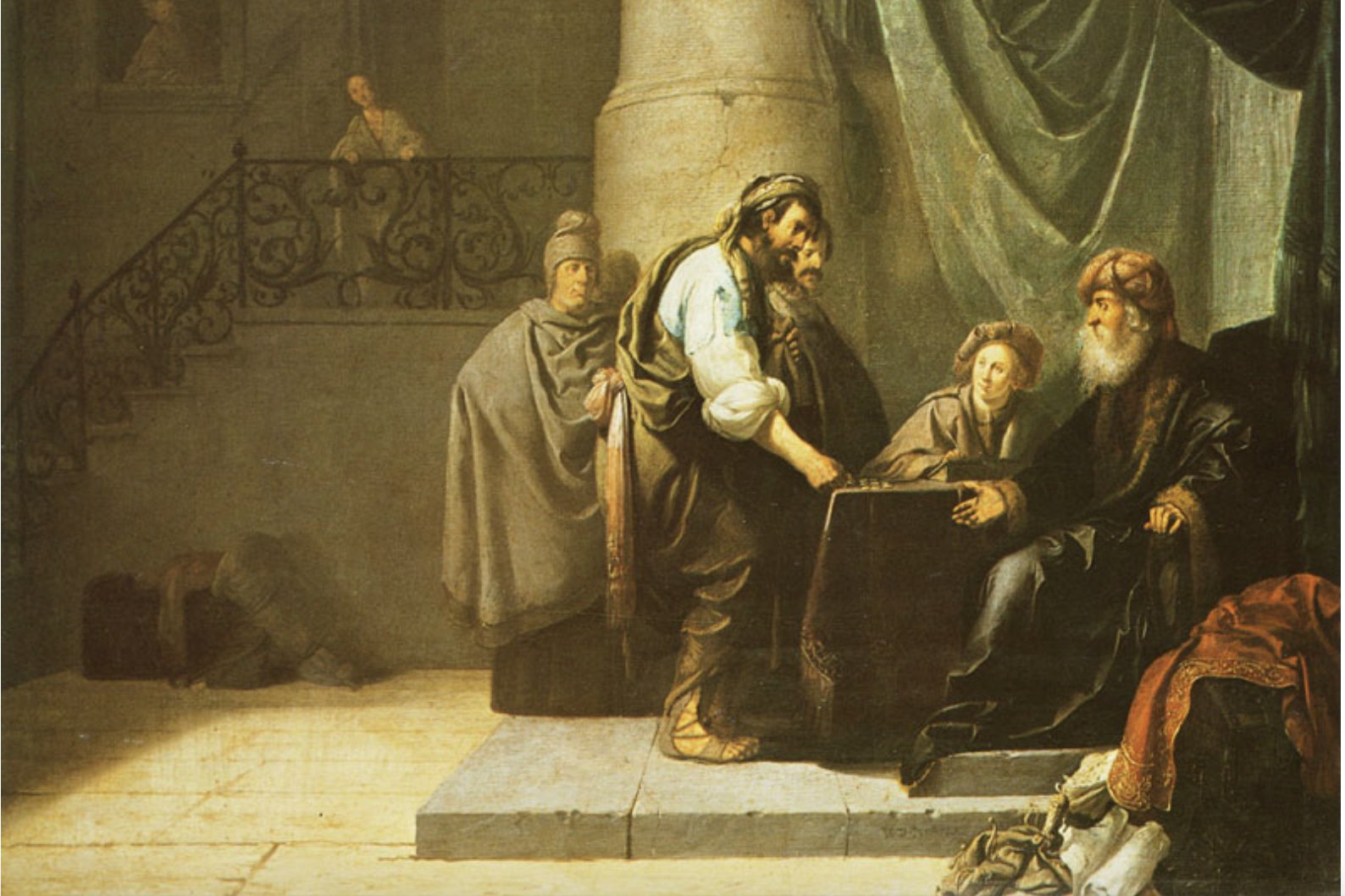
Attributed to Luca Giordano, Dives and Lazarus, 17th century, Fogg Museum, Harvard Art Museums — public domain.
Then the scene cuts, without transition, to the gate. "And lying at his door was a poor man named Lazarus, covered with sores, who would gladly have eaten his fill of the scraps that fell from the rich man's table. Dogs even used to come and lick his sores" (Luke 16:20-21, NABRE). The rich man is never described as cruel to Lazarus. He never has him driven off, never insults him. That's arguably the point Jesus is making: the rich man's sin in this story isn't an act of violence, it's a habit of not seeing. Lazarus is simply part of the furniture of the gate, walked past every day on the way to dinner.
The only named character in any parable Jesus tells
Here's a detail easy to read past: in every other parable in the Gospels, Jesus's characters go unnamed — a sower, a shepherd, a prodigal son, a Samaritan on a road. This is the one exception. The beggar has a name, Lazarus, from the Hebrew Eleazar, meaning "God has helped." The rich man never gets one; later Christian tradition nicknamed him "Dives," which is simply Latin for "a rich man," not an actual name given in the text.
The reversal is deliberate and it's the engine of the whole story. In life, the rich man is the person everyone in the neighborhood could have named on sight, while the beggar at his gate was invisible enough to go unnoticed. Jesus flips it: in the world the parable describes, Lazarus is the one whose identity survives, and the man of purple and fine linen becomes, permanently, "a certain rich man."
Death arrives, and everything changes
"When the poor man died, he was carried away by angels to the bosom of Abraham. The rich man also died and was buried, and from the netherworld, where he was in torment, he raised his eyes and saw Abraham far off and Lazarus at his side" (Luke 16:22-23, NABRE). The imagery here — Lazarus resting at Abraham's side, a position of honor and closeness reserved for a beloved guest at a banquet — would have struck first-century Jewish listeners as a vivid picture of final peace with the father of their faith. The rich man, by contrast, is described as being in torment in a place Luke's Greek calls Hades, the shadowy realm of the dead.
What follows is a conversation, not a punishment scene. The rich man calls out, still assuming a kind of social order survives death: "Father Abraham, have pity on me. Send Lazarus to dip the tip of his finger in water and cool my tongue, for I am suffering torment in these flames" (Luke 16:24, NABRE). Even now, he sees Lazarus as someone who exists to serve him — the habit of a lifetime doesn't disappear just because the lifetime has ended. Abraham's answer names the reversal outright: "My child, remember that you received what was good during your lifetime while Lazarus likewise received what was bad; but now he is comforted here, whereas you are tormented" (Luke 16:25, NABRE).
A chasm that cannot be crossed
Abraham then delivers the parable's hardest line: "Moreover, between us and you a great chasm is established to prevent anyone from crossing who might wish to go from our side to yours or from your side to ours" (Luke 16:26, NABRE). It's worth being honest about what this detail is doing theologically. The Catholic Church does not treat this parable as a systematic geography of the afterlife — it's a single teaching story, not a doctrinal treatise on the mechanics of Heaven and Hell. What it communicates plainly, though, is a moral truth Catholic tradition takes seriously: the choices a person makes in life — particularly how they treat the poor and suffering at their own gate — carry consequences that cannot simply be undone or renegotiated after death.
"They have Moses and the prophets"
The parable's final movement turns from the rich man's own fate to his family. Realizing he can't be helped, he begs Abraham to send Lazarus back from the dead as a warning to his five living brothers, certain that seeing a dead man walk would finally get their attention. Abraham's reply is blunt: "They have Moses and the prophets. Let them listen to them" (Luke 16:29, NABRE). When the rich man protests that a returning dead man would surely be more convincing, Abraham closes the story with a line that reads almost like a challenge thrown forward at the reader: "If they will not listen to Moses and the prophets, neither will they be persuaded if someone should rise from the dead" (Luke 16:31, NABRE).
Christian readers across the centuries have noticed the uncomfortable irony in that last line, coming as it does from the mouth of Jesus, who would indeed rise from the dead not long after telling this story — and whose resurrection would, in fact, fail to convince plenty of people who had already made up their minds. Luke doesn't spell out the connection for us; it's simply there, waiting to be noticed by anyone paying attention on a second reading.
Not the same Lazarus — a point worth making clearly
Because the name recurs elsewhere in the Gospels, it's worth stating plainly: this parable's Lazarus and Lazarus of Bethany, the friend Jesus raises from a real tomb after four days in the Gospel of John, are two entirely different figures. One is a character inside a teaching story; the other is a specific person in a specific town, with a sister named Martha and a documented illness, death, and resurrection. Nothing in Scripture connects the two beyond a shared, fairly common Jewish name of the period. Conflating them is an easy mistake to make, but the two Lazaruses belong to different literary genres entirely — parable and narrative — and neither Gospel treats them as related.
A story that still unsettles
Part of what has kept this parable current for two thousand years is how little theological machinery it requires to land. There's no vision, no angelic messenger explaining the moral, no dream sequence — just a gate, a beggar, a rich man, and the plain fact of what each one did, or didn't do, about the other's presence. It sits alongside Jesus's other warnings in Luke about the dangers of storing up treasure and ignoring the poor, as one of the more direct challenges in his teaching to notice the person at the gate before it's too late to do anything about it.
The parable never says the rich man did anything actively evil to Lazarus. That absence of villainy is exactly what makes the story endure — most people reading it recognize, uncomfortably, that indifference dressed in purple and fine linen is a much more common sin than outright cruelty, and a much easier one to commit without ever noticing you're doing it.
Trivia
Is the rich man and Lazarus a true story or a parable?
Why does the beggar have a name but not the rich man?
Is this Lazarus the same person Jesus raised from the dead in the Gospel of John?
What is the 'great chasm' the rich man describes?
What does the rich man ask Abraham to do for his five brothers?
Related Reading