Prayers for the Family: Practical Prayers and Tips

The family as a small church
The Second Vatican Council and later papal teaching gave the Christian family a specific name: the domestic church, a small community where children first encounter prayer, worship, and faith lived out in daily life, echoing in miniature what the wider Church does at a larger scale. The Catechism situates family prayer within this understanding, describing the home as the first place where a child learns to pray, primarily by watching parents pray rather than by being formally taught (CCC 1655-1657). Pope John Paul II's 1981 exhortation Familiaris Consortio develops the same idea further, calling the family a genuine setting for holiness in its own right, not a lesser substitute for it.
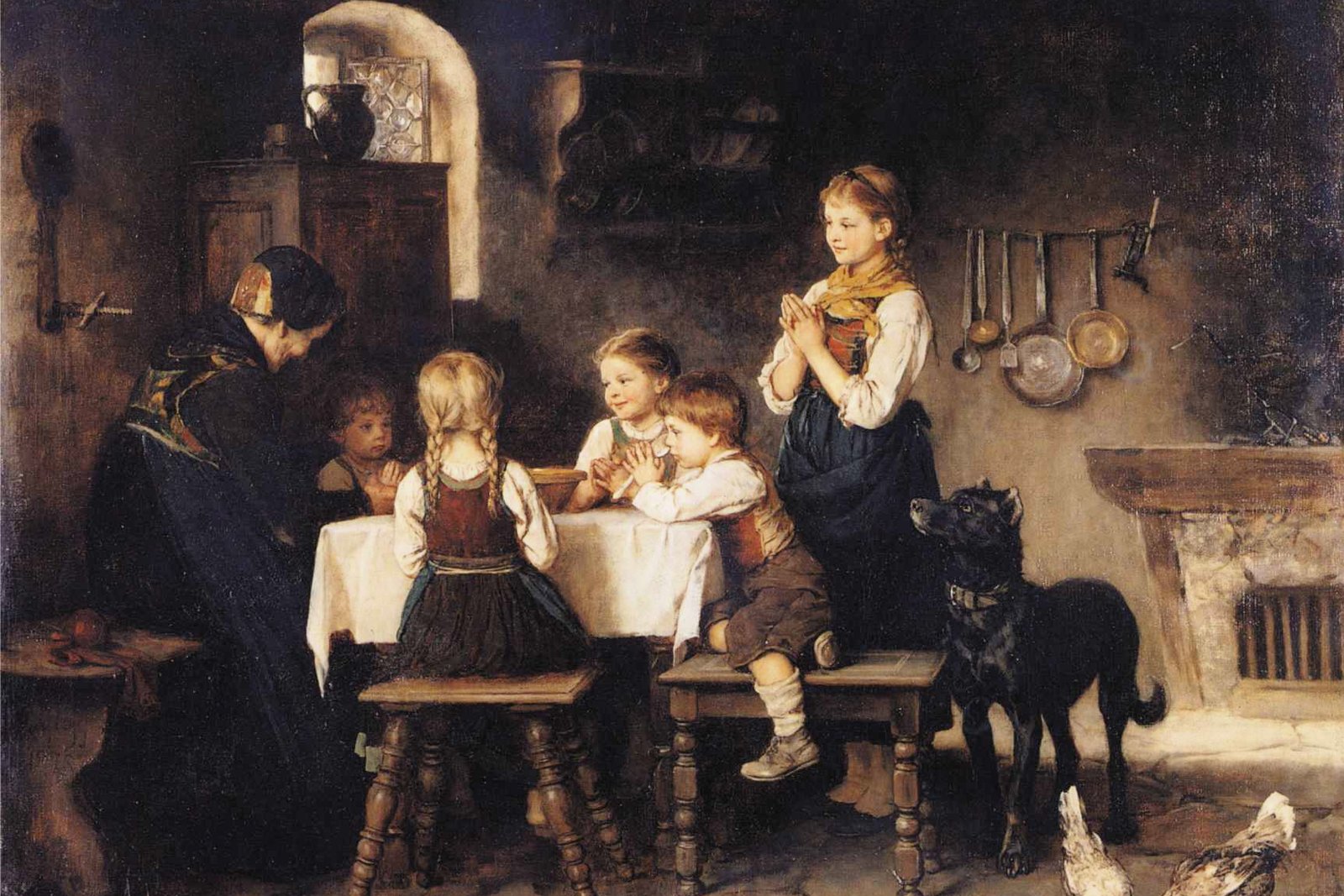
Franz von Defregger, Grace Before Meal, 1875 — public domain.
None of that theology requires elaborate execution. What it asks for is consistency — ordinary, repeated moments of prayer woven into a family's actual daily rhythm, not a single impressive ritual performed occasionally for its own sake.
Grace before meals
Grace is often the easiest entry point precisely because it already has a built-in occasion — a family gathers at the table anyway, at least some of the time, and pausing before eating costs almost nothing to add. A widely used traditional form runs: "Bless us, O Lord, and these Thy gifts, which we are about to receive from Thy bounty, through Christ our Lord. Amen." It's short enough for even a young child to memorize within a few repetitions, and many families bracket it with the Sign of the Cross.
Families with young children often let each child take a turn leading, even imperfectly — a four-year-old racing through the words too fast, or adding an unscripted "and bless the dog," is not a distraction from the prayer's purpose but often exactly the kind of participation that makes it stick. There's no single correct grace; some families add spontaneous thanks for something specific from the day, which works just as well alongside or instead of the memorized form.
A family Rosary that actually fits real life
A full five-decade Rosary with a house full of small children is, for most families, an aspiration rather than a weekday reality — and treating it as an all-or-nothing requirement is usually what causes family Rosary attempts to quietly stop happening altogether. A single decade, prayed together before bed or during a car ride, is a complete and genuine way of praying the Rosary, not a diminished substitute for the full version. For the mechanics of praying a decade and what each set of Mysteries meditates on, see how to pray the Rosary, step by step.
Giving each child a job helps more than almost anything else: one child holds the crucifix and leads the opening prayers, another announces the Mystery, a third counts the beads aloud. Younger children who can't yet follow the full prayers can still join in on the words they know — "Holy Mary" at the end of each Hail Mary is usually within reach well before the whole prayer is. None of these adaptations change what's actually being prayed; they just make it possible for a real family, at a real dinner table's worth of ages and attention spans, to pray it together.
Bedtime prayers for children
Evening is often the moment family prayer works best, since the day's demands have mostly ended and a child's own bedtime routine already includes a natural pause. The Angel of God prayer is one of the most widely taught bedtime prayers for Catholic children: "Angel of God, my guardian dear, to whom God's love commits me here, ever this day be at my side, to light and guard, to rule and guide. Amen." It reflects real Church teaching — the Catechism affirms that each person has a guardian angel watching over them from infancy (CCC 336) — in language simple enough for a very young child to grasp without explanation.
A short Our Father and Hail Mary work well alongside it, and many parents find it natural to add a brief, unscripted moment of thanks or a simple blessing traced on the child's forehead before lights-out. None of this needs to be long; two or three minutes, said consistently, does more over years than an elaborate nightly ritual attempted a handful of times and then abandoned.
When it doesn't go well
Every parent who has tried family prayer has a story about the night it fell apart — a toddler's meltdown mid-decade, a teenager visibly enduring rather than praying, a grace before meals interrupted three times by a ringing phone. None of this means family prayer "isn't working." The Church's vision of the family as a domestic church was never a claim that Catholic households pray more smoothly than anyone else's; it's a claim that the ordinary, repeated, sometimes chaotic act of praying together forms faith over the long run, in ways a single perfect evening never could. Showing up again the next night, imperfectly, is the whole practice.
Families looking to extend this rhythm into their own daily prayer as adults, not just with children, may find morning and evening prayer for beginners a useful next step, alongside the most important Catholic prayers for learning or reviewing the texts referenced here.
Trivia
What does the Catholic Church mean by calling the family the domestic church?
What is a simple grace before meals for a family with young children?
How can a family pray the Rosary together with young children who can't sit through it?
What is a traditional Catholic bedtime prayer for children?
Does family prayer have to happen every single day to matter?
Related Reading