What Does the Sacrament of Marriage Mean?

Not a blessing added on top of a wedding
It's easy to picture the sacramental part of a Catholic wedding as something the priest adds to an otherwise ordinary marriage ceremony — a blessing sprinkled on top of vows that would mean the same thing without it. That's not how the Church understands what happens. The Catechism teaches that Christ himself raised the marriage of the baptized to the dignity of a sacrament (CCC 1601), meaning the couple's covenant becomes an efficacious sign of grace, not a legal formality with religious decoration around it.
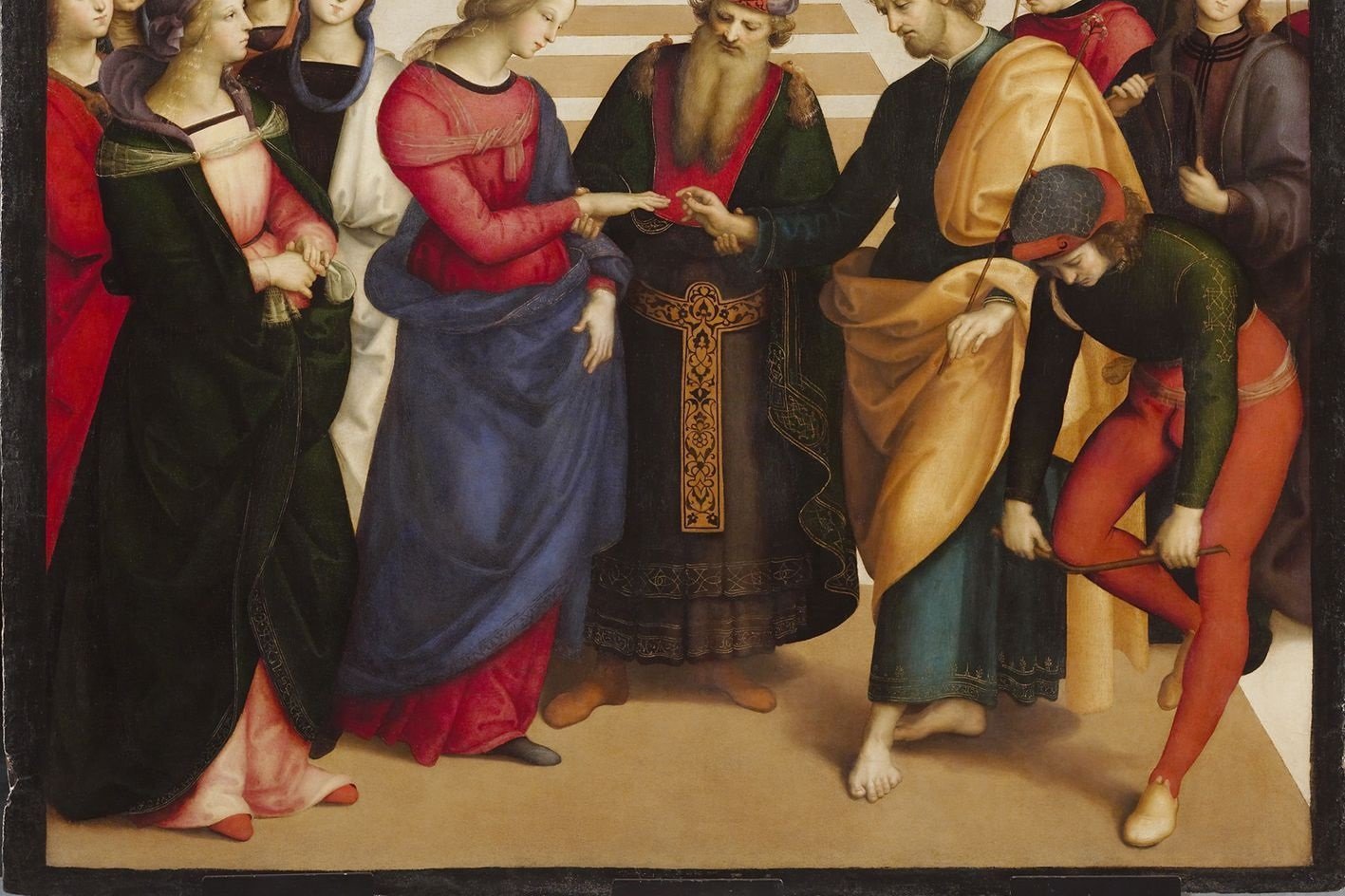
Raphael, Sposalizio (The Marriage of the Virgin), 1504 — public domain.
The word the Church uses matters here: covenant, not contract. A contract exchanges goods or services and can, in principle, be dissolved by the parties who made it. A covenant, in the biblical sense the Church draws on, is a total gift of persons to each other, modeled on God's own covenant fidelity to his people — the kind of bond the prophets describe when they compare God's relationship with Israel to a marriage. Gaudium et Spes, the Second Vatican Council's document on the Church in the modern world, describes marriage as an "intimate partnership of life and love" established by the Creator and structured by its own proper laws, not simply invented by the couple for their own convenience (Gaudium et Spes, 48).
Who actually confers the sacrament
Here's the detail that surprises a lot of people, including some Catholics: the priest or deacon at a Catholic wedding is not the minister of the sacrament. The spouses are. Catholic sacramental theology holds that the man and woman confer the Sacrament of Matrimony on each other through their mutual consent, freely given and properly expressed; the priest or deacon presides as the Church's official witness and gives the nuptial blessing, but the grace of the sacrament flows from the covenant the couple themselves establish (CCC 1623).
That's part of why the words of consent — "I take you to be my wife/husband... to have and to hold, from this day forward..." — carry so much theological weight in the ceremony. They aren't a formality leading up to the "real" moment. They are the sacramental act itself.
Grace for a specific mission
Because Matrimony is a sacrament and not merely a social institution, the Church teaches it confers a specific grace: the grace to love each other with the love with which Christ has loved his Church, and to help each other reach holiness, in their married life, and in welcoming and raising children (CCC 1641). This is often called the grace of the sacrament of Matrimony, and it's meant to be a real, ongoing resource a couple can draw on through the actual difficulty of married life — not a one-time spiritual boost that fades after the wedding day.
This is also why Catholic marriage prep and Catholic wedding liturgy treat the couple's relationship as having a mission beyond their own happiness. Spouses are called, in the Church's language, to be a visible sign of Christ's own faithful and fruitful love — imperfectly, as every human sign is imperfect, but really.
Indissolubility: the bond nobody can dissolve
The Church's teaching that a valid, consummated sacramental marriage cannot be dissolved by any human power (CCC 1640) is often the hardest part of this theology for people to sit with, especially anyone who has lived through the pain of a marriage failing. It helps to be precise about what the Church is and isn't saying.
The Church is not saying spouses in a genuinely destructive or abusive marriage must remain in physical danger or ongoing harm — civil separation, and even civil divorce for the sake of safety or practical necessity, are treated as morally legitimate in serious cases (CCC 2383). What indissolubility means is narrower and more specific: the sacramental bond itself, once validly formed, isn't something either spouse, a priest, a bishop, or even the pope can declare undone. That's why the Church uses annulments rather than divorces for internal Church purposes — an annulment isn't the Church dissolving a real marriage; it's a finding, after a real investigation, that something essential to a valid marriage (full consent, freedom from grave coercion, capacity to understand and fulfill the commitment) was absent from the start, so a sacramental bond was never actually formed at that particular wedding.
The four things every valid marriage needs
Catholic theology holds that authentic marital consent includes four things: freedom (given without coercion or grave fear), fidelity (exclusivity between the spouses), permanence (an intention toward lifelong commitment, not a trial arrangement), and fruitfulness (openness to children, meaning the couple doesn't deliberately exclude the possibility of having children from their consent). A couple who, at the moment of consent, deliberately rules out permanence or children, or who is marrying under serious external pressure, may not actually be exchanging valid marital consent at all — which is a large part of what marriage tribunals investigate in annulment cases.
Not a wedding-planning theology
None of this is about flowers, venues, or liturgical logistics — a couple can get every practical detail of the ceremony right and still misunderstand what they're actually doing at the altar, or get every detail "wrong" by convention and still enter a fully valid, graced sacramental marriage. What the Church is describing is a theology of what marriage is: two baptized people becoming, through their own free consent, ministers of a sacrament to each other, entering a bond the Church believes is upheld by God's own fidelity, and receiving a specific grace to live out a lifelong, faithful, fruitful love that images something bigger than the two of them.
Trivia
Who administers the Sacrament of Marriage — the priest or the couple?
Why does the Catholic Church teach that marriage is indissoluble?
What is the difference between an annulment and a divorce?
Does the Catholic Church require both spouses to be Catholic for a valid sacramental marriage?
What are the essential promises spouses make in a Catholic wedding?
Related Reading