The Four Marks of the Church — One, Holy, Catholic, Apostolic

Four words that carry a whole claim about the Church
Anyone who has been to a Catholic (or many other Christian) liturgies has said the words without necessarily pausing to unpack them: "We believe in one, holy, catholic and apostolic Church." These four terms — known as the four marks of the Church — come straight from the Nicene Creed, formulated at the First Council of Constantinople in 381, building on the earlier Council of Nicaea in 325. The Catechism treats the four together, not as separate boxes to check but as "inseparably linked with each other," indicating "essential features of the Church and her mission" (CCC 811). And crucially, the Catechism is clear about where these qualities come from: "The Church does not possess them of herself; it is Christ who, through the Holy Spirit, makes his Church one, holy, catholic, and apostolic" (CCC 811). The marks describe a gift received, not an achievement claimed.
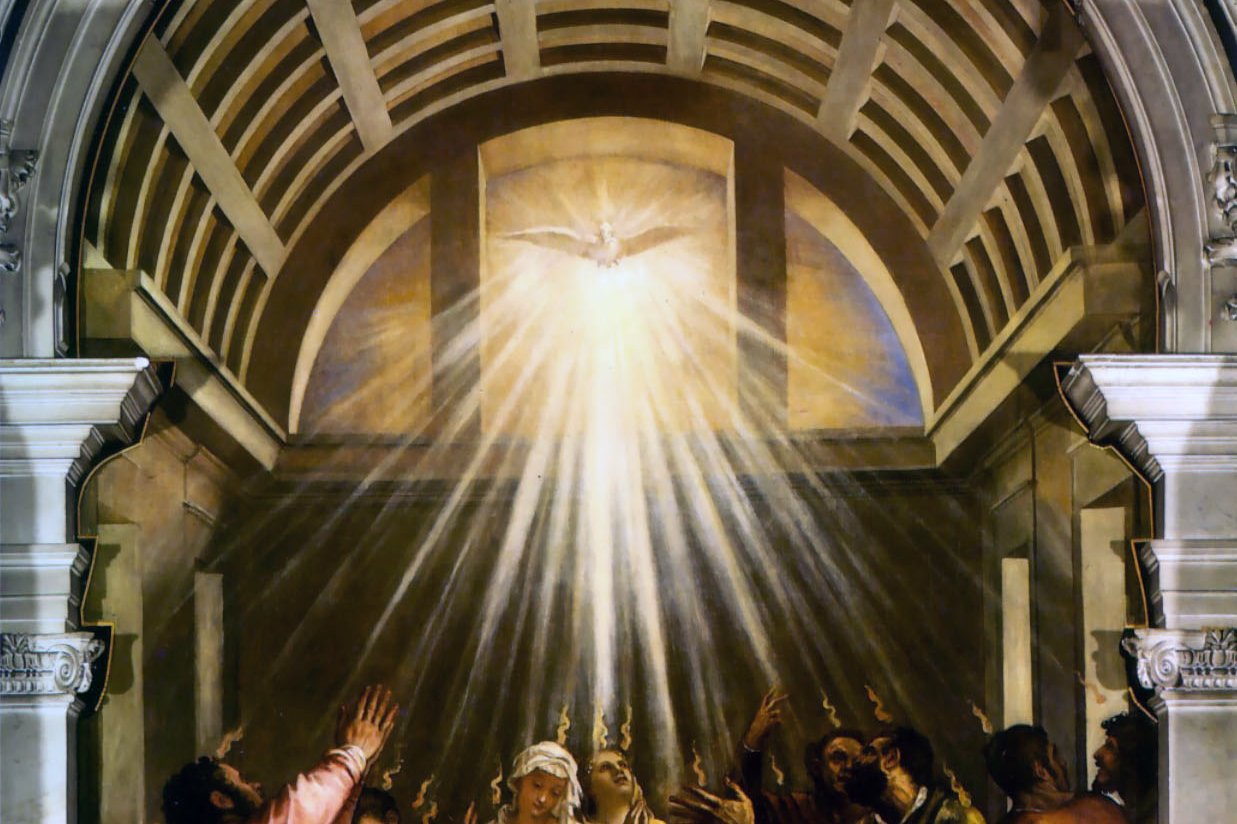
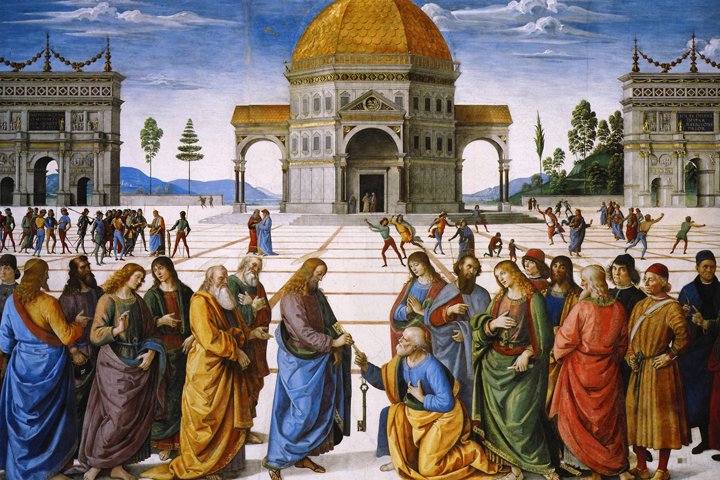
Image: Sistine Salon fresco, Vatican / Wikimedia Commons (Public domain)
One: a unity deeper than agreement
Calling the Church "one" isn't primarily a statement about organizational efficiency or unanimous opinion among its members. The Catechism roots this unity in three sources at once: the Church is one "because of her source" — the unity of the Trinity itself; one "because of her founder" — Christ, who "reconciled all men to God by the cross... restoring the unity of all in one people and one body"; and one "because of her 'soul'" — the Holy Spirit, who "joins them together so intimately in Christ that he is the principle of the Church's unity" (CCC 813). This is a theological claim about the Church's deepest identity, distinct from (though obviously related to) the historical reality of divisions among Christians that have occurred across centuries.
Holy: a claim about Christ, extended to his Bride
The second mark is often the one that draws the most pointed objections — how can an institution whose members visibly sin, sometimes gravely and publicly, be called "holy"? The Catechism doesn't dodge the question; it addresses it directly by locating holiness first in Christ, not in the moral record of individual Catholics: the Church "is held, as a matter of faith, to be unfailingly holy. This is because Christ, the Son of God... loved the Church as his Bride, giving himself up for her so as to sanctify her" (CCC 823). Holiness, in this sense, describes what Christ has done for and given to the Church as a whole, not a guarantee that every baptized person living within it has fully received or lived out that gift. The Church's own members — canonized saints alongside grave sinners, sometimes within the same lifetime — are called, individually, toward a holiness the Church herself already possesses as a gift from her founder.
Catholic: universal in reach, complete in content
The word "catholic" (lowercase, describing the mark, distinct from "Catholic" as the proper name of the Church) comes from a Greek term meaning "universal," and the Catechism specifies it "in the sense of 'according to the totality' or 'in keeping with the whole'" (CCC 830). Two senses run together here. First, the Church is catholic because the fullness of Christ subsists within her — "correct and complete confession of faith, full sacramental life, and ordained ministry in apostolic succession" (CCC 830) — a completeness of content, not merely geographic spread. Second, the Church is catholic in the more familiar sense of universal reach: sent by Christ to the whole of humanity, not restricted to any single nation, culture, or era, meant to gather every people into the one body described under the first mark.
Apostolic: an unbroken line of ministry
The fourth mark ties the Church directly back to its historical origin in the apostles Christ himself chose and sent. The Catechism describes this apostolicity as working in three linked ways: the Church "was and remains built on the foundation of the Apostles"; she "keeps and hands on the teaching... she has heard from the apostles"; and she "continues to be taught, sanctified, and guided by the apostles until Christ's return, through their successors in pastoral office: the college of bishops... in union with the successor of Peter" (CCC 857). This last point is the doctrine of apostolic succession — the belief that the authority and ministry given by Christ to the apostles has been handed down, bishop to bishop, in an unbroken chain, from the first century to the present.
Why the four marks stand or fall together
It would be possible to treat each mark as an isolated attribute, checked off independently. The Catechism resists that reading by calling the four "inseparably linked" (CCC 811). Unity without holiness would be mere uniformity. Holiness without universality would risk becoming a private club rather than a mission to "all nations." Universality without apostolic continuity would risk losing any connection to what Christ actually established, drifting instead. And apostolic authority without the other three would be structure without the life the Spirit gives it. Together, the four marks function less like a checklist and more like a single, four-sided description of one reality — what the Catholic Church holds itself, by Christ's own gift rather than its own achievement, to actually be.
Trivia
Where do the four marks of the Church come from?
What does it mean to say the Church is 'one'?
Why does the Catholic Church call itself 'holy' when its members visibly sin?
What does 'catholic' mean in the phrase 'one, holy, catholic, and apostolic'?
What does 'apostolic' mean, and how does it relate to bishops today?
Related Reading