Van Eyck's Ghent Altarpiece

An altarpiece built to open and close
Completed in 1432 for the church of Saint John in Ghent — later elevated to Saint Bavo's Cathedral — the Ghent Altarpiece is not a single painting but a large polyptych: twelve hinged panels that fold, presenting a different combination of images depending on whether the wings are open or closed. Closed, the altarpiece shows a more restrained scene of the Annunciation alongside portraits of the donors, a wealthy Ghent couple named Joos Vijd and Elisabeth Borluut, who commissioned the work. Opened, it reveals its full complexity: an upper register showing God enthroned (or, in some interpretations, Christ in majesty) flanked by the Virgin Mary, John the Baptist, singing and music-making angels, and nude figures of Adam and Eve, and a lower register dominated by the central Adoration of the Mystic Lamb, surrounded by four flanking panels depicting groups of judges, knights, pilgrims, and hermits converging on the same scene.
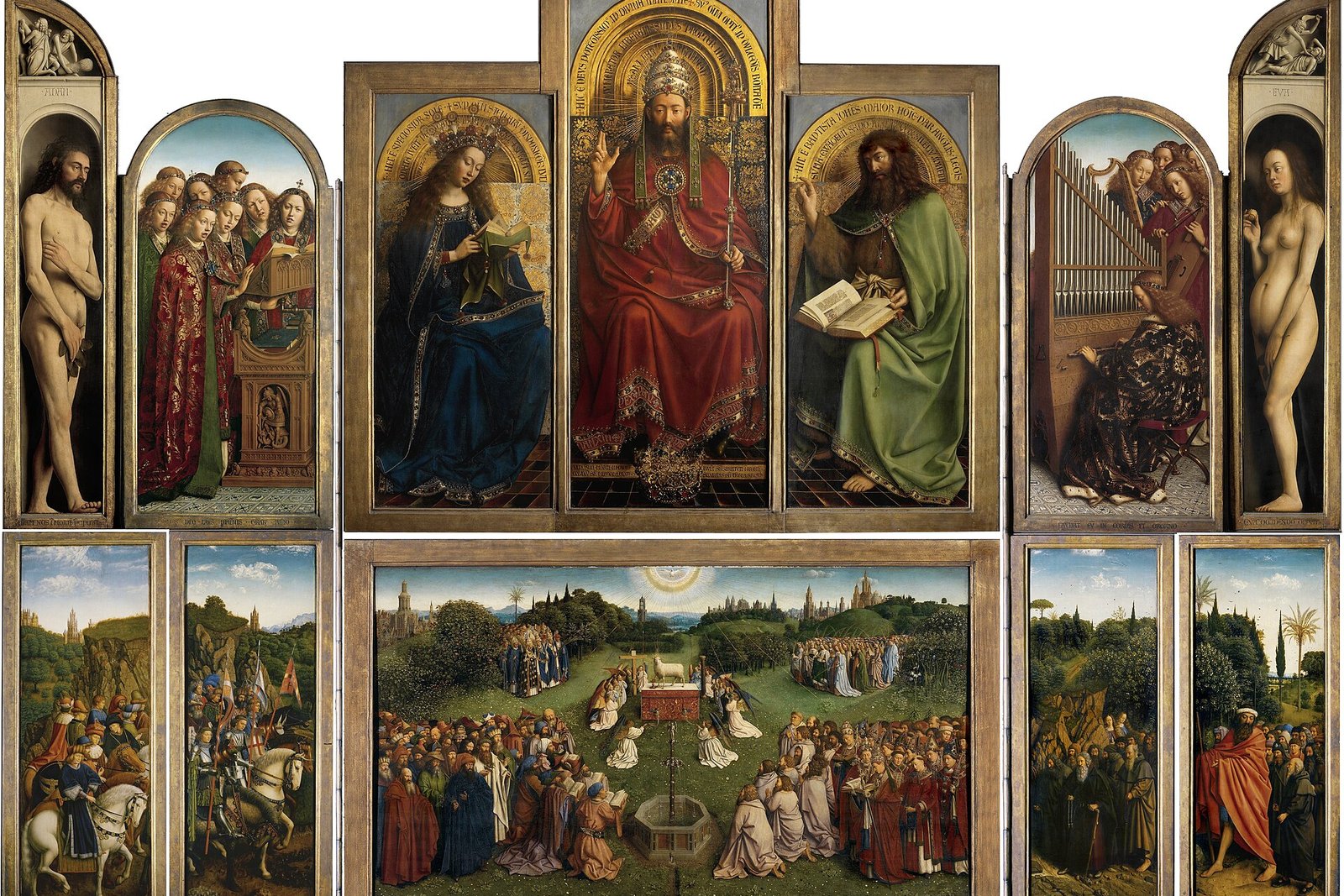
Jan van Eyck (and possibly Hubert van Eyck), "The Ghent Altarpiece" (opened view), 1432, Saint Bavo's Cathedral, Ghent — public domain.
An inscription on the altarpiece's frame, added sometime after its completion, states that Hubert van Eyck began the work and that his brother Jan van Eyck finished it in 1432. Hubert died in 1426, several years before completion, and because almost nothing else is documented about his independent career, art historians continue to debate how much of the altarpiece, if any, he personally executed before Jan took over and completed the enormous project.
The Adoration of the Mystic Lamb
The altarpiece's central and most celebrated panel depicts a lamb standing on an altar in an idealized, jewel-green landscape, blood flowing visibly from a wound in its chest into a golden chalice — a direct visual reference to the vision described in the Book of Revelation, in which the apostle John sees "a Lamb that seemed to have been slain" (Revelation 5:6, NABRE), understood in Christian tradition as a symbol of Christ's sacrificial death and resurrection. Angels kneel around the altar in adoration, while converging processions of Old Testament prophets, apostles, martyrs, virgins, and confessors approach from all sides across a richly detailed landscape filled with dozens of individually rendered plant species, a level of naturalistic botanical detail long admired by art historians and even, in recent research, studied by botanists identifying specific real-world species van Eyck appears to have observed directly.
This intense, almost microscopic realism — extending to individual strands of hair, the texture of fabric, and reflections of light on jewels and metal — was made possible by van Eyck's mastery of oil paint, applied in thin, translucent layers that built up depth and luminosity impossible to achieve with the faster-drying tempera favored by many earlier painters. While van Eyck did not invent oil painting, as older accounts sometimes claimed, his work here and elsewhere played a major role in establishing oil as the preferred medium for ambitious painting across Northern Europe, a technical shift with consequences for how artists across the following centuries — including, generations later, Rembrandt in his rich, textured late style seen in The Return of the Prodigal Son — would approach color, light, and surface detail.
A history of theft, war, and near-total loss
Few paintings in history have been targeted, stolen, or displaced as often as the Ghent Altarpiece. French revolutionary forces looted several panels in the 1790s during their occupation of the Austrian Netherlands, dispersing them to Paris before eventual partial return. In the nineteenth century, church officials sold six of the side panels, which ended up for a time in a Berlin museum before being returned to Belgium as part of the settlement following World War I. In 1934, thieves stole two panels directly from the cathedral in a crime that has never been fully solved; one panel was eventually recovered after a ransom negotiation collapsed, but the other — depicting the Just Judges — remains missing to this day, replaced in the altarpiece by a modern copy.
The altarpiece's most dramatic ordeal came during World War II, when Nazi Germany, under direct orders connected to Adolf Hitler's personal interest in the work, seized it from a French storage facility where it had been sent for safekeeping and transported it to Germany, eventually hiding it in the Altaussee salt mine in Austria along with thousands of other looted artworks. The Allied art protection unit known as the "Monuments Men" located and recovered the altarpiece from the mine in 1945, and it was returned to Ghent shortly afterward — an episode later dramatized, though loosely, in popular film and literature about the wartime effort to recover looted European art.
Restoration and modern display
Beginning in 2012, a multi-year, multi-phase restoration project undertaken by the Royal Institute for Cultural Heritage in Belgium removed centuries of discolored varnish and overpainting from the panels, revealing colors and details — including a strikingly more lifelike and unsettling rendering of the Lamb's face — that had been obscured or altered by restorers over previous centuries. The project, which extended through the early 2020s, was accompanied by extensive public research documentation, giving art historians and the public alike an unusually detailed look at both van Eyck's original technique and the layered history of interventions the altarpiece endured over nearly six hundred years. Today it is displayed in a dedicated, climate-controlled chapel within Saint Bavo's Cathedral, still in the same building it was created for in 1432.
Trivia
Who painted the Ghent Altarpiece?
What does the central panel of the altarpiece show?
Why is the Ghent Altarpiece called the most stolen artwork in the world?
What is significant about Jan van Eyck's use of oil paint in this altarpiece?
Where can visitors see the Ghent Altarpiece today?
Related Reading