Saint Andrew Dũng-Lạc, Priest, and Companions, Martyrs

A faith transplanted into hostile political ground
Christianity arrived in Vietnam through the work of Portuguese, and later particularly French and Spanish, missionaries beginning in the sixteenth and seventeenth centuries, most famously through the efforts of the French Jesuit Alexandre de Rhodes, who developed the romanized Vietnamese alphabet still in use today partly as a tool for spreading Christian teaching. The faith took root steadily over the following generations, but it did so within a political environment that grew increasingly suspicious of it, particularly as European colonial ambitions in Southeast Asia intensified during the eighteenth and nineteenth centuries.
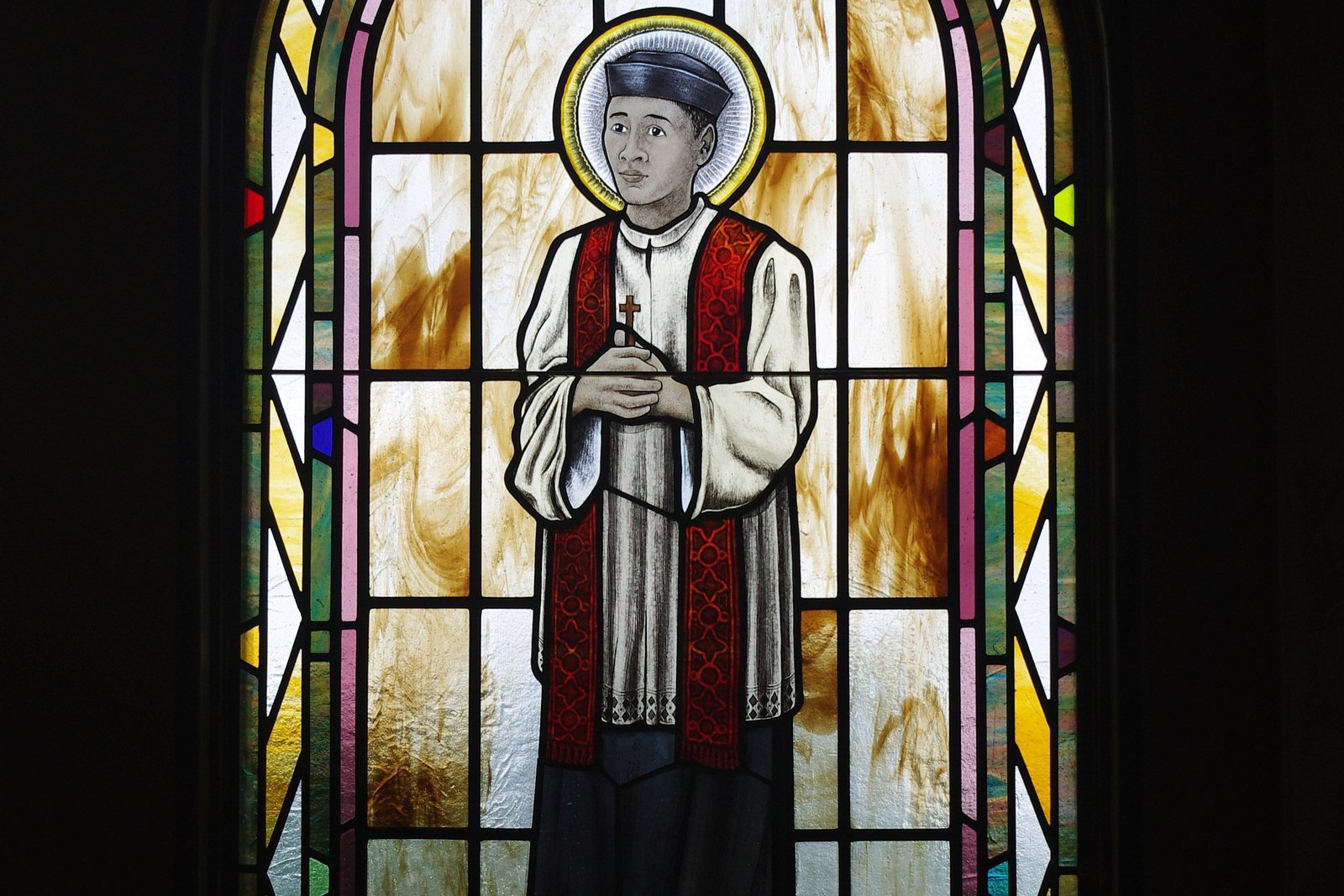
Photo by Nheyob, stained glass of Saint Andrew Dũng-Lạc, Saint Paul Catholic Church, Westerville, Ohio, cropped, CC BY-SA 3.0, via Wikimedia Commons.
Vietnamese emperors came to view Catholicism as a foreign import entangled with European political interference, a suspicion that was not entirely without basis given the close, sometimes overtly political relationships some missionaries and Vietnamese converts maintained with French colonial and commercial interests. This perception fueled a long, intermittent, and at times extraordinarily severe pattern of anti-Christian persecution that stretched from the seventeenth century through the late nineteenth, with the most intense and systematic waves occurring under the nineteenth-century emperors Minh Mạng, Thiệu Trị, and Tự Đức, whose successive edicts banned Christian practice outright, ordered the destruction of churches, and mandated the execution of clergy and the forced apostasy of ordinary believers.
Andrew Dũng-Lạc's ministry and repeated arrests
Andrew Dũng-Lạc, born around 1795 into a poor non-Christian family that later converted, was ordained a Catholic priest and spent years ministering to Vietnamese Christian communities under increasingly dangerous conditions, often moving between villages in disguise or under cover of night to avoid detection by authorities actively hunting for clergy. He was arrested at least twice during his ministry. The first time, his parishioners raised funds to ransom him from custody, a not uncommon practice at the time in regions where local officials could sometimes be persuaded, through bribery, to release captured priests rather than carry out the harsher penalties officially mandated from the capital.
His freedom did not last. Dũng-Lạc was arrested again in 1839, and this time no ransom or intervention secured his release. He was tortured and eventually beheaded near Hanoi in December of that year, one death among many thousands that occurred across Vietnam during these decades of persecution, but one whose documentation and circumstances made him, in later canonization proceedings, a fitting representative figure for the far larger number of Vietnamese Christians who died without leaving behind comparably detailed accounts of their final days.
A martyrdom shared by tens of thousands
The scale of anti-Christian persecution in Vietnam during this period was immense, with historical estimates suggesting that well over one hundred thousand Vietnamese Catholics may have died for their faith across the roughly three centuries of intermittent persecution, figures that, while difficult to verify with full precision given the scattered and incomplete surviving records, nonetheless indicate a persecution of extraordinary scope and duration, rivaling or exceeding many of the more famous persecutions of the early Christian centuries in the Roman Empire.
Those killed included not only Vietnamese priests, catechists, and ordinary lay believers, but also foreign missionary bishops and priests, chiefly French and Spanish, who had continued their ministry in Vietnam despite the mounting danger. Methods of execution documented across surviving accounts were often deliberately brutal, including beheading, strangulation, being cut into pieces, and prolonged forms of torture-execution, punishments intended not merely to kill individual Christians but to terrorize entire surrounding communities into abandoning the faith altogether, an intent that, across three centuries of sustained pressure, conspicuously failed to extinguish the Vietnamese Catholic community, which not only survived but continued to grow.
Canonizing 117 representatives of a much larger number
Given the sheer scale of the persecution, the Catholic Church's process for recognizing the Vietnamese martyrs necessarily worked by selecting a representative group rather than attempting to individually document and canonize every victim, a practical approach also used for other large-scale historical persecutions where complete records for every individual victim simply do not survive. Pope John Paul II canonized a group of 117 Vietnamese martyrs together on June 19, 1988, a group spanning deaths that occurred across roughly two centuries, from the seventeenth through the nineteenth, and including Vietnamese bishops, priests, catechists, and laypeople of every social background alongside foreign missionary clergy who had died serving alongside them.
Andrew Dũng-Lạc was designated the lead name for the entire canonized group, giving the collective feast its formal title as the memorial of Saint Andrew Dũng-Lạc and his companions, even though the group itself represents Christians who often lived, ministered, and died decades or even centuries apart from one another, united only by the shared fact of dying for the same faith in the same persecuted land.
A living legacy in the modern Vietnamese Church
The persecution commemorated by this feast forms a foundational part of the historical memory of the Vietnamese Catholic Church, one of the larger and more resilient Catholic communities in Asia today despite the severity of the persecution it endured across so many generations. The canonization of the 117 martyrs in 1988 was met with considerable celebration among Vietnamese Catholics both within Vietnam and among the large Vietnamese diaspora communities that had formed abroad, particularly in the wake of twentieth-century political upheavals in the country. The shared feast day, observed on November 24, honors not simply a list of individual names but an entire community's sustained, multi-generational witness under conditions that, for long stretches of Vietnamese history, made the simple act of practicing the Catholic faith itself a potential death sentence.
Trivia
Who was Saint Andrew Dũng-Lạc?
How many Vietnamese martyrs were canonized alongside Andrew Dũng-Lạc, and when?
Why were Christians persecuted in Vietnam over this period?
What methods of execution were commonly used against Vietnamese Christian martyrs?
What is the feast day of the Vietnamese Martyrs?
You May Also Like
Related Reading