Saint Angela Merici — Founder of the Ursulines

A childhood shaped by loss
Angela Merici was born in 1474 in Desenzano del Garda, a small town on the shores of Lake Garda in northern Italy, into a farming family that valued devotion even without wealth to back it. According to her early biographers, her father read aloud from the lives of the saints most evenings, and Angela grew up absorbing those stories the way other children absorbed folk tales. That grounding mattered because her childhood was cut short by grief: both her parents died while she was still young, along with a beloved older sister, and Angela was sent to live with an uncle in the nearby town of Salò.
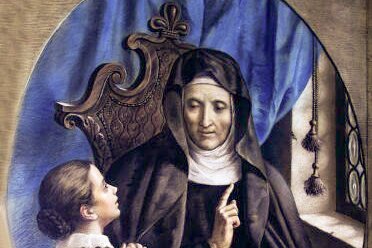
Pietro Calzavacca, Saint Angela Merici as a Teacher, 19th century, Museo Angela Merici, Brescia — public domain.
That early loss shaped the rest of her life in a specific, traceable way. Tradition holds that Angela was tormented by the fact that her sister had died suddenly, without receiving the last sacraments, and that Angela prayed intensely for reassurance about her sister's soul — later reporting a vision in which she understood her sister to be among the saved. Whether read as literal vision or as pious memory of an intense private consolation, the episode marked a turning point: Angela emerged from that grief with an unusually firm, almost fearless spiritual confidence that stayed with her the rest of her life, and a determination to do something useful with the years she had left.
A laywoman who chose not to enter a convent
At twenty, Angela joined the Third Order of Saint Francis, a lay branch of the Franciscan family that allowed members to live according to a rule of prayer and simplicity while remaining in ordinary secular life rather than entering a cloister. This choice reveals something important about Angela: she was drawn to religious life but resisted the conventional path into it. Many devout women of her social class in Renaissance Italy who wanted to dedicate their lives to God simply entered a convent. Angela, instead, stayed in the world, living an ascetic, prayerful life while working directly among the poor of her town.
It was through that work that her calling took shape. Brescia and the surrounding countryside had no organized system of education for girls, particularly poor ones, at a time when boys of means had access to tutors, schools, and eventually universities. Angela began gathering local girls informally to teach them reading, catechism, and practical skills, convinced that ignorance of the faith was as dangerous to a soul as poverty was to a body. Word of her work spread, and by the time she was in her fifties, she had built a reputation across the region as a teacher, spiritual counselor, and — increasingly — as someone other devout women wanted to work alongside.
Founding the Company of Saint Ursula
On November 25, 1535, Angela formally founded the Company of Saint Ursula in Brescia, gathering an initial group of twenty-eight unmarried women committed to lives of chastity, prayer, and teaching. She named the society after Saint Ursula, a legendary early martyr venerated as a patroness of young women and students, whose story — however uncertain in its historical details — carried strong symbolic weight for a group devoted to guiding girls toward virtue.
What made the Company genuinely new wasn't just its educational mission but its structure. Angela's original members took no public, permanent vows in the way traditional nuns did; they wore no distinctive habit that marked them out on the street; and, most unusually for the period, they continued living in their own family homes rather than moving into a shared convent building. They were, in effect, consecrated laywomen embedded directly in the towns and households they served — a model that let them reach girls no cloistered convent school could have easily reached, since families were often reluctant to send daughters away from home for schooling.
This structure reflected Angela's deeper conviction that holiness didn't require withdrawal from ordinary life. She wrote in her Rule that her daughters should be recognizable "not so much by an outward habit as by their manner of living," a striking instruction for a sixteenth-century religious founder and one that put her ahead of much of the thinking of her era about how consecrated women could serve the Church.
From Brescia to a worldwide teaching order
Angela led the Company for only five years before her death in 1540, but the society she founded did not stay small or local. Over the following century, as the Ursulines spread across Italy, France, and eventually into the Americas, the order gradually adopted a more traditional structure — communal living, a recognizable habit, and formal vows — largely under pressure from Church authorities who were uneasy with unenclosed religious women in the aftermath of the Council of Trent. By the seventeenth century, Ursuline convents were running some of the most respected girls' schools in Catholic Europe, and Ursuline missionaries, including Saint Marie of the Incarnation, carried the order's educational mission to Quebec, making the Ursulines one of the first women's teaching orders established in North America.
That later, more cloistered form would likely have looked different from what Angela originally envisioned in that rented house in Brescia — but the core mission never changed. Wherever Ursuline sisters went, girls' schools followed, built on Angela's conviction that education and religious formation for women mattered as much as it did for men, at a time when very few people in the Church were saying so.
A late canonization for an underestimated founder
Angela Merici died on January 27, 1540, and was buried in Brescia, where her body is still venerated today. Formal recognition came slowly: Pope Clement XIII beatified her in 1768, and Pope Pius VII elevated the process further, but it was Pope Pius IX who canonized her on May 24, 1861 — more than three centuries after her death. Her feast is kept on January 27. The long gap between her death and her canonization says less about any doubt over her sanctity than about how unusual her model of religious life was for the Church to formally categorize; it took centuries for the structures she pioneered to be fully absorbed into recognized religious life, even as the schools she inspired kept multiplying in the meantime. Readers interested in other women who founded lasting educational or charitable institutions may also want to read about Saint Frances Xavier Cabrini, whose missionary schools carried a similar spirit across the ocean centuries later.
Trivia
Who was Saint Angela Merici?
Why did Angela Merici found the Ursulines?
What made the original Ursuline rule unusual for its era?
When was Saint Angela Merici canonized?
What is Saint Angela Merici the patron saint of?
You May Also Like
Related Reading