Saint Anthony Mary Claret, Bishop

From a weaver's loom to the priesthood
Anthony Mary Claret was born in 1807 in Sallent, a textile town in Catalonia, the son of a wool weaver, and as a young man he trained in his father's trade, working for a time in the textile industry and even traveling to Barcelona to study the mechanics of industrial weaving. He felt drawn instead toward the priesthood, and abandoned the family business to pursue religious formation, eventually being ordained a priest in 1835.
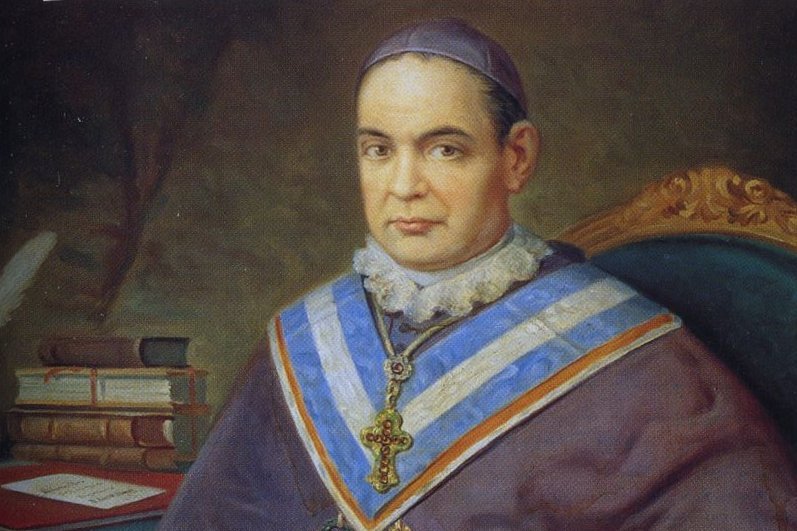
Luis de Madrazo, portrait of Saint Anthony Mary Claret, 19th century, Museo Nacional del Romanticismo, Madrid — public domain.
His early ministry took the form of parish work in Catalonia, but he increasingly felt called toward a broader missionary vocation, and he spent a period of formation with the Jesuits before an unresolved health issue interrupted that path. He turned instead to itinerant preaching, traveling across Catalonia delivering popular missions and retreats, and to the production of inexpensive, widely distributed Catholic literature aimed at combating the religious ignorance and anticlerical sentiment he encountered in rural parishes, an early sign of the emphasis on publishing that would remain central to his later missionary congregation.
Founding the Claretians
In 1849, Claret founded the Congregation of Missionary Sons of the Immaculate Heart of Mary in the city of Vic, a community of priests committed to itinerant preaching, popular missions, and the production and distribution of Catholic books and pamphlets, a combination of oral and printed evangelization suited to the religiously unsettled Spain of his time. The congregation, which came to be known simply as the Claretians, grew steadily and eventually spread well beyond Spain, becoming a significant missionary presence across Latin America, and later worldwide, in the decades and centuries following its founder's death.
Claret's own missionary energy did not stay confined to Spain for long. Later in 1849, the same year he founded his congregation, he was called across the Atlantic to a far more dangerous and demanding assignment.
Archbishop of Santiago de Cuba
In 1850, Claret was appointed archbishop of Santiago de Cuba, then a Spanish colonial territory marked by deep social inequality, the entrenched institution of slavery, and widespread clerical neglect. He approached the assignment with the same reforming intensity that had characterized his preaching missions in Catalonia, undertaking exhausting pastoral visitations across the diocese, regularizing thousands of irregular unions and marriages among the colonial population, and establishing schools, credit unions, and agricultural programs intended to give ordinary Cubans practical tools for improving their material circumstances alongside their spiritual formation.
He also took a public stand against the mistreatment of enslaved people, an unusually forthright position for a churchman in a colonial economy so thoroughly dependent on forced labor, and he worked to curb the exploitation of plantation workers by wealthy landowners who had grown accustomed to operating with little ecclesiastical oversight. These reforms made him powerful enemies among colonists whose economic interests he directly threatened, and Claret survived at least fifteen assassination attempts during his six years as archbishop. The most serious came in 1856 in the town of Holguín, when an attacker slashed him across the face and neck with a razor; Claret survived, though he carried the visible scar for the rest of his life, and the would-be assassin was later condemned to death, a sentence Claret himself petitioned the authorities to commute.
Confessor to a queen, and years of turmoil at court
In 1857, Queen Isabella II of Spain requested that Claret return to Spain to serve as her personal confessor, an appointment he accepted only reluctantly and on the condition that he would not be required to abandon his missionary and charitable commitments for a purely ceremonial court role. He used his position at court less to involve himself in politics, from which he deliberately kept a careful distance, than to continue founding schools, libraries, and charitable institutions, and to press for reforms in religious education across Spain.
The position placed him at the center of one of the most turbulent periods in nineteenth-century Spanish history. Isabella's reign grew increasingly unpopular amid political instability and factional conflict, and in 1868 a revolution forced the queen from the throne entirely, sending her into exile in France. Claret, closely associated with the deposed monarchy, followed her into exile, though by this point his own health, and his relationship with the increasingly complicated politics surrounding the queen's court, had grown difficult.
Final exile and canonization
Claret's final years were marked by continued harassment from anticlerical political factions in Spain, who viewed him as a symbol of the old religious and monarchical order. He spent his last months seeking refuge in various religious houses in France and Spain, eventually finding shelter at the Cistercian monastery of Fontfroide in southern France, where he died in 1870, largely isolated from the missionary and reforming work that had defined the rest of his life.
Pope Pius XII canonized him in 1950, honoring a life that had moved from a weaver's workshop in industrial Catalonia to the archbishop's palace in colonial Cuba and finally to the private chambers of a Spanish queen, while remaining throughout centered on the same instincts for direct pastoral reform, popular preaching, and printed evangelization that had first driven him to found the Claretians. His feast day is celebrated on October 24, and the missionary congregation he founded remains active in dozens of countries today.
Trivia
Who was Saint Anthony Mary Claret and when did he live?
What congregation did Claret found?
What happened during Claret's time as archbishop of Santiago de Cuba?
Why did Claret become confessor to Queen Isabella II of Spain?
When was Anthony Mary Claret canonized and what is his feast day?
You May Also Like
Related Reading