Saint Augustine Zhao Rong, Priest, and Companions, Martyrs

A soldier who escorted a bishop to his death
The man the Church now calls Saint Augustine Zhao Rong began his story on the wrong side of it. In 1815, he was a low-ranking Chinese soldier assigned to guard and escort Bishop Jean-Gabriel Taurin Dufresse, a French missionary of the Paris Foreign Missions Society, who had been arrested under one of China's periodic waves of anti-Christian edicts and sentenced to execution in Chengdu, in Sichuan province. Christianity had been present in China in various forms since Jesuit missionaries like Matteo Ricci arrived in the late sixteenth century, but the faith moved in and out of official tolerance depending on the emperor and the political climate, and by the early nineteenth century, foreign missionaries and native converts alike faced serious risk under renewed imperial edicts against the religion.
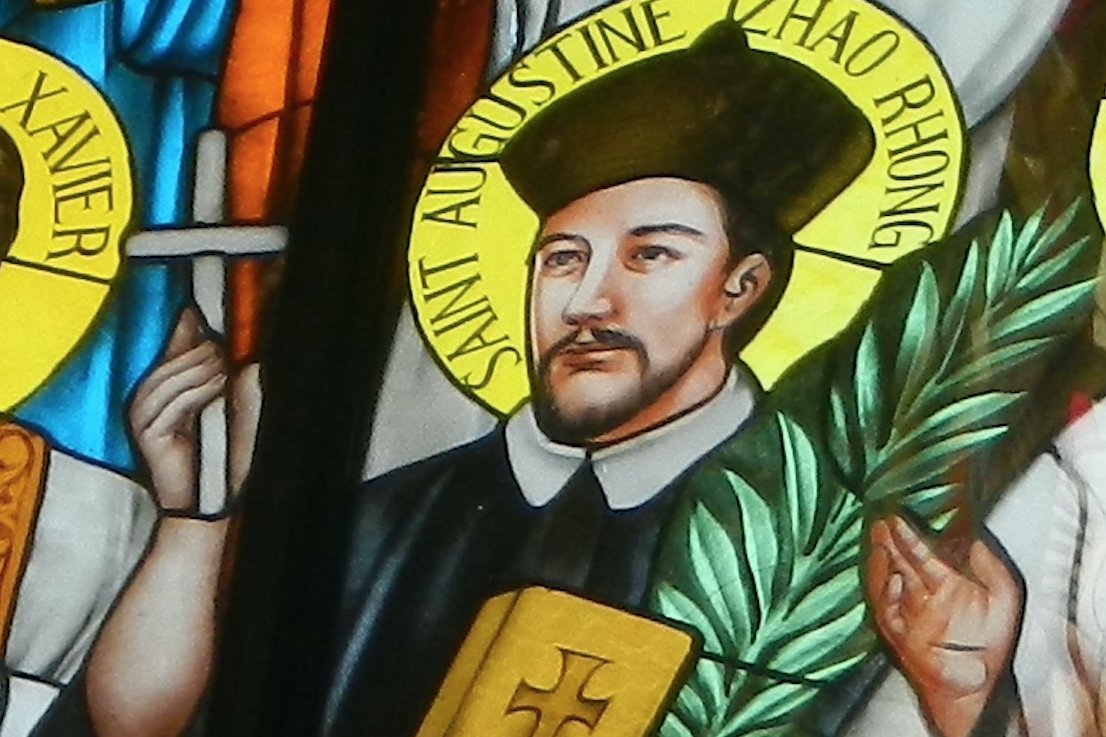
Stained-glass window depicting Saint Augustine Zhao Rong, photographed by Judgefloro, 2017 — CC0.
What Zhao Rong witnessed on that assignment changed the direction of his life. Bishop Dufresse faced his execution with a calm, unshaken composure that Zhao Rong could not reconcile with the picture of Christianity he had been given by the authorities who employed him. Moved by what he had seen, Zhao Rong sought out instruction in the faith, converted, and was eventually baptized. He went on to be ordained a Catholic priest himself — a striking reversal for a man who had once been paid to help carry out the execution of a bishop. Some years later, Zhao Rong was arrested for his own ministry, subjected to torture, and died as a result, becoming one more name in a long, largely unrecorded line of Chinese Catholics who paid for their faith with their lives.
A single feast spanning nearly three centuries
Augustine Zhao Rong's own remarkable conversion story is only the entry point into a much larger group. On October 1, 2000, Pope John Paul II canonized 120 martyrs of China together in a single ceremony at St. Peter's Basilica — Zhao Rong's name placed first on the list, giving the whole group its common title: Saint Augustine Zhao Rong and Companions. The 120 martyrs span an extraordinary range of time, from the mid-seventeenth century through the violent Boxer Uprising of 1899-1900, and an equally wide range of backgrounds: Chinese laypeople of every social class, catechists, seminarians, and religious sisters, alongside missionary bishops and priests who had come to China from France, Spain, Italy, and Belgium.
This combination matters. The canonization deliberately honored Chinese Catholics and foreign missionaries side by side, as a single body of witnesses rather than treating the foreign missionaries as the "main" martyrs and Chinese converts as a secondary footnote — a point Pope John Paul II emphasized directly in his canonization homily, describing the group as belonging "to different periods of history and diverse regions of China" but united by "the sacrifice of their lives" for the same faith.
The Boxer Uprising and the largest single wave of loss
A significant portion of the 120 martyrs died during the Boxer Uprising of 1899-1900, a violent, nationalist, anti-foreign movement that specifically targeted Chinese Christians and the foreign missionaries associated with them, blaming both for undermining traditional Chinese society and enabling foreign political influence. Historians estimate that tens of thousands of Chinese Christians were killed during this uprising, alongside dozens of foreign missionaries, in what remains one of the deadliest periods of anti-Christian violence anywhere in the modern era. Entire Catholic villages were destroyed, and whole families among the Chinese converts died together rather than renounce their faith — a detail reflected in the fact that several of the 120 canonized martyrs are children and entire family groups martyred alongside their parents.
This period is essential context for understanding the group as a whole: the 120 martyrs are not simply a list of individually heroic missionaries scattered across Chinese history, but a body of witnesses concentrated heavily around one of the most sustained and violent persecutions of Christians of the modern age, a persecution that fell disproportionately on ordinary Chinese Catholic families rather than foreign clergy alone.
A canonization that was not without controversy
When Pope John Paul II announced the canonization in 2000, the Chinese government objected strongly, arguing that some of the missionaries among the 120 had historical ties to European powers that had used unequal treaties and colonial-era pressure to force concessions from China in the nineteenth century, and that celebrating them as saints risked honoring that broader history of foreign intervention. The Vatican's response was that canonization recognizes the sanctity of a person's faith and the manner of their death, not an endorsement of every political circumstance surrounding missionary activity in that era — a distinction the Church has had to draw carefully in a number of missionary contexts beyond China as well. The tension illustrates something true of the whole group: their story sits at the difficult intersection of religious martyrdom and complicated colonial-era history, and honoring their faith does not require erasing that complexity.
Why this feast matters today
Saint Augustine Zhao Rong and his 120 companions are commemorated together on July 9 each year, a single feast day gathering martyrs separated by centuries, nationality, age, and social standing but united by the same refusal to abandon their faith under threat. For the Catholic Church in China today, still operating under significant government restriction and oversight, these martyrs carry particular weight — a reminder that the roots of Chinese Catholicism run far deeper and were paid for at a far higher cost than casual observers of Church history in the West often realize. Their story sits alongside other great missionary-era martyrdoms in Church history, from the early Roman martyrs of the first centuries to the missionary martyrs of later ages, as one more chapter in the much longer, worldwide story of Christians who held to their faith when holding to it meant risking everything.
Trivia
Who was Augustine Zhao Rong?
How many martyrs were canonized alongside Augustine Zhao Rong?
What was the Boxer Uprising, and why does it matter to this group of martyrs?
What is the feast day of the martyrs of China?
Why did the canonization of the Chinese martyrs cause controversy?
You May Also Like
Related Reading