Saint Gemma Galgani

An orphaned childhood in Lucca
Gemma Galgani was born on March 12, 1878, in Camigliano, near Lucca in Tuscany, the eldest daughter of a pharmacist, Enrico Galgani, and his wife Aurelia. Her mother died of tuberculosis when Gemma was only seven, and several of her siblings also died young of illness over the following years — a pattern of loss that marked the household well before Gemma reached adulthood. Enrico Galgani struggled financially in the years after his wife's death, and when he himself died in 1885, when Gemma was 19, the family's already precarious finances collapsed entirely, leaving Gemma effectively destitute.
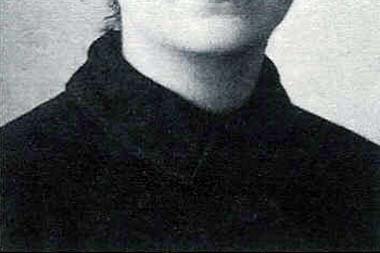
Photographer unknown, before 1903 — public domain.
As a teenager, Gemma had also developed a serious illness affecting her spine, which at one point left her partially paralyzed and unable to walk without support. She reported being miraculously healed of this condition in 1899 through the intercession of the recently canonized Passionist priest Gabriel Possenti — an episode that deepened her attachment to the Passionist order, whose spirituality centers on meditation on Christ's suffering and death.
Turned away from religious life
Given her devotion to the Passionists, Gemma sought to enter their convent in Lucca as a nun. She was refused, both because of her ongoing fragile health and, according to some accounts, because of the family's financial situation and the unusual, intense nature of the mystical experiences she had already begun reporting even before entering formal religious life. This rejection was a source of real sorrow for Gemma, who wanted nothing more than to formally join the community whose spirituality had shaped her so deeply; instead, she lived out her final years as a laywoman, taken in by a local Lucca family, the Gianninis, who cared for her and witnessed much of what followed.
The reported stigmata
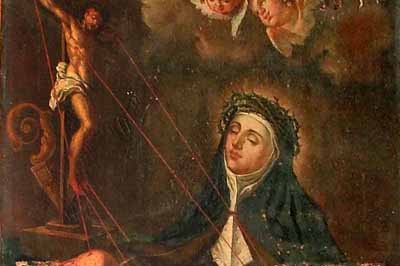
Beginning in 1899, Gemma reported a recurring physical phenomenon that would become the central and most closely documented feature of her short life: every Thursday afternoon or evening, wounds corresponding to the crucifixion — in her hands, feet, and side — appeared to open on her body, bled through the night and into Friday, and then closed and healed almost without trace by the following Sunday, a weekly cycle that repeated for roughly three years. Her spiritual director, the Passionist priest Father Germano Ruoppolo, along with a personal physician and, at points, an examining bishop, observed and documented the wounds directly during this period and reported finding no natural medical cause for them.
It's important to be direct about what can and can't be said here with confidence. Stigmata, by its nature, is not the kind of phenomenon modern science can test or independently verify after the fact, and the primary evidence for Gemma's case rests on the testimony of those who observed her directly during her lifetime, however carefully that testimony was recorded. This account should be read as a well-documented historical and devotional tradition — one taken seriously enough by the Church to feature prominently in her canonization process — rather than as an empirically proven claim.
A short life marked by illness
Alongside the reported stigmata, Gemma experienced other mystical phenomena during these years, including reported ecstasies, visions, and what she and those around her described as direct spiritual communication with Christ, the Virgin Mary, and her guardian angel, much of which she recorded in letters and a diary at her confessor's direction. Her underlying physical health, meanwhile, continued to decline. She contracted tuberculosis, the same disease that had killed her mother, and died on Holy Saturday, April 11, 1903, at the age of 25.
Her own words, preserved by her confessor
A significant part of what makes Gemma's case unusual among reported mystics is the volume of firsthand written material she left behind, almost all of it produced at the direct instruction of her confessor, Father Germano Ruoppolo, who asked her to keep a diary and to write detailed autobiographical letters describing her spiritual experiences as they occurred. This material, later published and studied as part of her cause for canonization, gives historians and theologians an unusually direct textual record to work from, rather than relying solely on secondhand testimony compiled after her death. Gemma herself expressed real discomfort with the task, describing herself in her own writing as reluctant and unworthy, a note of humility that her supporters have long pointed to as evidence against any suggestion of deliberate self-promotion or fraud — a person seeking public attention for mystical claims, the argument runs, would hardly have needed to be repeatedly ordered by her confessor to write anything down at all.
Contemporary medical skepticism
It is worth acknowledging directly that Gemma's reported experiences, including the stigmata, coincided with a period when European medicine — particularly in France and Italy — was intensely debating the boundaries between religious mysticism, hysteria, and other psychological or neurological conditions, a controversy that touched several reported stigmatics and visionaries of the late nineteenth and early twentieth centuries. Some contemporary physicians and later commentators have proposed psychosomatic or psychological explanations for phenomena like Gemma's, consistent with the broader medical skepticism of the era toward claims of supernatural bodily phenomena in general. The Church's own canonization process did not treat the stigmata as strictly required proof of her sanctity — heroic virtue, demonstrated through her patience, humility, and charity amid serious illness and poverty, carried at least equal weight in the formal case for her eventual canonization, with the mystical phenomena treated as a striking but secondary feature of a life whose holiness rested on more conventional spiritual grounds as well.
Canonization and patronage
Gemma Galgani was beatified in 1933 by Pope Pius XI and canonized on May 2, 1940, by Pope Pius XII. Because her father was a pharmacist and she is understood to have had a particular devotion tied to that household trade, she is popularly venerated as a patron of pharmacists, along with students and those who have lost their parents — a patronage that grew from the specific circumstances of her own life rather than from any formal, singular Vatican declaration.
Feast day
Her feast is celebrated on April 11, the anniversary of her death, though earlier calendars kept it on May 16.
Related reading
Gemma's short, intensely mystical life places her among a distinctive group of late-19th and early-20th-century Catholic women mystics — readers may also want to read about Saint Faustina Kowalska, a Polish nun whose reported visions of Christ's mercy a generation later became similarly central to her canonization, or Saint Rafqa of Lebanon, a near-contemporary whose own suffering was likewise understood as a direct participation in Christ's Passion.
Trivia
Who was Saint Gemma Galgani?
Did Gemma Galgani actually have the stigmata?
Why couldn't Gemma Galgani join a religious order?
What happened to Gemma Galgani's family?
When is Saint Gemma Galgani's feast day?
You May Also Like

Related Reading