Saint Rafqa of Lebanon

A childhood shaped by early loss
Rafqa was born Boutrossieh Choboq Ar-Rayes on June 29, 1832, in the mountain village of Himlaya, Lebanon, into a Maronite Catholic family. Her mother died when she was young, and her father later remarried, a transition that by most accounts left Boutrossieh feeling displaced within her own household. As a teenager she worked as a maid in Damascus and Beirut, sent by her family to earn money and, in part, to remove her from a difficult domestic situation at home — an unglamorous, working-class beginning entirely typical of 19th-century rural Lebanese girls, with nothing yet to suggest the extraordinary life ahead of her.
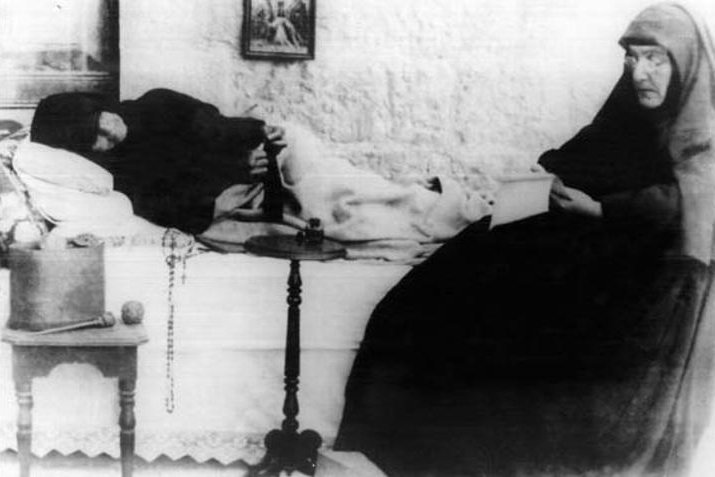
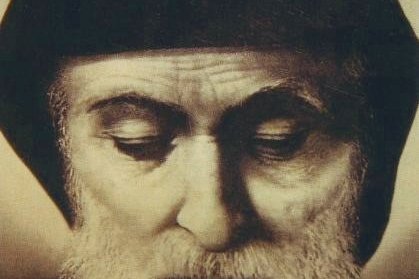
Photographer unknown, before 1914 — public domain.
Entering religious life
Boutrossieh felt drawn to religious life from a young age, and in 1855, at the age of 23, she entered the Congregation of the Maronite Sisters of the Visitation, taking the religious name Rafqa — the Arabic form of Rebecca. She spent years in this community teaching and serving in various convent roles across Lebanon, developing a reputation among her sisters for quiet, steady devotion rather than any particular dramatic spiritual experience.
In 1871, the Visitation Sisters' congregation was dissolved and merged into another community, and Rafqa chose to join the newly forming Lebanese Maronite Order of the Baladite Sisters (also called the Maronite Order of Mariamette) as one of its founding members — a significant vote of confidence in a brand-new religious foundation rather than an easier, established path. She eventually settled at the Monastery of Saint Joseph in Jrabta, in the mountains above Beirut, where she would spend the remainder of her life.
A prayer for suffering, and what followed
Sometime around 1885, according to the accounts gathered for her canonization process, Rafqa prayed specifically to be allowed to share physically in Christ's Passion — to take on some measure of bodily suffering as a spiritual offering. Not long afterward, she was struck by an intense, medically inexplicable pain centered in her head and eyes. A Lebanese physician who attempted to treat the condition reportedly made it worse rather than better, and her eyesight continued to deteriorate over the following years. By around 1899, Rafqa had gone completely blind.
The suffering didn't stop there. In the years that followed, she developed progressive paralysis affecting her limbs, along with chronic pain that the medical understanding of her time had no real answer for. She lived with this combination of blindness, paralysis, and pain for roughly three decades, largely confined to her cell at the Jrabta monastery, cared for by her fellow sisters, until her death in 1914.
How Rafqa understood her own suffering
What distinguishes Rafqa's story from a simple account of chronic illness is how consistently, according to the testimony gathered from those who knew her, she interpreted her condition as something she had asked for and continued to accept willingly, rather than as an affliction she merely endured. This reflects a long-standing thread in Catholic spirituality — sometimes called redemptive or "offered" suffering — that draws on New Testament language, such as Saint Paul's statement in his Letter to the Colossians (1:24, Douay-Rheims) that he rejoiced in his sufferings and was "filling up those things that are wanting of the sufferings of Christ" for the sake of the Church. It's worth being clear that this is a devotional and theological framework for finding meaning in unavoidable suffering, not a Catholic teaching that God inflicts illness as a direct transaction in response to prayer; Rafqa's own witness is presented by the Church as an example of extraordinary acceptance and peace in the face of suffering she did not choose to end, rather than as proof of any mechanical cause and effect.
Canonization and continuing devotion
Rafqa died on March 23, 1914, at the Jrabta monastery. She was beatified in 1985 by Pope John Paul II and canonized by the same pope on June 10, 2001. She remains one of the best-known and most visited Maronite Catholic saints, with her tomb at the Monastery of Saint Joseph in Jrabta continuing to draw pilgrims from Lebanon and beyond, many specifically seeking her intercession for eye conditions and other physical afflictions, given her own decades of blindness.
Feast day and legacy
Saint Rafqa's feast is celebrated on March 23 in the Maronite Church's liturgical calendar. She stands today as one of the relatively small number of canonized saints from the Eastern Catholic churches to gain wide recognition in the Western Church as well, and her life continues to be presented within Lebanese Maronite spirituality as a model of endurance during a period, the late 19th and early 20th centuries, that was itself marked by significant hardship for Lebanon's Christian communities.
Related reading
Readers drawn to Rafqa's witness of accepted suffering may also want to read about Saint Gemma Galgani, an Italian mystic and near-contemporary who likewise understood her physical suffering in explicitly redemptive terms, or Saint Elizabeth of the Trinity, another late-19th-century woman religious whose short life was marked by serious illness she interpreted through a similarly Christ-centered lens.
Trivia
Who was Saint Rafqa?
What order did Saint Rafqa belong to?
What happened to Saint Rafqa's eyesight?
How does the Church understand Rafqa's suffering theologically?
When is Saint Rafqa's feast day?
You May Also Like
Related Reading