Saint Jerome Emiliani, Priest

A soldier's war goes badly wrong
Jerome Emiliani was born in Venice around 1481 into a family of minor nobility, and like many young men of his class, he entered military service rather than the Church. By his early thirties he held a command in the Venetian army during the War of the League of Cambrai, a brutal conflict that pitted Venice against a shifting coalition of European powers for control of northern Italy. In 1511, Jerome was placed in charge of a small garrison at Castelnuovo, a fortress near Treviso — and it fell. He was captured by enemy forces and thrown into a dungeon, chained by the neck and feet, with little reason to expect he would ever leave alive.
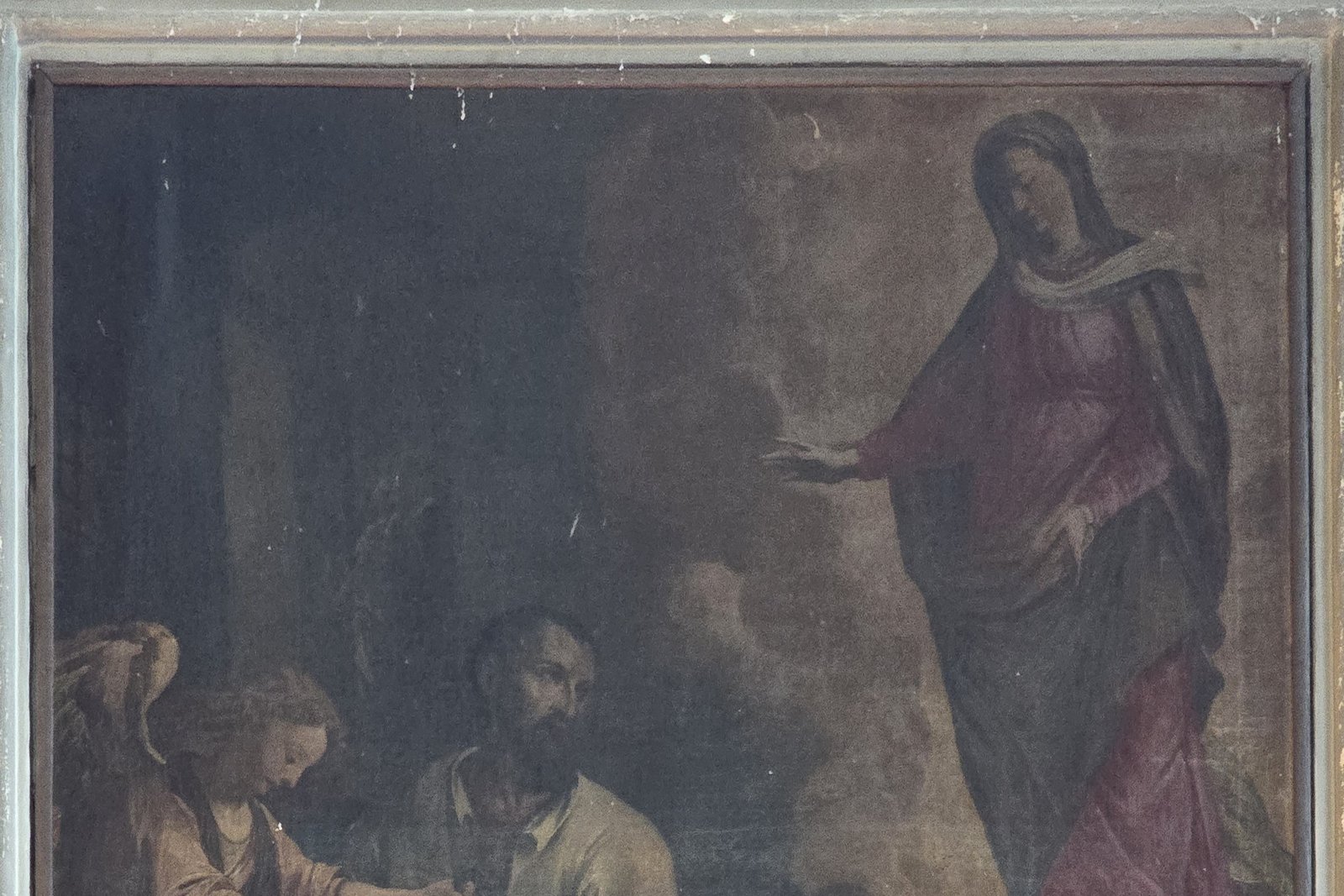
Anonymous painter, Miraculous Liberation of Saint Jerome Emiliani, Sanctuary of San Girolamo Emiliani, Somasca (Vercurago) — CC0
It was there, according to the tradition that has come down through his earliest biographers, that Jerome turned to prayer with an intensity he had never known in his comfortable, conventional life as a soldier. He appealed to the Blessed Virgin Mary, and — as the story is told — his chains loosened and fell away, the dungeon door opened, and he walked out of the fortress undetected, making his way on foot through enemy territory back to Venetian lines. Whatever the precise mechanics of his escape, Jerome himself treated it as nothing less than a direct intervention, and he never forgot it. He walked to the shrine of Our Lady of Treviso and hung his prison chains before the image of Mary as an offering of gratitude, a gesture still commemorated in devotional art associated with him today.
From city magistrate to street-level charity
The escape did not immediately turn Jerome into a saint. He returned to ordinary Venetian civic life for several years, serving for a time as a city treasurer and magistrate, and it was really a second crisis — a severe famine and plague that struck northern Italy in the early 1530s — that pushed him fully into the life he is remembered for. Venice and the surrounding Veneto region were overwhelmed with the sick, the starving, and, most painfully, children left with no one to care for them after their parents died. Jerome, by then ordained a priest, threw himself into that crisis directly rather than administering charity from a distance.
He began gathering abandoned and orphaned children off the streets, first sheltering them in his own home, and then organizing more formal houses of refuge. This was not simply a matter of finding them beds; Jerome insisted on teaching the children trades and religious instruction so they could eventually support themselves, an approach to orphan care that was notably practical for its era rather than merely custodial. He established orphanages in Venice itself, then in Brescia, Bergamo, and Como, moving between them as need demanded and funding much of the work by selling off what remained of his own family property.
Founding the Somaschi Fathers
Around 1532, Jerome settled at Somasca, a small village between Bergamo and Milan, and it was there that he gathered a community of priests and laymen committed to continuing this work permanently rather than as one man's individual mission. This community became known as the Clerks Regular of Somascha, or the Somaschi Fathers, formally recognized by the Church a few years after Jerome's death. Their charism combined care for orphans and abandoned children with broader charitable and educational work, and the order would go on to run orphanages, schools, and seminaries across Italy for centuries. The Somaschi Fathers still exist today, continuing work directly descended from the model Jerome pioneered in the 1530s: practical, hands-on, un-glamorous care for children society had otherwise written off.
Jerome also extended his concern to other vulnerable groups during this period, working to rehabilitate women who had been forced into prostitution by poverty and establishing hospitals for those suffering from what was then called the "French disease." None of this work carried much prestige. It required Jerome, a man of noble birth, to spend his days among the poorest and sickest people in a society that generally kept such people at arm's length — a pattern visible in the lives of several charitable founders of the era, though Jerome's own path from soldier to street-level caregiver remains distinctive.
A death that matched the life
In 1537, plague broke out again in Bergamo, and Jerome — by then an old man for his era, in his mid-fifties — went once more to nurse the sick and dying rather than staying at a safe distance. He contracted an infection while doing this work and died on February 8, 1537, in Somasca, among the community he had founded. It was, in a sense, exactly the kind of death his life had been building toward: not a quiet retirement, but one more act of direct, physical care for people no one else wanted to touch.
The Church recognized Jerome's holiness relatively slowly by the standards of his era — he was beatified in 1747 and canonized in 1767 by Pope Clement XIII, more than two centuries after his death. His broader significance was formalized in 1928, when Pope Pius XI declared him patron saint of orphans and abandoned children, a title that reflects the entire arc of his adult life rather than a single miracle or moment. Jerome's story sits alongside other founders remembered for direct, personal charity toward children, such as Saint Jean-Baptiste de la Salle, though Jerome's path there ran through a battlefield dungeon rather than a classroom.
Today, Jerome's chains — the very chains tradition says fell from him in that Venetian dungeon — are still venerated at the shrine of Our Lady of Treviso, a physical link between the soldier who nearly died in 1511 and the priest who spent the following decades making sure abandoned children didn't have to.
Trivia
Why is Saint Jerome Emiliani the patron saint of orphans?
What order did Jerome Emiliani found?
Was Jerome Emiliani a soldier before he became a priest?
How did Jerome Emiliani die?
When is Saint Jerome Emiliani's feast day?
You May Also Like
Related Reading